

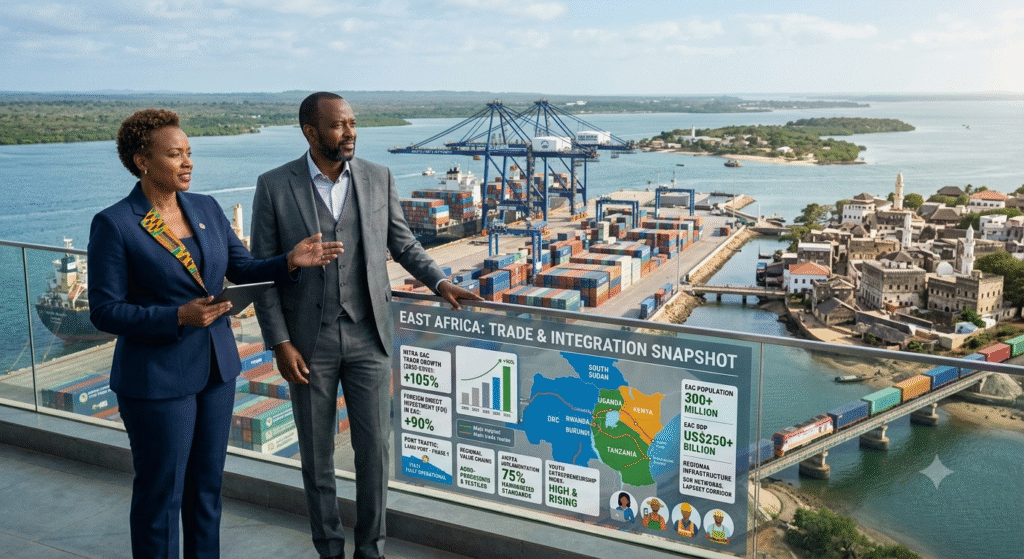
East Africa is cementing its position as Africa’s fastest-growing economic region, driven by ambitious infrastructure projects, aggressive trade facilitation measures, and a coordinated push toward deeper integration that is transforming the business landscape across its eight Partner States.
The Economic Engine of the Continent
Despite global uncertainties, East Africa is projected to grow by 5.9% in 2026, moderating from 6.6% in 2025 but remaining the continent’s top performer . The region’s resilience is underpinned by strong services activity, infrastructure investment, and deepening trade integration . Ethiopia, Tanzania, and Rwanda are among the standout performers, with the United Nations highlighting Ethiopia’s improved macroeconomic stability and resilient agricultural production as key drivers .
Uganda’s economy is expected to accelerate further in the coming years as commercial oil production begins, while the completion of the Grand Ethiopian Renaissance Dam is already boosting regional energy connectivity and attracting new investment .
Trade Booms, But Intra-Regional Gaps Remain
Total EAC trade rose by 25.4% from $124.9 billion in 2024 to $156.6 billion in 2025 . However, a striking gap persists: intra-EAC trade reached $19.3 billion in 2025 but accounted for only 12.3% of total trade .
This is the region’s most urgent business challenge. As Ahmed Farah, Executive Director of the East African Business Council, notes: “East Africa is growing, but it is not trading enough with itself” . Achieving the EAC’s target of 50% intra-regional trade by 2030 requires eliminating non-tariff barriers, harmonizing domestic fiscal policies, and fully implementing the Customs Union protocols .
Border Bottlenecks Under Scrutiny
EAC Secretary General Amb. Stephen P. Mbundi conducted a high-level assessment of the Sirari-Isebania (Tanzania-Kenya) and Busia-Busia (Kenya-Uganda) One Stop Border Posts, calling for decisive action to remove administrative bottlenecks that delay goods movement and undermine competitiveness .
Progress is evident: border clearance is faster, cargo movements are more predictable, and businesses benefit from lower transaction costs . Yet challenges persist: inadequate non-intrusive cargo scanners, increasing congestion, inconsistent 24-hour border operations, overlapping regulatory procedures, and domestic taxes that fragment the regional market .
Cross-border traders, particularly women and youth, also called for greater awareness of the Simplified Trade Regime and stronger support to transition small businesses into formal regional trade .
Fiscal Policy: The Integration Test
The FY2026/27 budget cycle is being viewed as a critical test for regional integration. Businesses are calling for disciplined implementation of the EAC Common External Tariff, which has been undermined by exceptions affecting 41% of tariff lines . Key demands include:
- Harmonized tax treatment: EAC-originating goods should be taxed as domestic products, not subjected to discriminatory excise duties or charges of equivalent effect .
- A common consultation calendar: National budgets should follow synchronized timelines, allowing businesses to provide timely input before Finance Bills are finalized .
- Removal of trade-distorting taxes: Import declaration fees, infrastructure levies, and other charges applied to EAC goods moving within the Customs Union must be eliminated .
Energy Connectivity Drives Industrial Opportunity
A landmark electricity supply agreement between Ethiopia and Kenya, signed on July 10, will boost regional energy connectivity and unlock new industrial opportunities . Ethiopia will supply power to Kenya at approximately $0.15 per kilowatt-hour, strengthening bilateral trade and supporting shared regional economic growth .
Ethiopia’s installed capacity has more than doubled over seven years from 4,462 to 9,752 megawatts, driven by the Grand Ethiopian Renaissance Dam. The country now exports electricity to Djibouti, Kenya, Tanzania, and Sudan, with new agreements underway with South Sudan and interest from Somalia .
Mega-Project: Lamu Port’s Second Chance
Kenya’s Port of Lamu, opened in May 2021 after an investment of $2.5 billion, has struggled to attract regular cargo volumes—handling just 74,000 metric tons in 2024. Yet a surge to nearly 800,000 metric tons in 2025, driven by Red Sea disruptions, demonstrated its potential as an alternative to Mombasa, Djibouti, and Port Sudan .
Nigeria’s Dangote Group is now considering Lamu as the site of a planned 700,000-barrel-per-day oil refinery—a project that could provide the port’s first major industrial anchor. The refinery would require large-scale crude imports and regular fuel exports, generating sustained traffic and accelerating development of the LAPSSET trade corridor . However, financing and crude supply remain unresolved, leaving the timeline uncertain.
Foreign Investment Inflows
Varun Beverages, PepsiCo’s second-largest bottling partner, is acquiring Devyani Food Industries Kenya for $32 million, deepening its presence in Kenya and the broader East African region . The acquisition includes a manufacturing facility in Nakuru producing dairy beverages, juices, and packaged water, with plans to expand into carbonated soft drinks .
Uganda is actively courting Tanzanian investors, using the Dar es Salaam International Trade Fair to showcase products and forge partnerships. Ugandan officials highlighted Tanzania’s open market and commitment to regional integration as key attractions .
The Digital Frontier
The EAC is accelerating the implementation of a Single Digital Market across the region, with the 2026 Digital for Development forum in Arusha focusing on transforming digital strategies into practical projects . Proposed initiatives include interoperable payment systems, regional e-government platforms, cross-border digital public services, and secure data-sharing infrastructure .
Annette Ssemuwemba, EAC Deputy Secretary-General, stated: “Digital transformation is no longer an option; it is a necessity for accelerating regional integration and expanding trade opportunities” . Significant obstacles remain, including fragmented digital systems, costly cross-border payments, isolated government platforms, and differing regulatory frameworks .
Political Federation Momentum
National consultations on the Constitution of the East African Political Confederation concluded in Rwanda, with President Paul Kagame reaffirming the country’s commitment to the integration agenda . The consultations, held in Kigali, Huye, Nyagatare, and Rubavu, represent progress toward the EAC’s ultimate goal of a Political Federation.
Business Outlook
For East African businesses, the message is clear: the region offers the fastest-growing market on the continent, with improving infrastructure, expanding energy connectivity, and ambitious integration targets. But the next phase of growth depends on eliminating the administrative and regulatory obstacles that continue to increase the cost and time of doing business . As Secretary General Mbundi noted: “Regional integration must deliver practical benefits to every trader, investor and citizen” . The FY2026/27 budgets will reveal whether governments are ready to turn that commitment into reality.
