

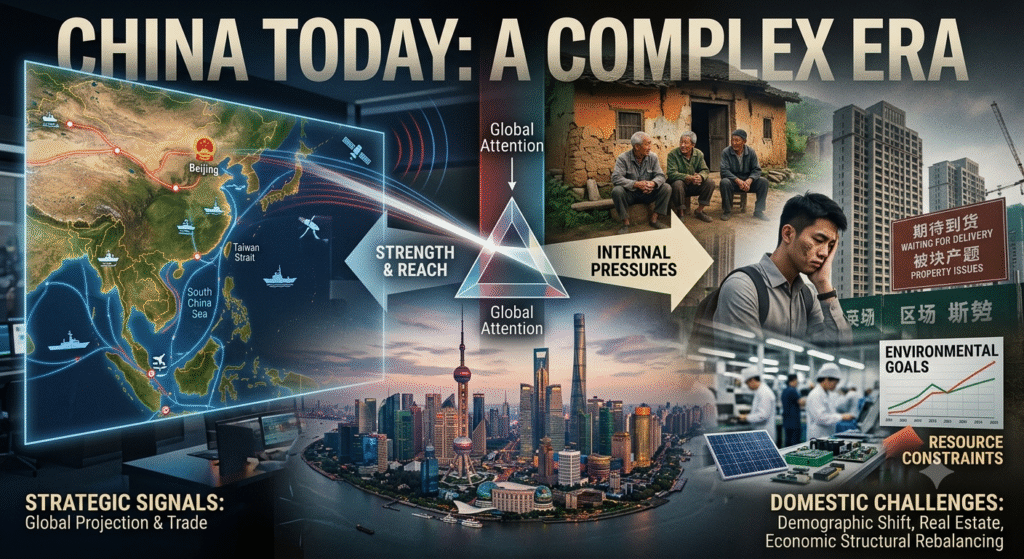
On July 13, 2026, China presents a complex portrait of a nation simultaneously projecting strategic power, grappling with domestic emergencies, and pursuing global technological leadership. Today’s news cycle illustrates a country navigating multiple fronts with a characteristic blend of assertive diplomacy and pragmatic governance.
Strategic Assertiveness: South China Sea and Military Signaling
China is flexing its military and diplomatic muscles on multiple fronts. On Monday, an official from the Chinese Ministry of Foreign Affairs summoned the chief minister of the Japanese Embassy in Beijing to lodge formal protests over Japan’s recent statements on the South China Sea. The protest came after Japan’s Foreign Minister Toshimitsu Motegi played up the so-called “South China Sea Arbitration Award” 10 years after its issuance, prompting China to accuse Japan of applying double standards and undermining regional peace.
In a significant strategic move, China publicly announced that it had launched a ballistic missile from a nuclear-powered submarine into the Pacific Ocean on July 6, with the test occurring just ahead of the NATO summit in Ankara. The People’s Liberation Army Navy stated the missile, carrying a simulated warhead, was launched from a Type 094 Jin-class ballistic missile submarine as part of annual training exercises conducted in accordance with international law.
This marks the first such publicly acknowledged test since 2024. A defense spokesperson, Chen Xi, emphasized that China notified relevant countries in advance, demonstrating “the openness and transparency of the Chinese armed forces”. The test carried significant geopolitical implications, drawing expressions of concern from Australia, Japan, and New Zealand, with the latter noting the missile landed in the South Pacific Nuclear-Free Zone.
The test highlighted a capability the Pentagon has long regarded as a top strategic concern: China’s ability to build a nuclear force at sea. Unlike land-based missiles, submarine-launched ballistic missiles are among the most survivable components of a nuclear arsenal, as these submarines are difficult to detect and destroy before they can retaliate. The Pentagon projects China will possess more than 1,000 nuclear warheads by 2030, up from an estimated stockpile of over 600 as of 2024.
APEC Leadership: China’s Digital and AI Ambitions
While China projects military strength, it is simultaneously positioning itself as a global leader in digital technology and artificial intelligence. On July 23, China will host the 2026 APEC Digital and AI Ministerial Meeting in Chengdu, Sichuan province, bringing together ministers from 21 Asia-Pacific economies.
The meeting, part of China’s 2026 host year for the Asia-Pacific Economic Cooperation forum, will be held under the theme “Digital and AI Technologies Empowering the Asia-Pacific Community”. Ministers are expected to discuss three key topics: leveraging digital and AI technologies for economic development, promoting universal digital connectivity, and advancing digital inclusion and skills across the region.
Over 30 companies have registered to participate in accompanying exhibitions and forums, including Meta Platforms, Google, Microsoft, Panasonic, Tencent, ZTE, Baidu, and Chinese robotics startup X Square Robot. This gathering comes as global governments race to develop AI strategies amid intensifying competition over computing power, semiconductors, and digital infrastructure.
MIIT Vice-minister Xiong Jijun stated: “The Asia-Pacific remains a major engine of global economic growth. APEC economies should seize the opportunities presented by digital technologies and artificial intelligence and deepen practical cooperation on digital empowerment”.
Domestic Crises: Flooding and Disaster Response
China is also confronting significant domestic challenges. In Guangxi Zhuang Autonomous Region, devastating floods triggered by rounds of torrential rain have left 39 people dead and nine reportedly missing. The central government has allocated an additional 80 million yuan (about $11.77 million) from the central natural disaster relief fund to support emergency response and recovery efforts, on top of 110 million yuan disbursed on July 6.
The national emergency disaster relief response for Guangxi was upgraded from Level IV to Level III as continuous heavy rainfall worsened flooding and related disasters. The funds will support the relocation and resettlement of affected residents, provide temporary living assistance, and repair or rebuild homes.
Vice Premier Liu Guozhong, who is also a member of the Political Bureau of the Communist Party of China Central Committee, conducted an inspection tour in Beijing on Sunday, emphasizing the importance of fully implementing flood response measures and ensuring the safe operation of reservoirs during the rainy season. He inspected two reservoirs in Beijing’s Pinggu District and stressed the need to improve monitoring and forecasting systems, implement dam safety responsibility systems, and ensure early warning information reaches grassroots communities without delay.
Economic Signals: Currency and Trade
On the economic front, the Chinese yuan strengthened by 17 pips to 6.7972 against the U.S. dollar on Monday, according to the China Foreign Exchange Trade System. This marks the yuan’s strongest level since 2023. Markets are closely watching the upcoming release of China’s second-quarter GDP, exports, and other key economic data.
China also imposed a temporary export ban on helium effective July 10, pursuant to its foreign trade law. The Ministry of Commerce and the General Administration of Customs issued the joint notice, stating that further adjustments will be announced separately. Helium is a critical gas used in semiconductor manufacturing, medical imaging, and aerospace applications, and the export ban could have significant implications for global supply chains.
Looking Ahead
China today is demonstrating the multiple dimensions of its global posture. On the security front, the submarine missile test and diplomatic protests signal Beijing’s determination to protect its perceived interests and strategic capabilities. In technology, the APEC Digital and AI Ministerial Meeting reflects China’s ambition to lead in the defining technologies of the coming decade. Domestically, the government is responding to devastating floods with substantial financial allocations and high-level oversight.
The common thread is a focus on strategic positioning—whether through military modernization, diplomatic assertion, or technological leadership—balanced against the need for domestic stability and disaster response. As China navigates these challenges, its actions will continue to shape the regional and global order.