

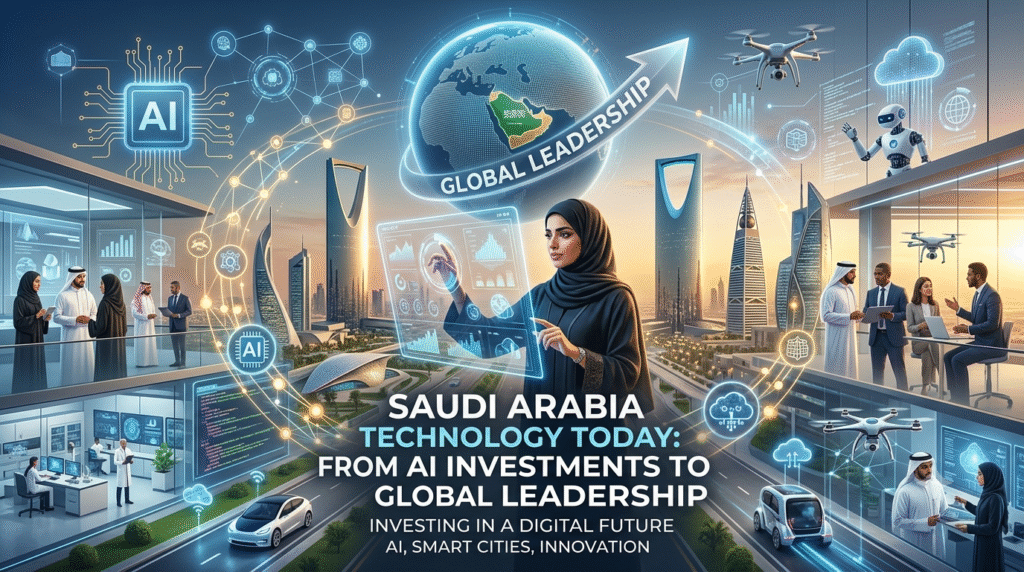
Saudi Arabia is rapidly solidifying its position as a global technological powerhouse, making headlines this week with major AI deals, international partnerships, and world-leading digital rankings. From a $5 billion AI Zone with Amazon Web Services to a new partnership with Canadian AI firm Cohere, and from leading the world in the ICT Development Index to hosting a major tech conference in Hong Kong, the Kingdom is demonstrating that its digital transformation under Vision 2030 is not just an ambition but a tangible reality delivering measurable results.
The AI Infrastructure Build-Out: Computing at Scale
The backbone of Saudi Arabia’s technological ambitions is its aggressive investment in physical AI infrastructure. The Kingdom currently operates 467 MW of data center capacity—nearly half (47%) of the Middle East and North Africa’s total operational capacity. But this is just the beginning. Saudi Arabia plans to develop 6.9 GW of data center capacity by 2034, including 3 GW by 2030, supported by 12.8 GW of available electricity generation capacity. This positions the Kingdom among the fastest countries globally in providing power for computing and AI infrastructure projects.
The strategic bet on computing infrastructure is being executed through multiple high-profile partnerships. On June 22, 2026, Saudi Arabia’s newly established AI company, HUMAIN, entered into a strategic partnership with Amazon Web Services (AWS) to launch the Kingdom’s first-ever AI Zone, backed by an investment of over $5 billion. The AI Zone will leverage AWS’s world-class AI and cloud infrastructure, including UltraCluster networks, Amazon SageMaker, and Amazon Bedrock, to create a unified AI environment designed for government and enterprise use across the Gulf region and beyond. The initiative builds on AWS’s existing $5.3 billion investment in a dedicated AWS cloud region in Saudi Arabia, scheduled to go live in 2026.
HUMAIN is also partnering with Canadian AI firm Cohere to develop one of the Middle East’s largest dedicated AI infrastructure deployments, expected to become operational by the fourth quarter of 2027. Under the agreement, HUMAIN will dedicate at least 50 megawatts of AI computing capacity to support Cohere’s next-generation foundation models, with additional capacity expected over the next five years. “The future of artificial intelligence will be defined by access to compute. Frontier AI models require infrastructure at an unprecedented scale,” said Tareq Amin, CEO of HUMAIN.
To finance this expansion, HUMAIN signed a Strategic Financing Framework Agreement of up to $1.2 billion with the National Infrastructure Fund in January 2026 to support the development of up to 250 MW of hyperscale AI data center capacity.
Global Recognition: World’s Top Digital Economy
Saudi Arabia’s technological progress has received international validation. The Kingdom ranked first globally in the 2026 ICT Development Index (IDI) issued by the International Telecommunication Union (ITU), scoring 99.8 out of 100. This marks the second consecutive year Saudi Arabia has topped the global rankings, which evaluate the digital development of 159 economies through indicators measuring universal connectivity and meaningful connectivity.
The Kingdom’s ICT market reached SR199 billion ($53.1 billion) by the end of 2025, with a compound annual growth rate of 8% over the past five years, making it the largest and fastest-growing ICT market in the Middle East and North Africa. Internet usage and mobile phone penetration both reached 100% in the Kingdom, while median fixed broadband speeds climbed to 151 Mbps and median mobile internet speeds reached 216 Mbps.
According to a KPMG Saudi Arabia Tech Report 2026, 76% of Saudi organizations expect to be deploying artificial intelligence at scale and delivering return on investment across multiple use cases within the next 12 months—the highest level recorded anywhere in the KPMG survey. Currently, 46% already report AI in enterprise production, compared with just 21% globally. Saudi organizations report an average of approximately $200 million in value realized from digital technologies, with no respondent reporting zero or negative returns.
Bridging East and West: Saudi Arabia’s Global Tech Positioning
Minister of Communications and Information Technology Abdullah Alswaha has articulated the Kingdom’s ambition to become a global AI hub connecting East and West. Speaking at the opening of LEAP East 2026 in Hong Kong, Alswaha emphasized that Saudi Arabia is building one of the world’s most accessible and AI-ready digital infrastructures, positioning the Kingdom as a trusted partner in enabling the digital economy.
Alswaha highlighted the significance of the Asian technology ecosystem, noting that the East represents a $34 trillion economy—nearly 30% of global GDP—and accounts for 82% of global AI patents, 60% of the semiconductor market, and 90% of the world’s advanced chip manufacturing. Saudi Arabia is leveraging large-scale investments in digital infrastructure to strengthen its role as a bridge between Asian technology ecosystems and global markets. Leading technology companies from Asia, including ByteDance, Lenovo, and Tencent, have already begun investing and expanding in the Kingdom.
Responsible AI Governance
Saudi Arabia is also positioning itself as a global leader in AI governance. President of the Saudi Data and AI Authority (SDAIA), Dr. Abdullah bin Sharaf Alghamdi, affirmed the Kingdom’s commitment to advancing international efforts to strengthen AI governance and promote the responsible and safe use of its technologies. Key initiatives include the establishment of the International Center for AI Research and Ethics (ICAIRE) in Riyadh under the auspices of UNESCO. Saudi Arabia will host the fourth Global Forum on the Ethics of Artificial Intelligence in Riyadh from September 14-17, 2026, as part of the Kingdom’s Year of Artificial Intelligence.
Conclusion
Saudi Arabia today is executing one of the world’s most ambitious technology transformations. With its top global ICT ranking, $5 billion AI Zone with AWS, major partnerships with Cohere and the National Infrastructure Fund, and leadership in AI governance, the Kingdom is demonstrating that it has the three critical ingredients for the AI era: compute, customers, and capital. As one KPMG report concluded, Saudi organizations are not only investing more than their global counterparts but are also turning that investment into measurable financial returns faster and at greater scale. The vision is becoming reality—Saudi Arabia is emerging as a global AI powerhouse.
