

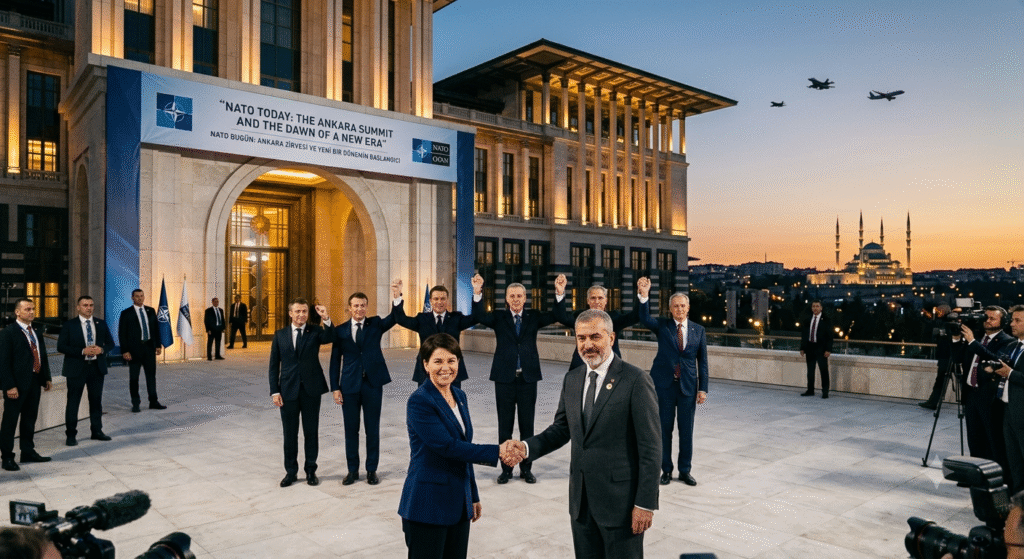
NATO leaders gathered in Ankara, Turkey, for a pivotal two-day summit on July 7-8, 2026. The meeting, set against a backdrop of the ongoing war in Ukraine, rising tensions with Russia and China, and unprecedented demands from U.S. President Donald Trump, has been described as marking the beginning of a fundamental transformation for the 32-member alliance . The summit concluded with pledges of unity, massive new defense investments, and a strategic upgrade for Ukraine, but it also laid bare deepening internal rifts that threaten the transatlantic bond.
The Spending Push and the “NATO 3.0” Concept
The central theme of the Ankara Summit was defense spending and the shift toward what leaders called “NATO 3.0”: a stronger Europe within a stronger NATO . Under immense pressure from the U.S., European allies and Canada have dramatically increased their investment. In 2025 alone, they increased spending on core defense requirements by more than $139 billion .
The alliance’s aggregate defense expenditure is projected to exceed $1.8 trillion in 2026, an 11% increase from the previous year . The United States remains the largest spender, accounting for approximately 57% of the total with $1.03 trillion, followed by Germany ($147 billion) and the United Kingdom ($110 billion) .
Five NATO members—Lithuania, Estonia, Latvia, Poland, and Greece—are projected to meet the alliance’s new target of spending 3.5% of GDP on core defense already in 2026 . However, the path to the more ambitious goal of 5% of GDP on total defense and security spending by 2035 remains a source of friction . President Trump, who has pressed allies to reach 5%, criticized European nations for relying too heavily on the U.S. and even threatened to cut off trade with Spain for resisting higher spending targets .
New Strategic Projects: Drones, Air Defense, and Raw Materials
Beyond simple spending, the alliance is launching a series of concrete initiatives to overhaul its defense industrial base and military capabilities. The summit announced more than $50 billion in new arms procurements, with investments in air defense, long-range strike, unmanned systems, and surveillance .
Key projects include a multinational program involving 12 member states to secure the supply chain for essential defense raw materials, aiming to reduce dependence on China, which dominates the rare earth mineral market . The “NATO Drone Edge” initiative will invest $40 billion over five years to expand the alliance’s Unmanned Aerial Vehicle (UAV) capabilities, a key lesson from the Ukraine war . Eight members have also committed $26.3 billion to integrated air and missile defense systems .
To complement these initiatives, NATO is also strengthening its operational posture. In the weeks leading up to the summit, the alliance conducted two major Flexible Deterrent Option (FDO) missions in the Baltic and Black Sea regions, integrating fighter aircraft, surface-based air defense systems, and advanced command-and-control assets to enhance multi-domain interoperability and collective readiness against evolving security challenges .
Ukraine: “Security Contributor” but Still Not a Member
At the summit, President Volodymyr Zelensky once again urged NATO to admit Ukraine, arguing that its battle-hardened forces would offer a “unique source of defensive strength” . While NATO leaders did not offer membership, they did agree to a significant upgrade: Ukraine will be formally recognized as a “security contributor”—a state capable of enhancing security on NATO territory . This is one of the key criteria for membership and signals a shift in the bloc’s stance.
In terms of immediate support, the allies pledged €70 billion in military equipment, assistance, and training for Ukraine in 2026 and committed to maintaining equivalent levels in 2027 . Zelensky’s main request remains air defense, as Ukraine struggles to counter Russian ballistic missiles. He urged allies to pressure the U.S. to allow Ukraine to produce Patriot interceptor missiles under license .
Internal Divisions and the Evolving Threat
Despite the show of unity in the final declaration, the Ankara Summit revealed significant strains within the alliance. President Trump’s blunt criticism of allies and his administration’s ongoing review of troop levels in Europe have created deep anxiety about the U.S. commitment to Article 5 . European leaders now accept that they must assume greater responsibility for their own conventional defense, but there are serious questions about how quickly they can fill the gaps left by a possible U.S. withdrawal .
The summit also highlighted NATO’s broader security concerns. Secretary General Mark Rutte warned that Russia, while dedicating half its budget to the Ukraine war, is increasing coordination with China, North Korea, and Iran . To counter this, the alliance is adopting a “360-degree approach” to deterrence, looking not just to the east but also to the south .
The 2026 Ankara Summit likely marks a pivotal moment for the transatlantic alliance. It is a watershed where Europe is being forced to step up as the U.S. shifts its focus elsewhere. The question is no longer whether NATO will change, but whether Europe can do so fast enough to maintain deterrence in the face of a resurgent Russia and an increasingly assertive China.