

July 10, 2026
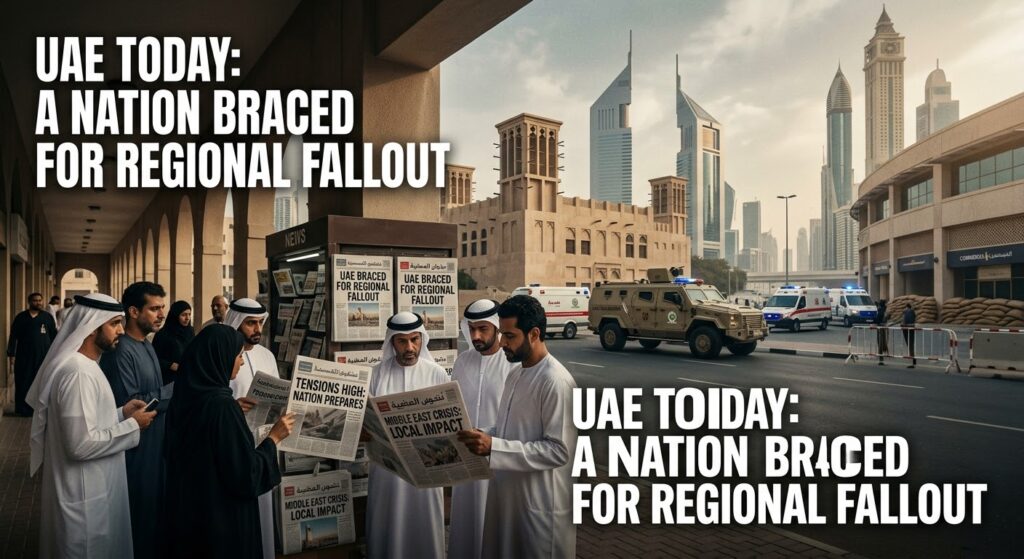
As the United States and Iran trade accusations over a crumbling ceasefire, the UAE finds itself navigating the most precarious geopolitical environment in years. Fresh U.S. strikes have been reported near Iran’s South Pars gas field , Iranian missiles have targeted a Saudi tanker , and the UAE’s own economy is showing signs of stress—with non-oil business activity growing at its slowest pace in five years . Yet amid the turmoil, the nation is also pressing forward with its long-term strategic transformation, positioning itself as a global trade and technology hub.
Part 1: The Immediate Geopolitical Shock
The fragile ceasefire between the United States and Iran appeared to be collapsing Thursday after both sides accused each other of violating the truce . Iranian state media reported that U.S. forces carried out fresh strikes overnight, targeting sites in southern Iran, including areas near the port city of Asaluyeh on the Arabian Gulf—home to critical energy infrastructure linked to the South Pars gas field, one of the world’s largest natural gas reserves .
While the U.S. military had not publicly confirmed the strikes, reports of renewed fighting have reignited concerns that weeks of diplomacy could give way to a broader regional conflict . The crisis has also spilled over into Jordan, where the Armed Forces said its air defenses intercepted “several missiles and drones” that entered the kingdom’s airspace .
Part 2: Condemnation and Solidarity
The UAE has responded forcefully to the escalating threats. On July 7, the Ministry of Foreign Affairs strongly condemned the Iranian attack targeting the Saudi tanker Wadiyan while it was transiting the Strait of Hormuz .
In a statement, the ministry said the attack posed a “grave threat to the safety and security of international navigation” and represented a “dangerous escalation” aimed at undermining the security of one of the world’s most vital maritime waterways . The UAE expressed full solidarity with Saudi Arabia, reaffirming support for all measures to safeguard the security of the Kingdom’s vessels and ensuring freedom of navigation in regional and international waters .
The ministry further stressed that the attack constituted a “flagrant violation” of United Nations Security Council Resolution 2817, which underscored the importance of protecting freedom of navigation and rejecting attacks on commercial vessels .
On July 9, Sheikh Abdullah bin Zayed Al Nahyan, Deputy Prime Minister and Minister of Foreign Affairs, held a phone call with Qatar’s Prime Minister and Foreign Minister to discuss regional developments . The two leaders strongly condemned the targeting of the Qatari tanker Al Rekayyat while it was transiting near the Strait of Hormuz, describing these attacks as a threat to “the safety and security of international navigation” .
Part 3: The Economic Impact
The conflict has taken a toll on the UAE’s economy. Business activity in the UAE’s non-oil private sector grew at the slowest pace in five years in June, while employment contracted for the first time in more than four years . The S&P Global UAE Purchasing Managers’ Index fell to 50.8 in June, from 52.6 in May—a reading above 50 indicates growth in economic activity .
David Owen, principal economist at S&P Global Market Intelligence, noted: “The robust nature of the drop in employment underscores the hit to firms from the double whammy of soft client demand and rising cost burdens” .
Dubai, the region’s key commercial and tourism center, also saw a slowdown in demand growth, with the Dubai PMI falling to 50.7 in June, the weakest improvement in the health of the emirate’s non-oil private sector since January 2021 .
Yet despite four months of disruption, Gulf economies have maintained growth momentum, albeit at a slower rate . S&P Global reported that “future expectations were broadly unchanged since May and ‘solidly optimistic'” . The greater movement of shipping along the Strait of Hormuz in June led to shorter delivery times, a sign of cautious improvement .
Part 4: A Long-Term Transformation
Despite the immediate challenges, the UAE is continuing its strategic transformation. DMCC’s Future of Trade 2026 report, released in June, found that the UAE is set to play an “outsized role” in the next phase of global trade as businesses seek trusted “connector economies” .
The report notes that South-South trade now accounts for around 35% of global trade, surpassing North-North flows at around 25% . The UAE is identified as a “key connector economy” combining strategic geography, advanced infrastructure, capital, commodities expertise, and diversified trade relationships . The UAE ranked among the top five recipients of greenfield investment globally in 2024 .
The UAE also retains second place in DMCC’s 2026 Commodity Trade Index, behind only the United States . The report notes that the UAE offers the “most competitive corporate tax regime of all ten leading commodities hubs assessed” .
Part 5: AI and the Next Generation of Trade
The report identifies AI-related goods as one of the clearest sources of global trade growth, representing around 15% of global trade by volume but accounting for 43% of global trade growth in the first half of 2025 . Trade across 100 AI-related product lines reached USD 1.92 trillion in the same period, up more than 20% year-on-year .
The UAE is also a frontrunner in building the next generation of financial infrastructure for trade, and is among a small group of jurisdictions introducing clear stablecoin regulatory frameworks . The country is also a core participant in mBridge, the most significant wholesale central bank digital currency initiative underway .
Part 6: Business Setup and Entrepreneurship
Despite the volatile environment, the UAE remains one of the most attractive destinations for business setup in the world. The country has ranked #1 globally in the Global Entrepreneurship Monitor report for five consecutive years .
Trends shaping UAE business setup in 2026 include AI startups, sustainability-focused ventures, flexible free zone models, cross-border business models, and the growing importance of expert guidance in navigating corporate tax and compliance requirements .
Part 7: The Fintech and Remittance Hub
On July 9, Remitly became one of the first international remittance companies to secure a Stored Value Facilities license from the Central Bank of the UAE . The UAE moves an estimated $50 billion across borders every year . The license reflects the UAE’s accelerating position as a global fintech leader and supports the ‘We the UAE 2031’ vision, which places fintech and digital financial services at the heart of the country’s ambition to double the contribution of its digital economy to GDP .
Part 8: Navigating the Regional Reconfiguration
Diplomatic adviser to the UAE President, Dr. Anwar Gargash, noted that while the UAE and Iran have made significant strides in de-escalating tensions, building a relationship based on “deep-seated trust” will require a considerable amount of time . The UAE is pursuing a “zero problems” foreign policy, focusing on economic de-escalation and shared prosperity, with the restoration of full diplomatic representation being central to this strategy .
Part 9: The Strategic Imperative
The week’s events underscore a fundamental reality: the UAE is no longer operating in a world where the U.S. security umbrella can be taken for granted . The war with Iran has shattered the old order, forcing Gulf states to engineer their own security solutions .
One key development is the deepening UAE-Israel defense partnership. During the war, Israeli air-defense systems were deployed in UAE territory to intercept Iranian missiles targeting Abu Dhabi . More significantly, a multi-billion-dollar joint defense fund is developing advanced air defense and counter-drone systems .
At the same time, the UAE’s competition with Saudi Arabia continues across several fronts—from Sudan and Yemen to oil production and regional influence . In June, after nearly 60 years of membership, the UAE withdrew from OPEC . The UAE has been the most critical of Iran in the Gulf during the current crisis .
Conclusion
UAE today is a nation operating in two realities. One is the immediate, volatile reality of a crumbling ceasefire, Iranian attacks on commercial shipping, and an economy adjusting to four months of disruption. The other is the long-term reality of strategic transformation, positioning itself as a global connector economy, a fintech pioneer, and a key player in the reconfiguration of the Middle East’s security architecture .
For businesses and investors, the UAE offers one of the most supportive environments for entrepreneurship and trade in the world . For the region, its role is becoming more central—and more contested. For the coming months, the UAE’s ability to navigate between these pressures will determine not just its own trajectory, but the stability of the entire Gulf.