

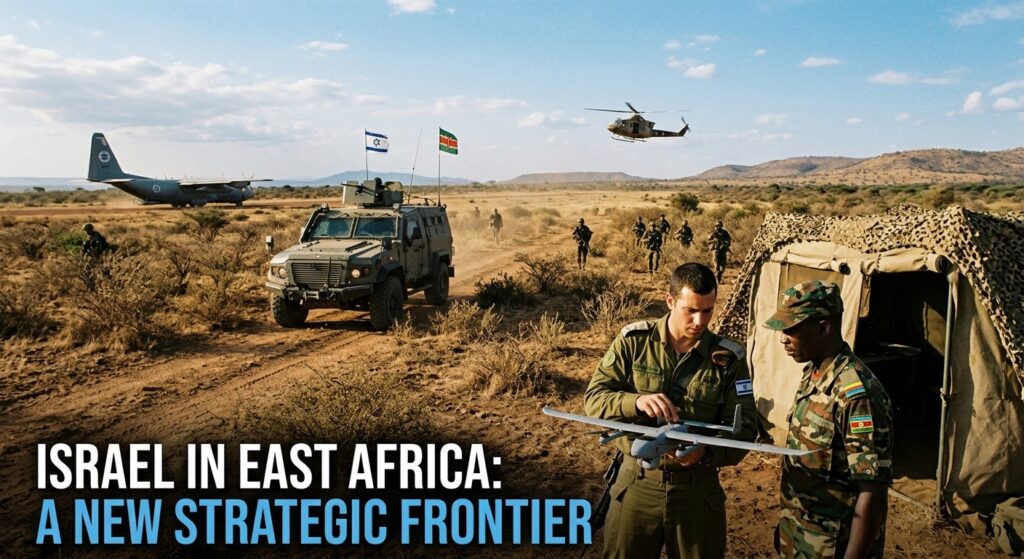
Israel’s military footprint in East Africa has undergone a dramatic transformation in recent months. What was once a network of quiet, behind-the-scenes defense cooperation has burst into the open with Israel’s historic recognition of Somaliland in December 2025, bringing with it the prospect of Israeli military access to the Horn of Africa—and triggering a wave of regional counter-moves from Egypt and others.
The Somaliland Breakthrough: Recognition and Military Cooperation
Israel’s decision to formally recognize Somaliland as an independent state on December 26, 2025, was never purely diplomatic. The move opened the door to a deepening military relationship with the breakaway territory, which declared independence from Somalia in 1991 but remains largely unrecognized internationally .
In January 2026, Israeli Foreign Minister Gideon Sa’ar visited Hargeisa, meeting with Somaliland’s president and military chief of staff. Sa’ar made the strategic intent clear: “We will also cooperate on defence and develop a strategic partnership” . By June 2026, during Somaliland President Abdirahman Mohamed Abdullahi’s landmark state visit to Israel, Israeli officials publicly acknowledged what had been conducted “under the radar” for years .
Military Training on the Ground
The military relationship is already operational. Somaliland’s Defence Minister Mohamed Yusuf Ali confirmed during the June visit that “Israel is helping Somaliland… they are supporting to train some of our police and military” . Reports indicate that around 50 Israeli servicemen have been deployed to Somaliland, with the personnel reportedly selected for their African heritage—including Ethiopian-Israeli soldiers—to facilitate local integration .
Somali intelligence sources claim the deployment includes soldiers of Ethiopian Jewish descent chosen specifically to “blend in more easily with the local community” . While Israel has denied reports of a permanent military base, the scale of cooperation suggests a sustained presence .
The Berbera Connection: Israel’s Strategic Prize
The real prize for Israel is Berbera International Airport, located on the Gulf of Aden just 550 kilometers from Yemen’s capital Sanaa. For the Israeli Air Force, this represents a 70% reduction in distance from existing bases in Israel, significantly cutting response times for potential strikes against Houthi targets in Yemen .
Berbera’s infrastructure has already been substantially upgraded. The 4,000-meter runway was paved in 2018, and facilities have been expanded with aircraft shelters, storage areas, and raised platforms likely intended for air-defense systems . While the UAE was involved in earlier developments, it remains unclear who is behind the latest expansion .
Israeli media have cited Somaliland officials saying a military base “is on the table and being discussed” . Israeli Defense Minister Israel Katz acknowledged that security cooperation had been ongoing “for many years” and that both sides are now determined to “bring our security cooperation to new heights” .
Broader Regional Engagement
Beyond Somaliland, Israel’s military engagement in East Africa extends to long-standing partnerships:
Ethiopia: Israel has described Ethiopia as a “long-term strategic partner,” with Foreign Minister Sa’ar emphasizing a shared interest in deepening ties amid regional challenges . President Isaac Herzog made a state visit to Ethiopia in February 2026, reinforcing historical ties and defense cooperation .
Kenya: In February 2026, Kenya and Israel reaffirmed their bilateral defense cooperation, with discussions covering counter-terrorism, intelligence sharing, and cybersecurity. The two countries agreed to establish a Strategic Defence Dialogue mechanism to institutionalize their partnership .
Sudan: Israel had pursued normalization with Sudan through the Abraham Accords, seeking access to its Red Sea coast. However, Sudan’s civil war, which erupted in April 2023, has disrupted these ambitions .
The Regional Backlash: Egypt’s Response
Israel’s expanding military presence has triggered alarm in Cairo. Egypt has broadened its military mission in Somalia, with an estimated 10,000 personnel providing weapons, counterterrorism support, and training to Somalia’s federal government .
Egyptian officials view Israel’s recognition of Somaliland as an attempt to establish a strategic foothold near the Bab al-Mandab Strait and the Red Sea—waterways critical to Egypt’s national security. Cairo also fears Israel could leverage its regional ties to deepen cooperation with Ethiopia, with whom Egypt is locked in a dispute over Nile water rights .
Israeli security assessments suggest Egypt’s growing presence in Somalia is a direct response to Israel’s expanding influence in the Horn of Africa . Egypt has also reached agreements to upgrade ports in Djibouti and Eritrea, potentially creating berths for Egyptian warships .
The Iran Competition
Africa has emerged as a new front in the Israel-Iran rivalry. Iran accelerated its outreach to the continent following the Abraham Accords, with then-President Ebrahim Raisi visiting Kenya, Uganda, and Zimbabwe in July 2023—the first official contact by an Iranian president with Africa in 11 years .
Israel views the Horn of Africa as strategic for countering Iran-backed Houthi threats in Yemen and securing maritime routes. Its military cooperation with countries in the region serves both intelligence-gathering and counter-proliferation objectives .
Iran, meanwhile, could establish influence through proxy actors, including Shiite groups in Nigeria and elsewhere, potentially creating new pressures on regional security .
Security Risks and Vulnerabilities
An Israeli military presence in Somaliland carries significant risks. Yemen’s Houthi movement has threatened to target any Israeli presence in Somaliland . Somalia-based Al-Shabaab has also indicated it would fight against Israel’s use of Somaliland territory .
For Somaliland, hosting an Israeli military presence could exacerbate its international isolation by antagonizing the African Union, China, and other countries. Houthi attacks may not be limited to Berbera airport—the port of Berbera, Somaliland’s economic lifeline, could also be targeted .
Looking Ahead
Israel’s military engagement in East Africa represents a calculated bet on strategic positioning in the Horn of Africa. The operational benefits are clear: reduced response times, enhanced intelligence coverage, and a strengthened posture against Iran-backed threats in Yemen.
Yet the risks are equally real. Regional powers are mobilizing against Israel’s expanding footprint, and the security vulnerabilities of fixed basing in a volatile region could prove costly. For now, Israel is proceeding with a strategy of incremental military cooperation, public diplomacy, and careful denial of basing ambitions—while keeping all options open for the future.