

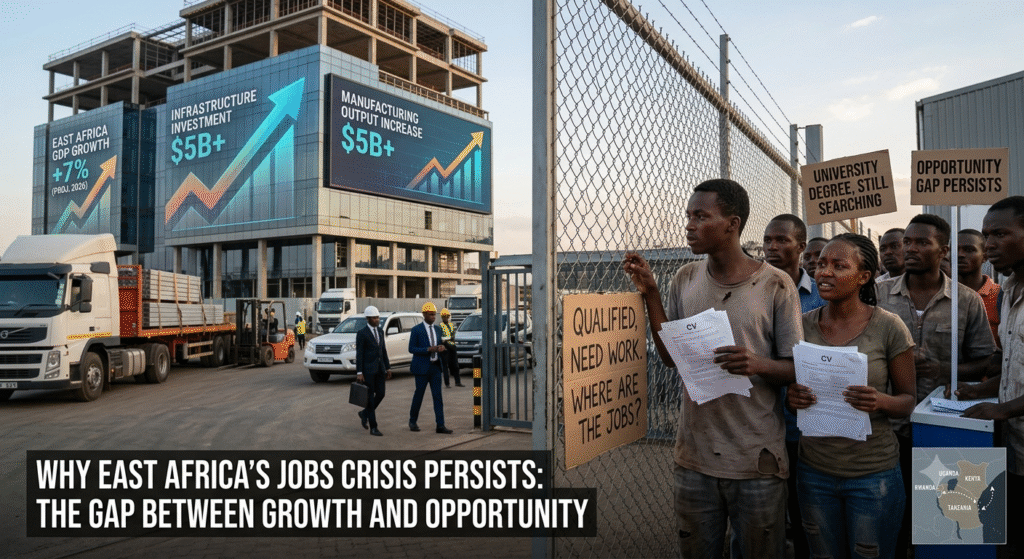
East Africa faces a profound paradox. The region remains one of Africa’s fastest-growing, yet its young people are increasingly locked out of quality employment. New research paints a stark picture of an economy that is expanding without creating the stable, well-paying jobs needed to lift millions out of poverty .
Part 1: The Conversion Rate Problem
Economic growth in East Africa is failing to translate into meaningful employment. One percent of economic growth yields just 0.4 percent growth in youth employment—significantly below the global average of 0.7 percent . The region creates fewer jobs for each unit of growth compared to the rest of the world.
Part 2: Jobless Growth Explained
“Most of the jobs that are created are actually low-productivity informal sector jobs,” says Haroon Bhorat, economics professor at the University of Cape Town . East Africa’s expansion is concentrated in sectors that generate few stable, well-paid positions—a pattern economists call “jobless growth.”
Part 3: The Jua Kali Economy Dominates
Across East Africa, 92 percent of employed youth work in the informal sector, compared with a global average of 60 percent . Formal employment accounts for just 8 percent of youth jobs. This “jua kali” economy is marked by low wages, limited social protection, and poor working conditions.
Part 4: New Jobs Fail to Deliver
By the end of 2026, 2.3 million young people are projected to find jobs across the region—but only 282,693 (about 12 percent) will be formal positions . Nearly ten times as many young people will enter the labour market seeking opportunities that simply do not exist.
Part 5: Working Poverty
Having a job does not guarantee escaping poverty. In Tanzania, at least one-third of working youth are extremely poor, and more than 70 percent are moderately poor . In Kenya, 53 percent of youth are employed, yet 35 percent live in extreme poverty .
Part 6: The Education Mismatch
Only 9 percent of Africa’s youth have completed tertiary education, leaving many ill-equipped for a changing labour market . Large numbers of school-age youth are already working in low-paid informal jobs, which depresses educational attainment and reinforces a cycle of precarious employment.
Part 7: The Gender Divide
Women bear a disproportionate burden. Although young women account for 44 percent of employed youth, they represent 48 percent of working youth living in extreme poverty . They make up just 38 percent of young people in formal employment, highlighting persistent structural barriers .
Part 8: Gig Economy Controversy
Young people are pushing back against policymakers who promote gig work as a solution. “What is this kind of structured job where you have a job today and then in two weeks you’re jobless?” asked one youth leader at a Nairobi forum .
Part 9: Ethiopia’s Workers Under Strain
Ethiopian workers face compounding pressures—earthquakes displacing thousands of sugar factory workers, health professionals striking for better pay, and teachers protesting months of unpaid salaries . Legislative tax reforms have failed to match union expectations.
Part 10: Jobless Youth Crisis
Nearly 2.83 million Kenyan youth are jobless and not in school—the highest in the region . About 1.7 million young women are idle compared to 1.1 million men. Seventy percent of Kenyan youth want to leave the country for better opportunities .
Part 11: The Migration Factor
With 13.7 million migrant workers in Africa and 3.6 million in the region, labour mobility is a key driver of movement . IOM reports that most labour movements are intra-regional, yet migrants often face exploitation and lack social protection .
Part 12: What Works
Evidence shows that combining soft skills training with practical job-search support can significantly improve employment outcomes, especially for women . TVET graduates who received soft-skills training saw employment rise from 4% to 37% for women and 9% to 43% for men .
Conclusion
East Africa’s jobs crisis is not simply about unemployment—it is about the quality of work available. The region has plenty of people working, but not enough people working in jobs that provide stability, dignity, and a path out of poverty. Addressing this will require faster, more inclusive growth, investments in education, and policies that recognise the informal economy as a permanent feature—not a problem to be eliminated, but a reality to be improved.