

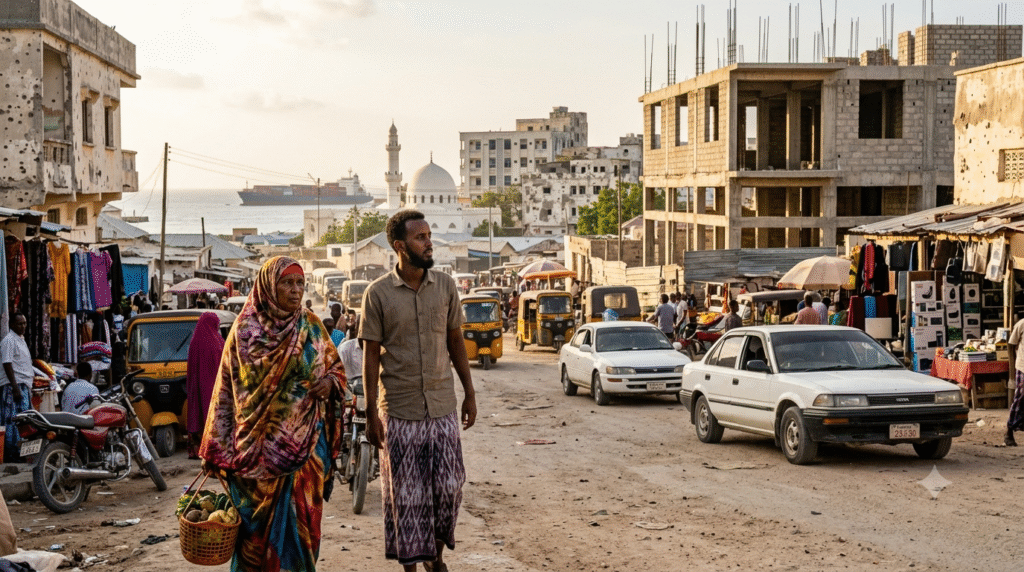
MOGADISHU — June 30, 2026
On the surface, Mogadishu’s bustling markets and sun-drenched coastline project an image of resilience. Yet beneath this veneer of normalcy, Somalia is teetering on the edge of a multifaceted crisis. The nation is simultaneously grappling with a devastating humanitarian emergency, a deepening constitutional crisis that threatens to fracture the fragile federal state, and a persistent insurgency that exploits every weakness in the country’s political fabric.
Part 1: The Constitutional Crisis — Authority Without Legitimacy
The most significant driver of instability is the political standoff in Mogadishu. President Hassan Sheikh Mohamud’s official democratic mandate expired on 15 May 2026. Rather than yielding a negotiated transitional framework, his government pushed through a controversial constitutional overhaul that extended the terms of both the president and parliament from four to five years, allowing the incumbent to remain in office for an additional year .
Critics view these measures as an autocratic, unilateral restructuring imposed without the broad-based, multi-clan political consensus required to sustain a fragile federal experiment . The resulting collision has exposed deep, tectonic fissures among the political class, former heads of state, and regional administrations, transforming a constitutional dispute into an existential struggle over the very source of political authority .
The military encirclement seen in Mogadishu carries significance far beyond temporary political maneuvering. When opposition leaders, former presidents, and veteran statesmen become targets of coercive security measures—including the tactical cut-off of vital municipal utilities to their quarters—the issue shifts from a standard political impasse to an acute constitutional emergency .
Part 2: Violence Erupts in the Capital
The political deadlock exploded into violence in early June. Heavy gunfire erupted across the capital as federal government forces clashed with militias aligned with opposition leaders in the Howlwadaag, Abdiaziz, and Hodan districts . The clashes marked the first violent expression of a constitutional crisis that had been building for years and displaced thousands of residents.
The government characterized its actions as a “large-scale security operation” against “heavily armed militias” and accused opposition figures of orchestrating a coup attempt. The opposition, however, claimed they were being targeted for their political opposition to the term extension and constitutional amendments .
This fragmentation has also driven a wedge between Mogadishu and key federal member states. Puntland and Jubaland have repeatedly severed ties over the constitutional path pursued by the federal executive, while South West State has also come into conflict with the central government over what it sees as interference in local political processes .
Part 3: The Humanitarian Catastrophe — A Record Surge of Malnutrition
As politicians clash, Somalia’s most vulnerable are paying the ultimate price. A deepening humanitarian crisis, driven by failed rains, severe funding cuts, and spillover effects from the Middle East conflict, is pushing the nation to the brink of famine .
Six million people—31 percent of the population—are facing high levels of acute food insecurity between April and June 2026, including 1.9 million in Emergency (IPC Phase 4). This marks an increase of more than half a million people compared to initial projections . The World Food Program warns that emergency-level hunger now affects two million people, a twofold increase from the previous year .
The malnutrition crisis is particularly dire. Nearly 1.88 million children are now expected to require treatment for acute malnutrition in 2026 . Médecins Sans Frontières (MSF) reports that malnutrition wards in Baidoa are facing a record surge of children arriving in critical condition. Between March and May, nearly 1,400 patients were admitted to the inpatient therapeutic feeding centre at Bay Regional Hospital. Even after expanding from 50 beds to 125, the facility is being pushed beyond its limits as admissions continue to rise .
Screening by MSF teams found that nearly one in two children under five in the area is acutely malnourished. More than 90 percent of patients admitted for measles had never been vaccinated . Humanitarian food assistance currently reaches only 450,000 people, leaving 76 percent of those in Emergency (IPC Phase 4) without support .
Part 4: The Economy — Fuel Prices and Funding Cuts
The humanitarian catastrophe is being compounded by severe macroeconomic pressures. The ongoing conflict in the Middle East has sent shockwaves through Somalia’s import-dependent economy. Government figures show that fuel prices in Mogadishu have risen from approximately $0.60 to $1.50 per liter . The FAO warns that this is driving inflation in food, transport, utilities, and services, significantly increasing logistics costs .
Nearly 60 percent of households are now unable to meet their basic needs, up from 47 percent in 2025, leaving up to 2.5 million additional people at risk of being priced out of a basic food basket . A constrained global funding environment, coupled with shifting donor priorities, has reduced operational efficiency and heightened the risk of scaled-back humanitarian assistance .
The onset of the Hagaa dry season, marked by poor rainfall across central Somalia and parts of Puntland, is now threatening a population whose recovery from previous droughts remains extremely fragile .
Part 5: The Security Threat — Al-Shabaab Exploits the Vacuum
As the political class becomes consumed by constitutional confrontation, the fight against Al-Shabaab has suffered. Security experts caution that sustained political wrangling could shift attention away from counterterrorism efforts and create opportunities for the extremist group to exploit divisions . Reports indicate that some units of the Somali National Armed Forces have been reassigned from frontline duties to roles linked to the political standoff .
Despite these diversions, security forces continue operations. The National Intelligence and Security Agency recently announced the seizure of a large cache of explosive chemicals allegedly destined for Al-Shabaab militants in Lower Shabelle region . The agency said the 100-plus containers of chemicals had been buried by militants after learning security forces were tracking their movements .
However, analysts warn that every day consumed by political confrontation is a day diverted from the struggle against the insurgency, weakening coordination and undermining public confidence .
Part 6: The Path Forward — A Nation’s Last Lifeline
Somalia stands at a crossroads. It can choose either gradual reform toward direct elections—at the expense of greater central authority—or further decentralisation, which could lead to deeper fragmentation and the erosion of central authority . Political philosopher John Rawls argued that stable political systems depend upon an “overlapping consensus.” Political actors do not need to agree on every issue, but they must maintain a shared commitment to the rules that govern disagreement. This is the bedrock of any functioning republic .
No leader is larger than the republic, and no political ambition is worth sacrificing the future of a nation still struggling to emerge from the long shadow of its past . The path to a stable Somalia will involve protracted discussions, negotiations, and unpleasant compromises from all sides . As Somalia enters July 2026, the fundamental question remains: will its leaders choose peace and unity, or will they allow the nation to descend further into a crisis from which it may never recover?
