

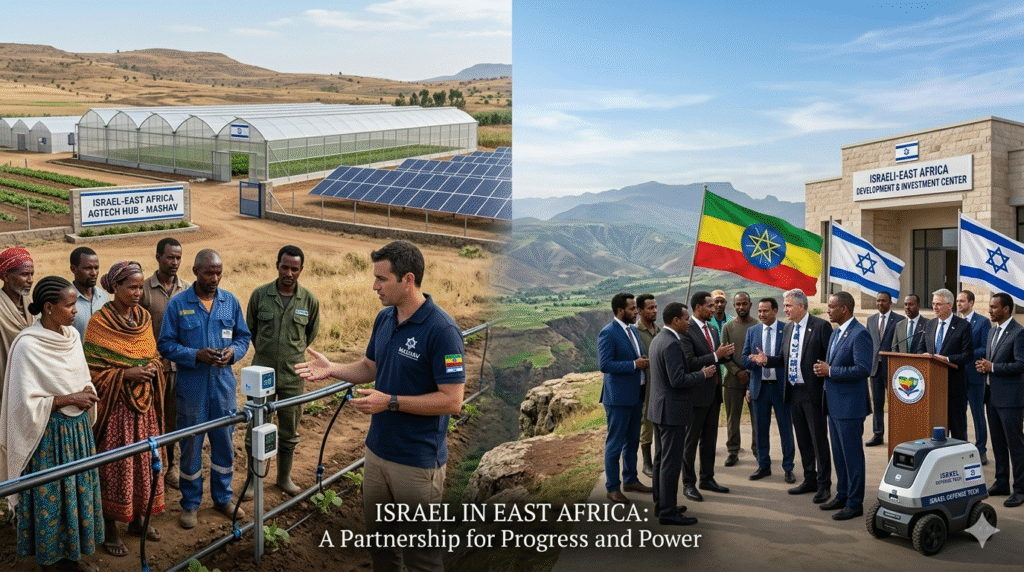
From the shores of the Red Sea to the highlands of Ethiopia, Israel is executing one of its most ambitious strategic pivots in decades. The past week has seen historic diplomatic milestones, military cooperation agreements, and diplomatic spats—all signaling that East Africa has become a central arena in Israel’s competition with Iran and its quest for regional influence .
The Somaliland Breakthrough: Recognition and Military Training
The most consequential development this week has been the historic visit of Somaliland President Abdirahman Mohamed Abdullahi to Israel. The visit marks the first official state visit by a Somaliland president to another country, and it comes on the heels of Israel’s groundbreaking decision in December 2025 to become the first nation to formally recognize Somaliland as an independent state .
President Abdullahi led a large delegation to Israel, seeking to deepen economic ties and attract Israeli investment in agriculture, water management, renewable energy, healthcare, and cybersecurity . At a business conference in Tel Aviv, he declared: “Somaliland is open for business, and Somaliland is ready for Israeli investment,” touting the territory’s “vast natural resources” and position as a maritime gateway to Africa .
However, it is the military dimension that has captured international attention. The Somali Guardian reported that Israel had opened an intelligence base in Somaliland and that discussions were underway regarding a potential Israeli military base . Somaliland’s Defence Minister Mohamed Yusuf Ali, who was part of the delegation, forcefully denied these reports: “There is no Israeli military presence or military bases in Somaliland… But Israel is helping Somaliland … they are supporting to train some of our police and military” .
While official negotiations for a base are denied, a January 2026 analysis from the International Institute for Strategic Studies (IISS) noted that Israeli media had cited Somaliland officials saying a military base “is on the table and being discussed” . The IISS report highlighted the strategic value of Berbera International Airport, just 550 kilometers from the Yemeni capital Sanaa—a 70% reduction in distance from existing Israeli bases. This proximity would significantly reduce response times for strikes against Iran-backed Houthi targets .
The Ethiopian Partnership: Deepening Historical Ties
Israel’s engagement with Ethiopia has also intensified. In February 2026, President Isaac Herzog made an official state visit to Ethiopia, meeting with President Taye Atske Selassie and Prime Minister Abiy Ahmed Ali . Herzog emphasized the historical bonds between the two nations: “The relationship between our peoples is woven deep into the pages of history and human tradition” .
Ethiopia’s strategic significance is multi-layered. As a pivotal nation in the Horn of Africa, Ethiopia offers Israel a partner with regional influence and access to Red Sea trade routes. The IISS report noted that access to Somaliland’s Berbera airport could be part of a broader Israeli strategy to expand its presence in the region, but it also risks causing friction with Egypt, Saudi Arabia, and Türkiye, which view such moves with suspicion .
The Ebola Controversy: A Diplomatic Setback and Recovery
Amid these strategic gains, a diplomatic stumble occurred when Israel imposed Ebola-related travel restrictions on Kenya, Uganda, Rwanda, South Sudan, and the Democratic Republic of Congo . The directive, issued by Ben Gurion International Airport’s Head of Border Control on June 10, instructed airlines to deny boarding to foreign nationals from these countries or anyone who had visited them in the preceding 21 days .
Kenya reacted swiftly and forcefully. Foreign Affairs Principal Secretary Dr Korir Sing’oei publicly decried the decision, calling it “unfortunate” and “unjustified” given Kenya’s robust public health record. He stated: “With over 80,000 tests, no case of Ebola has been reported in Kenya” .
Health Cabinet Secretary Aden Duale echoed this sentiment: “What they have done is very unfair. Kenya is not in the epicenter of Ebola. We have no case” .
The diplomatic pressure paid off. Within days, the Israeli Embassy in Nairobi announced that Kenya—and Rwanda—had been removed from the restricted list . Sing’oei welcomed the reversal, stating: “Israel’s decision to lift this restriction shows that science, dialogue and mutual trust work; that facts can beat fear; that partnership beats barriers. This is how friends must act” .
Regional Tensions: IGAD’s Warning
The regional bloc, the Intergovernmental Authority on Development (IGAD), has expressed concern over the escalating tensions between Israel and Somalia . Following Israel’s recognition of Somaliland and the opening of a Somaliland embassy in Jerusalem, IGAD reaffirmed its commitment to Somalia’s sovereignty, unity, and territorial integrity .
“IGAD has taken note of reports concerning the opening of a Somaliland embassy in Jerusalem and reiterates its longstanding position that Somalia’s unity and territorial integrity must be fully respected,” the bloc stated, warning that actions undermining Somalia’s sovereignty risk “raising tensions and damaging regional peace and cooperation” .
Somalia has condemned Israel’s recognition of Somaliland as a “deliberate attack” on its sovereignty .
The Iran Factor: A Proxy Rivalry
At the heart of Israel’s East Africa push lies its competition with Iran . The war between Israel and Iran has forced Israel to reassess its foreign policy, and Africa has emerged as a potential focus for new spheres of influence . Israel is seeking to counter Iran’s influence, which could be exerted through proxy actors in Africa, while also securing maritime routes in the Red Sea .
The competition extends to the Horn of Africa, where Israel has long developed cooperation with countries on defense and military matters. Israeli investments in the Berbera Port and the recognition of Somaliland are seen as part of a strategy to limit Iranian influence and ensure the free flow of global maritime trade .
The Risks Ahead
Israel’s deepening engagement in East Africa carries significant risks . A military presence in Somaliland could provoke attacks from Iran-backed Houthis, who have threatened to target any Israeli presence in Somaliland. It could also invite retaliation from Al-Shabaab, the Somalia-based militant group .
Furthermore, diplomatic friction with regional powers—including Türkiye, which has growing influence in the region, and Egypt, which views the Red Sea as a sphere of influence—could complicate Israel’s broader strategy .
Conclusion
Israel in East Africa today is a story of bold strategic moves and calculated risks. The recognition of Somaliland, the deepening ties with Ethiopia, and the potential for military cooperation represent a significant expansion of Israeli influence. Yet, the backlash from Somalia, IGAD, and regional powers underscores the contentious nature of these developments. As Israel competes with Iran for influence, the Horn of Africa has become a new frontier in an old rivalry—with consequences that will shape the region for years to come.