

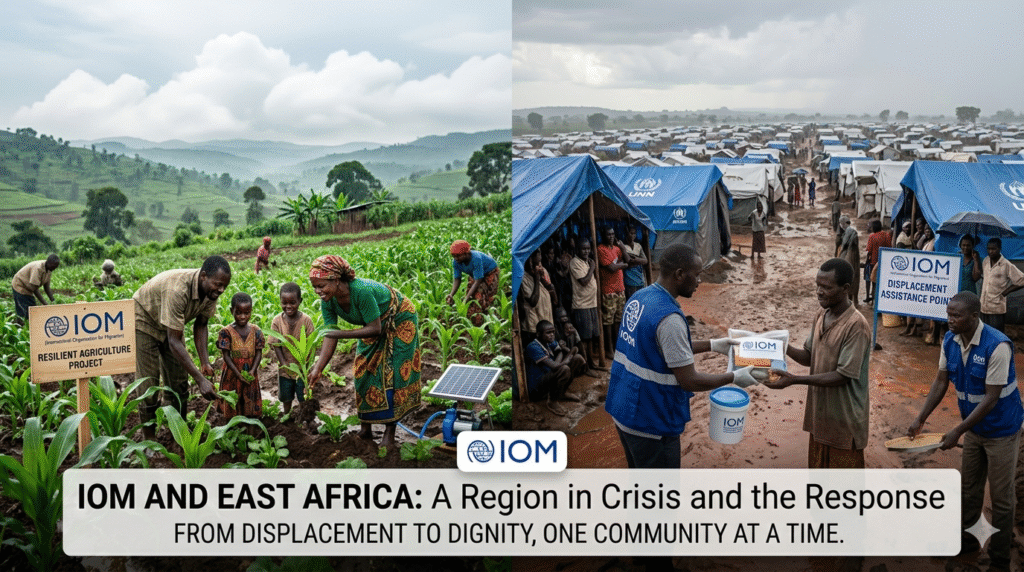
As mid-June 2026 unfolds, the International Organization for Migration (IOM) is operating at full capacity across East Africa, responding to a convergence of humanitarian emergencies. From the Ebola outbreak spreading across the Democratic Republic of Congo and Uganda to the devastating drought displacing tens of thousands in Somalia, and from the conflict-driven displacement in Sudan to the policy gaps in regional migration governance, the IOM is at the forefront of the region’s most pressing challenges .
Part 1: The Ebola Response — One Million Health Screenings
The most immediate and urgent IOM operation in East Africa is the response to the Ebola outbreak that has spread across eastern DRC and into Uganda. Since the outbreak began in mid-April 2026, IOM has conducted more than one million health screenings at borders and along key cross-border routes and travel corridors .
The scale of the challenge is staggering. The outbreak has now resulted in 198 deaths and over 856 infections as of June 18, according to the World Health Organization . Neighbouring countries including Burundi, Rwanda, and South Sudan remain at elevated risk due to high levels of population movement along regional migration corridors .
Frantz Celestin, IOM Regional Director for East, Horn and Southern Africa, emphasized the centrality of mobility to both the spread and containment of the disease: “Human mobility is central to both the spread and containment of infectious diseases. With more than one million health screenings already conducted, IOM is working alongside governments and partners to strengthen preparedness and response capacities, protect people on the move, and to mitigate cross-border transmission” .
Part 2: The Border Health Response
IOM’s Ebola response is built around a comprehensive border health strategy. The Organization is boosting health surveillance across 110 Points of Entry (PoE) and 43 additional health screening points along major routes, with surge personnel deployed to high-risk border areas .
The challenge of border health is magnified by the region’s high mobility. In Ituri Province alone, more than 16,000 people cross porous borders every day for trade, work, family reunification, and access to essential services . This highlights the critical role of border health leadership in helping to mitigate cross-border transmission.
Population mobility mapping has been expanded to inform national and regional containment strategies, strengthen surveillance along key routes and at major border crossings, and inform preparedness and response in high-risk locations and hotspots .
Part 3: Disease Surveillance in Ethiopia
Beyond the Ebola emergency, IOM is strengthening health systems across the region. In Ethiopia, IOM’s Migration Health Assessment Centre (MHAC) in Addis Ababa provides medical screenings for refugees and migrants before their journeys abroad . In 2024, IOM Ethiopia supported the safe resettlement of 6,105 vulnerable migrants to Canada and the United States via chartered flights .
IOM works with the Ethiopian government to strengthen border health systems and improve disease surveillance through training and population mobility mapping. These systems proved vital during COVID-19 and the mpox epidemic, and remain crucial in detecting and preventing outbreaks today .
Part 4: Somalia’s Drought Crisis — 62,000 Displaced
While Ebola dominates headlines, a slower-moving crisis is devastating Somalia. IOM data shows that nearly 62,000 people have been displaced by drought across five districts in Somalia since the beginning of 2026 .
Drought now accounts for three out of every four new displacements in the five most affected districts—a 22 percent increase from last year that underscores the growing severity of climate shocks . Even if the current Gu rainy season (April–June) brings normal to above-normal rainfall, IOM projects that nearly 125,000 more people could be displaced by drought in the second quarter of 2026 .
Part 5: The Most Affected Districts
The hardest-hit districts include Baidoa, Dayniile, Kahda, Diinsoor, and Doolow, where worsening drought conditions are driving crop failure and the collapse of livelihoods . Water sources have been depleted, grazing conditions have deteriorated, and agricultural production has been severely reduced .
IOM’s Displacement Tracking Matrix projections indicate that drought-related mobility, particularly among pastoral and farming communities, is expected to increase further in the coming months if rainfall conditions do not improve . This raises concerns that displacement pressures may intensify across already vulnerable regions as displaced households move toward towns and cities where they hope to access assistance or basic services .
Part 6: The Urban Pressure — Camps at Breaking Point
The displacement crisis is not limited to rural areas. Displaced families are moving to urban centers, but these cities are not capable of rapidly absorbing sudden population growth. Many newly displaced families settle in informal or underserved areas where access to basic services and infrastructure remains extremely limited .
IOM’s Emergency Trend Tracking Report for Week 63 (May 23-26, 2026) recorded 3,390 new arrivals across 385 settlements, with 88 percent in urban areas . Most new displacements were caused by drought (54 percent), followed by conflict (31 percent), evictions (13 percent), and floods (2 percent) .
The pressure on urban centers is immense. In displacement sites and informal settlements, families face overcrowded conditions, limited access to safe water and sanitation, and inadequate shelter .
Part 7: The Regional Policy Gap — Stranded Migrants in the EAC
Beyond emergency response, IOM is working to address structural gaps in regional migration governance. The East African Community (EAC) and IOM are partnering to develop a Regional Framework on Return and Reintegration for stranded migrants .
Despite the existence of international frameworks—including the Migration Policy Framework for Africa (MPFA), SDG 10.7, and the Global Compact for Migration—there remains a policy gap in the EAC region, resulting in fragmented standards, lack of accountability, and limited cooperation between states on return and reintegration .
Part 8: The Framework Development Process
The initiative to develop a regional framework responds to a directive from the 14th Meeting of the EAC Sectoral Council on Foreign Policy Coordination in April 2024 . In April 2026, the 13th Joint Meeting of the Sectoral Councils adopted the Terms of Reference for a consultant to undertake a comprehensive study to inform the development of the framework .
IOM is providing technical, operational, and financial support to the process. The framework aims to establish common standards, guiding principles, and coordinated approaches for the governance of return and sustainable reintegration of migrants, promoting rights-based, safe, orderly, and dignified processes .
Part 9: The Consultant Recruitment
IOM is seeking a consultant with expertise in research, analysis, and policy development on return and reintegration of migrants to undertake a comprehensive study on existing policies, practices, gaps, and opportunities in the EAC region . The consultancy is open to East Africans from the eight EAC Partner States: Burundi, Kenya, Rwanda, South Sudan, Somalia, DRC, Uganda, and Tanzania .
The study will inform the development of the regional framework, which is considered an essential pillar for sustainable migration management and regional integration . The consultancy will run for up to seven months, from June 2026 to January 2027 .
Part 10: IOM’s Commitment to Migrant Dignity
At the heart of IOM’s work is a commitment to the dignity and well-being of migrants. The Migration Health Assessment Programme (HAP) in Ethiopia provides services under strict ethical principles, free from exploitation, abuse, or fraud, ensuring that all migrants are treated with dignity and respect .
In 2024, IOM Ethiopia supported the safe resettlement of 6,105 vulnerable migrants to Canada and the United States, with an additional 15,900 travelling on commercial flights. Each journey was carefully planned and medically supported, with doctors and nurses accompanying those with significant health conditions to ensure safe travel and continuity of care .
Part 11: Regional Crisis Response
Beyond health and displacement, IOM is also responding to the broader regional crisis environment. The conflict in Sudan continues to drive mass displacement, while Ethiopia faces overlapping crises including droughts, floods, conflict, and disease outbreaks .
IOM’s approach is holistic: health teams work alongside Shelter, WASH, and Protection colleagues to bring essential health services to affected communities, including in displacement sites and remote host communities. Services include maternal and child health, nutrition support, and immunizations .
Part 12: The Path Forward — Urgent Needs
The scale and pace of the crises are rapidly outstripping available resources. IOM is calling for urgent and sustained support to address the growing impacts across the region .
The priorities are clear: scaling up life-saving humanitarian assistance remains critical, alongside stronger investment in water infrastructure, drought resilience, and climate-resilient livelihoods that help communities withstand future shocks . Border health systems must be strengthened to contain disease outbreaks, and regional frameworks must be developed to ensure the protection and dignity of migrants across East Africa .
As the Ebola outbreak continues to spread and drought-driven displacement deepens, the coming months will test the region’s response capacity like never before. IOM remains committed to supporting governments and communities to address these overlapping crises—but sustained international support is essential.
Conclusion
IOM’s work in East Africa today represents the full spectrum of the migration challenge: emergency health response to disease outbreaks, humanitarian assistance to climate-displaced populations, and long-term policy development for regional migration governance. From the border screening points in DRC and Uganda to the drought-stricken districts of Somalia, from the resettlement clinics in Addis Ababa to the policy tables in Arusha, the Organization is working to ensure that migration is safe, orderly, and dignified. But as the crises continue to escalate, the gap between need and resources grows wider. The coming months will determine whether East Africa—and the international community supporting it—can meet the challenge.
