

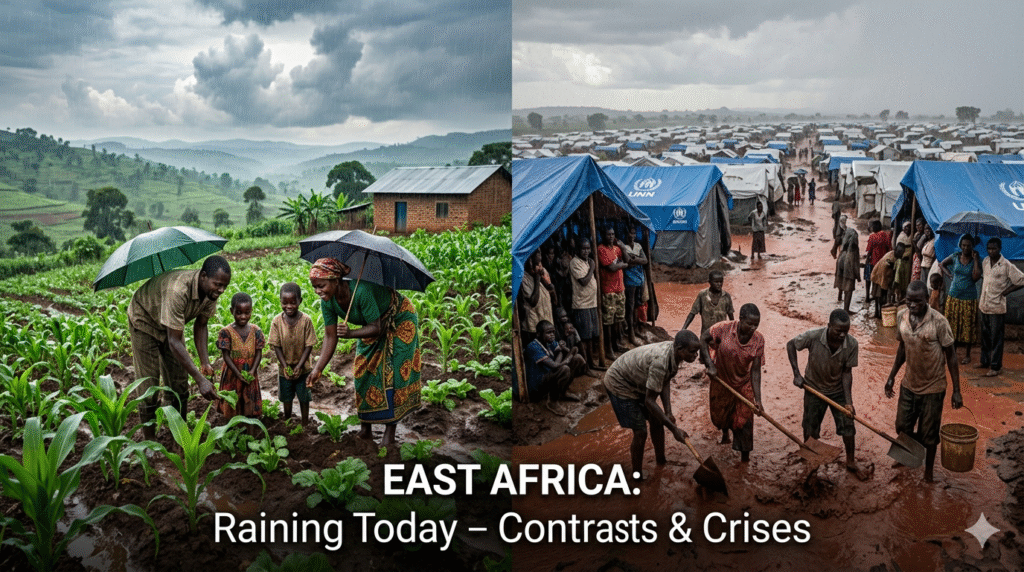
As mid-June 2026 unfolds, the skies over East Africa are telling a story of stark contrasts. From the dry, cracked earth of Somalia to the flooded plains of South Sudan and the devastating aftermath of a burst dam in Kenya, the region is a patchwork of weather extremes. This is the complex reality of rainfall in East Africa today.
A Season of Mixed Performance
The March to May rainy season, which is critical for agriculture across the region, has delivered highly uneven results. While the season began early with average to above-average rainfall in many areas, a prolonged dry spell in April negatively impacted parts of Kenya, Uganda, Rwanda, and Burundi . This erratic timing has created a challenging environment for farmers.
The most significant area of concern is southern Somalia, particularly the Bay and Bakool regions. Here, the April-to-June Gu rains were delayed and are now expected to be below average, leading to forecasts of reduced crop yields . This regional stress is compounded by the fact that much of the Greater Horn of Africa is bracing for a drier-than-normal June-to-September season, raising fears for the next harvest cycle .
The Threat of El Niño
Looking beyond today, the specter of a significant El Niño event looms large. Global climate models indicate an 80-82% chance of El Niño developing between June and August, with the likelihood rising to 90-96% for it to persist through the end of 2026 . This phenomenon is expected to create a “split” climate trajectory for the region .
The immediate future, for the June-to-September period, is likely to bring drier-than-normal conditions to many areas, including parts of Ethiopia, South Sudan, Uganda, and western Kenya . A delayed onset of rains is expected in parts of South Sudan and Ethiopia, which could severely affect planting .
However, the flip side of this is the potential for intense rainfall later in the year. The same El Niño event is expected to bring above-average rainfall to many eastern and southern areas during the October-to-December season . The combination of El Niño with a positive Indian Ocean Dipole could amplify this effect, raising the risk of widespread flooding across the region .
Regional Rain Predictions: June 2026
Current forecasts for the coming weeks show a mixed picture .
- Heavier Rains Expected: Wetter-than-usual conditions are predicted over much of Sudan, most of South Sudan, parts of Uganda, and central to northern Ethiopia . There is also a risk of exceptional rainfall exceeding the 90th percentile in southwestern Ethiopia and parts of South Sudan .
- Drier Conditions Expected: Conversely, drier-than-usual conditions are expected across large swathes of the region. This includes South Sudan, Uganda, western Kenya, central-to-northern Ethiopia, and parts of Somalia .
When Rain Becomes a Disaster
The human cost of these weather patterns is being felt with deadly force. Just last week, a devastating tragedy struck Kenya’s Rift Valley, where a makeshift dam burst its banks near the town of Mai Mahiu . The resulting flood killed at least 45 people, washing away homes, cutting off roads, and leaving communities in shock .
The disaster unfolded in the dead of night when a dam, naturally formed by decades of railway construction, gave way. Residents reported hearing “what sounded like an earthquake and roars like a moving train” as water surged down a hill . This single event raised Kenya’s total death toll for the March-to-May wet season to more than 120, underscoring the lethal power of extreme weather .
The Kenyan government has since ordered an immediate inspection of all public and private dams and reservoirs across the country . They have also warned against “risky behavior” such as attempting to cross flooded rivers .
A Humanitarian Wake-Up Call
As June comes to a close, the situation highlights the precarious balance of life in East Africa. The mixed rainfall performance, combined with the threat of a powerful El Niño, presents a dual threat of drought and flood in the coming months . The dam tragedy in Kenya serves as a grim reminder that a single day of rain can, in an instant, turn from a blessing into a catastrophe.