

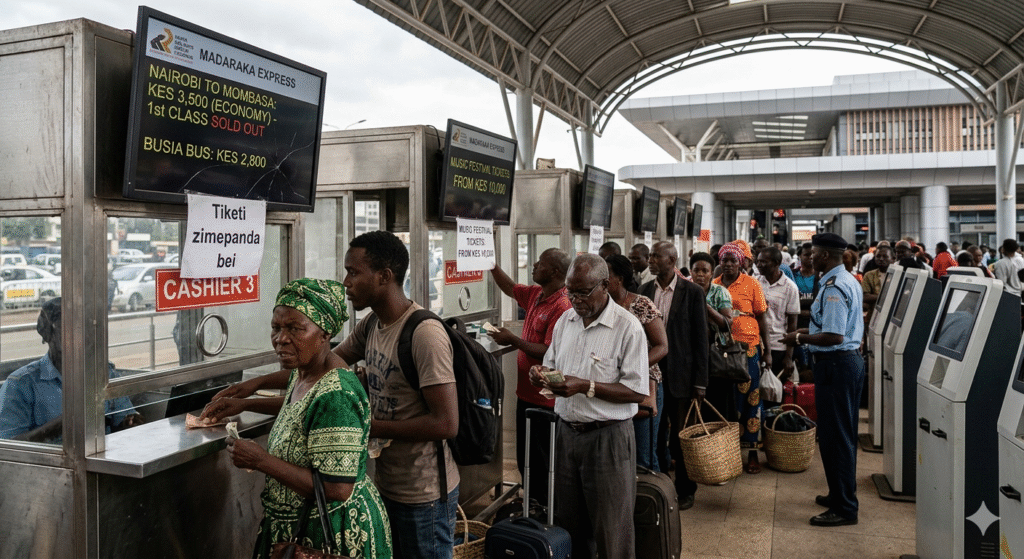
From park entrance permits to concert passes, from flight bookings to cargo freight, the price of a “ticket” in East Africa is undergoing a significant transformation. As June 2026 unfolds, a combination of geopolitical shocks, regional integration policies, and seasonal demand is reshaping what people pay to move, explore, and enjoy life across the region.
The Changing Cost of Travel Tickets
For residents of the East African Community, one of the most significant developments is the rising cost of regional transport, driven primarily by the ongoing crisis in the Gulf. The cost of ferrying goods in the region is already nearly double the global average and is projected to climb further . This is spilling over directly into passenger transport costs.
Aviation operators in Kenya and Uganda have added fuel surcharges to cushion against price volatility . The Kenya Railways Corporation has introduced a fuel price adjuster on its 2026 cargo tariffs. Running its trains on diesel across both the Standard Gauge Railway (SGR) and the Metre Gauge Railway (MGR), the corporation has created a formula that directly links tariff changes to the prevailing price of fuel in Nairobi. Should fuel prices rise significantly, tariffs could jump by 12% .
This is not just a cargo issue. For a traveler booking a flight between Harare and Dar es Salaam, fares fluctuate significantly depending on the airline and booking time, with non-stop options from Air Tanzania offering competitive rates around AED 1247 . For those flying into East Africa, the ticket price is a reflection of the same volatile fuel market.
Wildlife and Safari: A Premium on the Mara
For tourists and regional travelers alike, the “ticket” to East Africa’s crown jewel—the Masai Mara—remains one of the region’s most significant expenses. In 2026, a trip to the reserve is governed by a complex tiered pricing structure that differs by nationality and season.
Non-resident adults are looking at $100 per 12-hour entry ticket from January to June, but this doubles to $200 during the high season from July to December . Children aged 3-17 pay half price, with those under 3 entering for free .
For East African residents, the rates are lower but still carry a premium. A resident adult pays KES 1,200 in the low season and KES 2,400 in the high season (July–December) . This has sparked some debate, as residents pay significantly more than Kenyan citizens. For instance, in the high season, an East African resident pays KES 5,000 per entry, whereas a Kenyan citizen pays only KES 3,000 . The spread is even wider for children, where residents can pay up to 300% more than citizens .
For tourists looking to visit multiple parks, tour operators like SkySafari offer all-inclusive packages. For a 13-day tour covering Amboseli, the Mara, Serengeti, and Ngorongoro, rates start at $20,600 per person during the “Green” season, rising to $23,153 during peak travel periods .
The Cultural Scene: Music and Festival Tickets
Beyond travel and nature, tickets for entertainment and culture are becoming a vital part of the regional economy.
The third edition of the Tunataka Ku Enjoy Festival, scheduled for July 25-26 in Kigali, is a prime example. Featuring artists like Nel Ngabo and Christopher Muneza, this two-day showcase represents the growing appetite for regional music festivals . Early bird packages are priced at Rwf 12,500 for a general admission day pass, Rwf 20,000 for a weekend pass, and Rwf 25,000 for a VIP day pass . VIP weekend passes are available for Rwf 45,000 .
Earlier this year, the inaugural Talanta Afrika Festival made its debut, with tickets being sold for events in Kampala, Kigali, and Nairobi . The series was promoted as a platform to strengthen cross-border creative industries, indicating that tickets to such events are not just about music—they are about funding a “movement” to unify the region .
Regional Integration vs. Economic Reality
The EAC was founded to lower barriers and facilitate the free movement of people, goods, services, and capital . Yet, the current reality shows that the “ticket” to regional trade and tourism is subject to inflationary pressures.
For traders, high fuel costs are pushing up the price of moving goods . For safari-goers, the cost of conservation has gone up. For concert-goers, tickets reflect the growing professionalization of the creative industry. While the EAC aims to make East Africa a cohesive block, the rising price of “entry”—whether into a park, a country, or a festival—poses a challenge to the affordability of that dream.
