

MOGADISHU — June 14, 2026
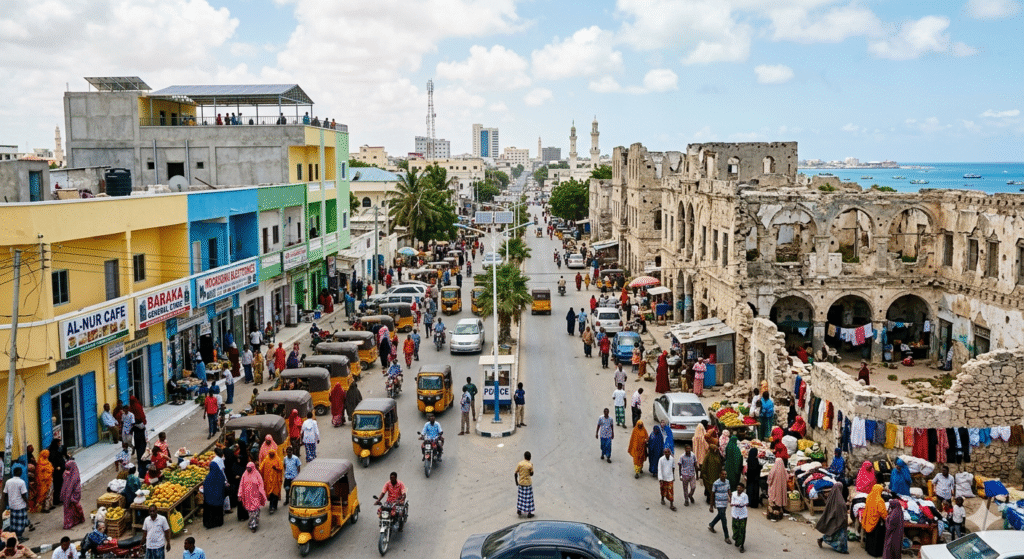
The sun rises over the white-washed minarets of the historic Fakr ad-Din Mosque, casting long shadows across the bustling alleys of the Bakara Market. Thousands of merchants and shoppers have already filled the stalls, haggling over the price of imported rice, vegetables, and qat leaves. The daily rhythm of commerce continues—defiant, almost aggressive in its normalcy.
Yet, just a few kilometers away, heavily armed government forces guard barricaded streets. Opposition militia fighters remain hidden in residential districts. And overhead, the faint hum of military drones serves as a constant reminder that in Mogadishu, peace is never more than a rumor away.
This is Mogadishu today. The city of 3 million people—once the “White Pearl of the Indian Ocean” and later synonymous with anarchy—is locked in a fierce struggle between promising reconstruction and political fragmentation, between economic potential and humanitarian catastrophe. Here is the complete picture of the Somali capital today.
Part 1: The Black Week — Political Violence Shakes the Capital
The past week has been one of the most violent periods Mogadishu has witnessed in years. On June 3, heavy gunfire erupted across the city as forces loyal to the federal government clashed with armed militias aligned with opposition leaders .
The violence began on the night of June 3 when opposition leaders, including former Prime Minister Hassan Ali Khaire and former President Sharif Sheikh Ahmed, moved into the capital ahead of planned protests against President Hassan Sheikh Mohamud’s term extension. By dawn, residents in the Howlwadaag, Abdiaziz, and Hodan districts were reporting the sounds of heavy machine guns, mortars, and rocket-propelled grenades .
“I no longer trust that I can live in this country,” said Fartun Da’ud, a 27-year-old mother of two, as she fled her home in a district where the fighting was heaviest. “No politician seems concerned about our safety. I’m worried about my children” .
The government characterized its actions as a “large-scale security operation” against “heavily armed militias who launched mortar attacks on some neighborhoods of the capital” . The opposition, however, offered a different narrative. Khaire claimed he had been attacked by government forces “with the apparent objective of killing me” .
The international community responded with alarm. The US embassy in Mogadishu described the violence as “reckless,” while a joint statement from the EU and UN missions called the clashes “deeply concerning” . The African Union and IGAD have called for maximum restraint and immediate de-escalation .
Part 2: The Spark — A Constitutional Crisis Over Term Limits
The violence did not emerge from a vacuum. It is the violent expression of a political crisis that began on March 4, when Somalia’s parliament passed constitutional amendments extending the terms of both parliament and the president from four to five years .
President Mohamud’s original term expired on May 15. With the amendments, he announced a one-year extension, arguing that the additional time is necessary to transition Somalia from clan-based indirect elections to a one-person, one-vote democratic system .
The opposition rejects this entirely. “This is a grave assault on the constitutional rights of Somali citizens,” Khaire said . Former President Sharif Sheikh Ahmed has been equally defiant, stating that the planned protests would continue despite the government’s show of force .
The political analyst Mahad Wasuge, director of the Mogadishu-based think tank Somali Public Agenda, warns that the implications are dire: “The political situation in Somalia has entered a critical stage… Key national political stakeholders are not currently part of the direct elections that the federal government has been working on” .
Part 3: The Security Battle — Fighting Al-Shabaab While Battling Politically
Even as political factions fight each other in the capital, the war against Al-Shabaab continues unabated. The security forces are stretched thin across multiple fronts.
On June 11, the National Intelligence and Security Agency (NISA) announced a major success: security forces seized a large cache of explosive chemicals in the Lower Shabelle region . The chemicals, more than 100 containers in total, had been buried by Al-Shabaab militants after they learned security forces were tracking their movements .
Just days earlier, on June 2, Somali security forces backed by international partners killed 29 Al-Shabaab militants, including a senior commander, in coordinated operations in the Middle Shabelle and Hiran regions .
The double reality of Mogadishu is stark: the same week that government forces were battling opposition militia in the city center, they were also hunting militants in the countryside. The resources required for both are immense, and analysts warn that the political distraction could undermine counter-insurgency progress .
Part 4: The Maritime Lifeline — Mogadishu Port’s Transformation
Amid the political chaos, one sector is quietly defying the odds: maritime commerce. The Port of Mogadishu is experiencing a renaissance.
On June 12, the Turkish shipping firm Akkon Lines officially launched operations in Somalia, with a ceremony at Mogadishu Port attended by Somalia’s Minister of Ports and Marine Transport, Abdulkadir Mohamed Nur, and officials from the Turkish Embassy . The company will introduce direct shipping services between Turkey and Somalia, reducing logistical barriers and potentially lowering transport costs .
The port’s performance justifies the investment. Official figures show container traffic at Mogadishu Port increased from 94,404 TEUs in 2016 to 188,152 TEUs in 2024. A new container terminal commissioned in 2025 increased annual handling capacity to approximately 250,000 TEUs .
However, this success is straining against physical limitations. The current port sits in a dense urban area with limited room for expansion, shallow draft limitations, and constrained road access. The demand for cargo processing is expected to outstrip capacity in the short to medium term .
Part 5: The Mega-Project — New Mogadishu Maritime Port
The solution to the port’s capacity constraints is ambitious. Approximately 35 kilometers north of the capital, plans are advancing for the New Mogadishu Maritime Port (NMMP)—a greenfield development designed to catapult Somalia into the ranks of regional logistics hubs .
The numbers are transformative. Phase One alone is estimated at approximately $718 million, including breakwater construction and facilities capable of handling 600,000 TEUs and 1.5 million tonnes of cargo annually. The total envisioned capacity is about 1.2 million TEUs and 5 million tonnes of general cargo .
The project is part of a wider “New Mogadishu” development agenda unveiled in 2024 by President Mohamud, which also includes a new airport, a special economic zone, and major commercial infrastructure .
For global investors, the message is clear. “Somalia is rebuilding rapidly after decades of conflict,” an analysis in Hiiraan Online noted. “Among the most promising opportunities is the New Mogadishu Maritime Port. The time to act is now” .
Part 6: The Cost of War — Fuel and Hunger Bite
While politicians and investors look to the future, ordinary residents are struggling with the present. The war in the Middle East has sent shockwaves through Mogadishu’s economy.
Government figures show that fuel prices in the capital have risen from approximately $0.60 to $1.50 per liter—a 150 percent increase . The Food and Agriculture Organization of the UN warns that this is driving inflation across food, transport, utilities, and services, significantly increasing logistics costs .
“The sharp rise in fuel prices is driving inflation in food, transport, utilities, and services,” said Gordon Dudi, FAO Food Security Cluster Coordinator .
The impact on already vulnerable families is devastating. More than 6.5 million Somalis have been pushed to the brink of severe hunger—nearly a third of the population. Internally displaced people living in camps across Mogadishu are the worst affected, surviving on overcrowded sites with limited access to water, sanitation, and health facilities .
Part 7: The Displaced — Life in the Camps
In the Kahda district of Mogadishu, hundreds of thousands of displaced people live in makeshift shelters. Zeynab Ibrahim, a 38-year-old single mother, arrived two months ago with her six surviving children—four of her children died during three years of drought in her village .
“So hunger is what brought us here,” Ibrahim says, sitting in front of her shelter made of sticks and covered with old clothes and plastic .
The family has not received support from the government or aid agencies. They survive on one meal a day, which Ibrahim secures by begging at the Bakara market. “We are lucky if we get one meal a day,” she says. “I’m not healthy enough to work, and I don’t have any skills other than farming” .
Across Mogadishu, more than one million displaced people live in similar conditions. Nearly 1.9 million children under five face acute malnutrition across the country, and nearly 500 nutrition clinics have closed because of a lack of funding .
Part 8: The Climate Threat — From Drought to Floods
Compounding the political and economic crises is the climate crisis. Somalia is trapped in a brutal cycle in which drought and floods alternately devastate communities.
Adan Roble, 77, experienced this cycle directly. Years of drought destroyed his crops and dried up his farmland in the Lower Shabelle region. Then, last month, rains falling on the parched earth created flooding that swept through his village .
As the water washed away everything, above them the sky was full of military drones as government forces fought Al-Shabaab nearby .
Now Roble lives in a Mogadishu camp. “Imagine losing everything and trying to survive without food and clean water, while fighting continues around you and drones keep flying overhead,” he says .
The FAO warns that an El Niño phenomenon is forecast to develop in mid-2026 and intensify toward the end of the year. “From that point onward, we are likely to see a shift from drought concerns to flood risks,” said Bethwell Mutai, SWALIM’s lead meteorologist .
Part 9: The Turkish Partnership — A Strategic Anchor
Amid the turbulence, one foreign partner has remained consistently engaged: Turkey. The relationship is multi-dimensional, spanning infrastructure, trade, and maritime cooperation.
The launch of Akkon Lines at Mogadishu Port is only the latest development in a deepening partnership. Turkish companies have been involved in rebuilding the airport, constructing roads, and providing security training. The Turkish Embassy in Mogadishu maintains a significant presence, and officials from Ankara frequently visit the capital .
The partnership is part of a broader strategy. Somalia is also deepening maritime cooperation with Saudi Arabia and engaging with the European Union on port modernization and maritime security .
For the federal government, these international partnerships serve multiple purposes: they bring investment and expertise, they signal international confidence, and they counterbalance the influence of other regional powers.
Part 10: The Human Cost — Stories from the Streets
Behind the statistics and political maneuvering are individual stories of survival.
Xalimo Salad, a resident of Mogadishu’s Howl Wadaag district, described the night of June 3 to AFP: “We did not sleep throughout the night because of sporadic gunfire. More intense gunfight broke out on Thursday morning. We have seen federal government forces deploying reinforcements” .
Other residents told the BBC that the fighting was the worst they had experienced in years. Fartun Da’ud, a 27-year-old mother who fled her home, captured the sentiment of many: “I no longer trust that I can live in this country. No politician seems concerned about our safety” .
For residents of Mogadishu, the political crisis is not abstract. It is the sound of mortars landing near their children’s bedrooms. It is the sight of armed forces deploying to their neighborhoods. It is the fear that the fragile gains of the past decade could be lost in a matter of days.
Part 11: The International Response — Calls for Restraint
The international community has responded to the crisis with urgent calls for restraint. The African Union Commission said it is “deeply concerned” by reported security developments in Mogadishu, including armed clashes in civilian areas. It called on all parties to “immediately stop the fighting and exercise maximum restraint, protect civilians and refrain from actions that could further escalate tensions” .
IGAD, the East African bloc, echoed these concerns, urging all parties to “immediately exercise maximum restraint, de-escalate tensions and resolve their differences through peaceful, inclusive and constructive dialogue” .
The US embassy in Mogadishu warned that leaders on all sides “have a responsibility to preserve stability and resolve differences through peaceful means” .
Part 12: The Road Ahead
As June 14 draws to a close, Mogadishu stands at a crossroads. The violence of the past week has subsided, but the underlying political crisis remains unresolved. The opposition has vowed to continue its protests. The government has shown no willingness to reverse the term extension.
Meanwhile, the humanitarian situation continues to deteriorate. The UN humanitarian chief, Tom Fletcher, recently visited Somalia and expressed frustration over the shrinking ability of aid agencies to respond due to severe funding cuts. “It just frustrates me because we are running out of ways to try to drive this message home,” he said .
The port expansion offers a glimpse of a more prosperous future. The Turkish partnership provides a strategic anchor. The resilience of the city’s residents—who return to the Bakara Market each morning despite the risks—demonstrates a will to survive.
But the political crisis shows no sign of resolution. The climate crisis worsens by the month. The humanitarian funding gap grows wider.
As Mahad Wasuge, the political analyst, warned: “As this is a pressing and critical political development, the humanitarian situation and efforts to address humanitarian emergencies seem secondary. I do not see a refocus on the humanitarian situation from the leadership without dialogue and agreement on the national electoral process” .
Conclusion
Mogadishu today is a city of paradoxes. The port is expanding, but the people are hungry. The government is fighting Al-Shabaab, but it is also fighting its political opponents. International partners are investing, but the humanitarian response is starved of funds.
The residents of Mogadishu have survived civil war, famine, and terrorism. They have rebuilt their city from the ashes of complete state collapse. They have demonstrated a resilience that the rest of the world has, at times, failed to match.
But resilience has its limits. The violence of the past week pushed many to the breaking point. The rising fuel prices and food costs are squeezing families who were already barely surviving. The political crisis threatens to undo the hard-won gains of the past decade.
As the sun sets over the Indian Ocean, Mogadishu waits. It waits for its political leaders to find a path through the impasse. It waits for international donors to fulfill their promises. It waits for the rains to come—but not too much. It waits for a future that has been promised for decades but remains stubbornly out of reach.
For the millions who call this city home, the waiting continues. And in Mogadishu, waiting is the hardest part.
