

TEHRAN — June 14, 2026
Just before midnight on Saturday, a maritime radio channel crackled with a warning that sent shivers through the shipping industry. The navy of Iran’s Islamic Revolutionary Guard Corps (IRGC) addressed all vessels operating in the Persian Gulf and the Gulf of Oman: the Strait of Hormuz had been “completely closed,” and any vessel movement within the strait would be dealt with “decisively” .
“For the sake of your health and safety, absolutely refrain from any movement in the Strait of Hormuz until further notice,” the recorded message said .
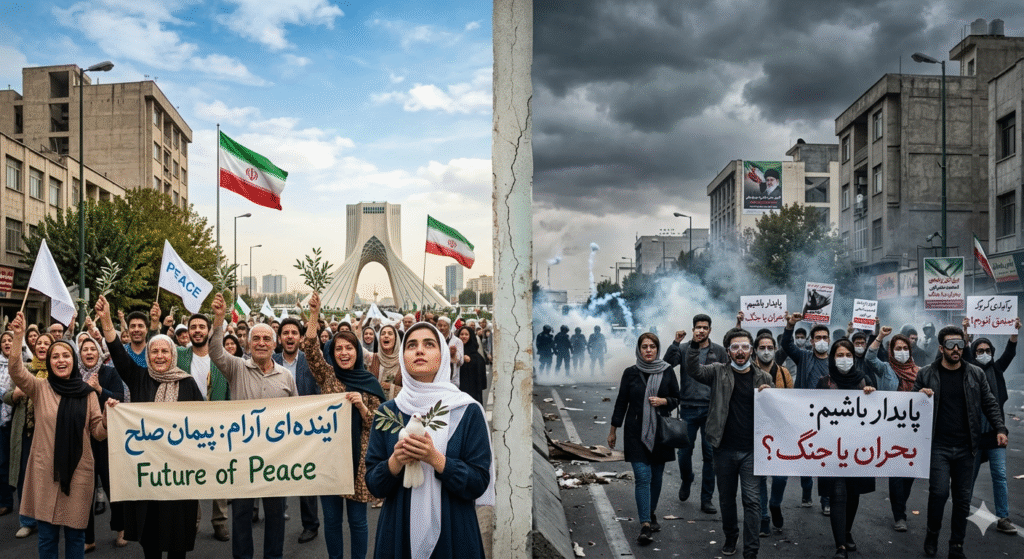
The warning came just hours after U.S. President Donald Trump announced that a peace deal with Iran was scheduled to be signed on Sunday — and that the Strait of Hormuz would reopen “immediately after it is signed” . The gap between Trump’s optimism and the IRGC’s hardline stance could not be wider. And it captures Iran today perfectly: a nation torn between diplomatic breakthrough and military defiance, between economic collapse and strategic resilience, and between a population demanding relief and a leadership navigating the most precarious transition in four decades.
Here is a comprehensive look at Iran today.
Part 1: Trump’s Sunday Deal — Optimism from Washington
On Saturday, President Trump took to Truth Social with an announcement that would have seemed unthinkable just weeks ago. “The Deal is scheduled to get signed tomorrow, and immediately after it is signed, the Hormuz Strait is OPEN TO ALL,” he wrote .
Trump claimed that Iran now “no longer wants a Nuclear Weapon” and suggested the United States would work with Iran to remove enriched uranium at an “appropriate time” . He promised that the signing would make U.S. relations with Iran “different and better,” but warned that “we have the ultimate alternative” unless the process moves forward “quickly, easily and smoothly” .
His optimism was echoed by Pakistan’s Prime Minister Shehbaz Sharif, whose country has been mediating the U.S.-Iran peace negotiations. Sharif said a deal could be finalized “in the next 24 hours,” and that Pakistan was preparing “for the electronic signing of the peace deal immediately after, followed by technical level talks next week” .
Behind the scenes, a senior U.S. official painted a picture of negotiations in a much better state. “I think we’ve reached a language agreement that we’re happy with, and the Iranian side has actually said, ‘Okay, we can agree on that,’” the official told reporters .
The draft reportedly includes provisions for dismantling Iran’s nuclear program, with Iran committing “indefinitely to never possessing or developing nuclear weapons” . Technical details of how to dispose of Iran’s highly enriched uranium stockpile have not yet been agreed upon, and discussions will take place in the next round of technical negotiations — a 60‑day period that would follow the memorandum’s signing .
Crucially, the Trump administration has also signaled willingness to accept Iran’s civilian nuclear energy program as part of a broader nuclear deal — provided Tehran dismantles infrastructure that could allow it to manufacture nuclear weapons .
“We have absolutely no concerns about the idea of building civilian power plants in Iran,” a senior U.S. official said. Instead, the concern lies in “the kind of infrastructure that would allow them to transition from civilian electricity production to nuclear weapons development” .
Part 2: Tehran’s Denial — No Sunday Signing
But Iran’s Foreign Ministry threw cold water on Trump’s announcement. Spokesperson Esmaeil Baqaei denied that a memorandum of understanding between Iran and the United States would be signed on Sunday, citing what he described as “the other side’s hesitation” .
“We will have to wait and see about the exact time of signing the memorandum; although it will not be tomorrow, the possibility of this happening in the coming days cannot be ruled out,” Baqaei said .
He stressed that any potential MoU “would merely serve as a framework for continuing talks” and should not be regarded as “a final agreement” . Discussions on the nuclear issue are expected to continue over a 60‑day period, according to Iranian state media reports .
Foreign Minister Abbas Araghchi was more optimistic but still cautious. Writing on social media on June 12, he said an agreement “has never been closer” — but added that the final document was not yet complete . He also noted that a statement regarding future control of the Strait of Hormuz would be issued soon .
The mixed signals reflect a deliberate strategy: Tehran wants to keep diplomatic channels open while maintaining maximum leverage on the ground.
Part 3: The IRGC’s Defiance — Strait Remains Closed
The IRGC’s Saturday night warning made clear that, whatever Trump may claim, the military calculus on the ground has not changed. The recorded message addressed to all vessels in the region was unambiguous: the strait is “completely closed,” and any movement would be dealt with “decisively” .
The audacity of the warning — broadcast on an open maritime channel for all to hear — underscores how the war has fundamentally altered the strategic reality of the region. As The Hindu noted in an editorial on Saturday: “Yes, Iran has absorbed significant military and economic costs, but it has emerged strategically stronger by taking control of the Hormuz Strait and effectively trapping the U.S. in a costly stalemate” .
Iran’s position has hardened since February 28, when the U.S. and Israel launched their war. If Iran was willing to make concessions on its nuclear program on the eve of the war, it now insists that any discussion on the nuclear file can take place only after hostilities cease and the blockade is lifted .
This is the IRGC’s message to Washington: you may talk to our diplomats, but we control the strait. And we are not moving until you do.
Part 4: The Economic War — $270 Billion in Damage
While diplomats haggle over texts and timelines, the economic devastation of the war has been staggering. The Iranian government recently stated that the economic damage from weeks of U.S.-Israeli airstrikes has reached $270 billion — nearly matching Iran’s projected GDP for this year .
The IMF forecasts that Iran’s economy will contract by 6.1% in 2026, the largest decline in decades . The EIU is even more pessimistic, projecting a contraction of 9.2% . The rial has collapsed, inflation has crossed 40 percent, and basic goods like eggs, rice, and potatoes have become luxuries for many households. Bloomberg reported that some Iranian families have replaced beef and chicken with cheaper soy protein in their diets .
Unemployment is also soaring. At least 1 million jobs are expected to disappear since the war began, and the UNDP projects that up to 4.1 million more people could fall into poverty .
Yet — remarkably — Iran’s economy has not collapsed. Bloomberg attributes this resilience to Iran’s “survival know-how,” accumulated over decades of enduring international sanctions . Iran has developed methods to export crude oil using shell companies, indirect trade networks, and so-called “dark fleets” to evade sanctions .
The government has also entered emergency mode: banning exports of food and agricultural products, prioritizing foreign currency for essential imports, and seeking new trade routes — such as transporting goods via railways through Pakistan, Afghanistan, and China — to bypass the closed Strait of Hormuz .
These responses align with the “Economy of Resistance” policy promoted since 2013 by the late Supreme Leader Ayatollah Ali Khamenei, which aims to reduce reliance on imports, strengthen domestic production, and prepare for Western pressure .
Part 5: The Protests — A Nation in Agony
The economic pain has exploded into the streets. Protests that began in late December over the collapsing rial and soaring living costs have spread to all 31 provinces, making this the most serious wave of unrest since the 2022‑23 protests following the death of Mahsa Amini .
Crowds have been chanting anti-government slogans and targeting symbols of state authority. Rights groups report that at least 39 people have been killed and more than 2,000 detained . Security forces have clashed with crowds in Tehran, Isfahan, and parts of western and northeastern Iran .
Markets and bazaars have shut in several locations. Internet monitoring services say selective disruptions appear to be linked to government action .
A new dimension has emerged: exiled crown prince Reza Pahlavi, the eldest son of Iran’s last monarch, has urged Iranians to chant and rally at a fixed evening hour. Witnesses say the call was taken up in several neighborhoods of the capital and in other cities, with slogans heard against the leadership and in support of the former monarchy .
The Iranian leadership is trying to balance dialogue with a crackdown. President Masoud Pezeshkian has called for restraint and engagement, but the late Supreme Leader’s successor — Mojtaba Khamenei — has urged firm action against “rioters” . The judiciary has declared “no leniency” for those causing violence .
Part 6: The Leadership Transition — A Supreme Leader’s Funeral
Behind the diplomatic maneuvering and domestic unrest looms an unprecedented leadership transition. Iran’s long-serving Supreme Leader, Ayatollah Ali Khamenei, was killed in a joint U.S.-Israeli airstrike on February 28 .
His son, Mojtaba Khamenei, was selected as Iran’s new supreme leader in early March . The transition — from a revered, octogenarian cleric who had led the Islamic Republic for 36 years to his relatively untested son — has introduced a new layer of uncertainty into Iran’s political calculus.
The funeral for the late supreme leader is scheduled to begin in Tehran on July 4, with farewell ceremonies at Imam Khomeini’s Mosalla prayer hall on July 4‑5. Funeral processions will follow in the capital and the central city of Qom on July 6‑7, and the final ceremony will be held in Mashhad on July 9, where Khamenei will be laid to rest at the holy shrine of Imam Reza .
The fact that the funeral has been scheduled for nearly five months after Khamenei’s death underscores the complexity of the transition — and the leadership’s desire to use the occasion to consolidate support.
Part 7: The Banking and Finance Crisis
Even if a deal is signed, Iran’s re-entry into the global financial system will be slow and painful. The EIU warns that even in a scenario where limited sanctions relief is granted, “the degree of integration with the global financial system will be low” .
“Global financial institutions will remain even more risk-averse than they were in 2016‑18, when sanctions were temporarily lifted under the JCPOA,” the EIU notes . Current geopolitical and macroeconomic conditions are now significantly less favorable than then, suggesting that foreign bank participation will remain negligible.
Iran holds more than $100 billion in overseas assets, some of which could be released under a negotiated settlement . However, the UAE has reportedly warned that it could freeze Iranian-linked assets estimated at up to $50 billion — a move that would directly target Iran’s shadow banking network .
US Treasury data shows that $8.6 billion in Iran-linked flows were detected across the UAE and Asian financial centers in 2024, over 70% of which involved UAE-based firms. Freezing these assets would significantly disrupt Iran’s ability to intermediate oil proceeds through its shadow banking architecture .
Part 8: The Regional Landscape — From Isolation to Leverage
Before the war, Iran was regionally isolated and under unprecedented pressure. The “Axis of Resistance” had been degraded: Hamas was weakened in Gaza, Hezbollah was under pressure in Lebanon, and the Assad regime in Syria had fallen.
The war has fundamentally changed that calculus. By taking control of the Strait of Hormuz, Iran has gained strategic leverage that it did not have on February 27. By surviving 40 days of U.S.-Israeli bombing, it has demonstrated resilience that its adversaries may have underestimated.
As The Hindu editorial concluded: “Rather than chasing a delusional Iranian surrender, Washington should adopt a phased, realistic diplomatic approach. The priority should be to enforce and extend the ceasefire in good faith and lift the blockade in exchange for Iran reopening the Strait of Hormuz. Once stability is restored, both sides can return to substantive talks on Iran’s nuclear programme and work towards a durable end to the conflict” .
Part 9: The Civilian Nuclear Question
One of the most significant developments in the negotiations is the Trump administration’s willingness to accept Iran’s civilian nuclear energy program .
This represents a shift from the administration’s earlier maximalist position, which sought the complete dismantlement of Iran’s nuclear infrastructure. The new approach distinguishes between civilian power generation and weapons capability — a distinction that could provide a face-saving pathway for both sides .
The official pointed out that many other countries in the region are operating civilian nuclear programs without possessing the necessary infrastructure for weapons development . Under the proposed agreement, Iran would be allowed to continue producing electricity through its civilian nuclear facilities — but under close supervision, with inspections designed to verify long-term compliance.
Part 10: The Path Forward — Three Scenarios
As June 14 draws to a close, three scenarios are possible:
Scenario One: Deal Signed. Trump’s Sunday timeline materializes — perhaps not today, but in the coming days. A memorandum is signed, the Strait of Hormuz reopens, and a 60‑day period of technical negotiations begins. Iran receives some sanctions relief and access to frozen assets. The regime stabilizes, and protests subside.
Scenario Two: Continued Stalemate. The IRGC’s warning proves prophetic. The strait remains closed. No deal is signed. The ceasefire frays. Protests continue, and the economy deteriorates further. The leadership faces increasing pressure from both the street and the military.
Scenario Three: Deal Breakdown. The talks collapse entirely. Trump follows through on his “ultimate alternative.” Hostilities resume. The region plunges back into full-scale war, with consequences that no one — in Washington, Tehran, or the Gulf — can predict.
The most likely outcome, based on the available evidence, is Scenario One. Both sides have compelling reasons to reach an agreement. Trump wants a diplomatic victory to take into the US election season. Iran wants sanctions relief to stabilize its collapsing economy and address domestic unrest. The mediators — Pakistan, Saudi Arabia, Türkiye, Egypt, and Qatar — have invested significant capital in bringing the parties together .
But the IRGC’s warning on Saturday night was a reminder that nothing is certain. The same Revolutionary Guards who control the strait and the same hardliners who have opposed any deal with the “Great Satan” are watching. And they have their own ideas about Iran’s future.
Conclusion
Iran today is a nation at a crossroads — perhaps the most consequential crossroads since the 1979 Revolution.
On one path lies diplomatic breakthrough, economic relief, and a potential end to decades of estrangement from the West. On the other lies continued confrontation, deepening poverty, and the risk of state collapse.
The signals from Tehran are contradictory. The Foreign Ministry says a deal is not ready, while the Foreign Minister says an agreement has “never been closer.” The IRGC closes the strait, while the government negotiates its reopening. The people protest in the streets, while the leadership prepares for a supreme leader’s funeral that will test the regime’s stability.
Trump’s Sunday deadline may come and go without a signature. But the momentum toward a deal — however fragile, however contested — is real. The question is whether Iran’s fractured leadership can overcome its internal divisions and seize the opportunity before it slips away.
For the Iranian people, who have endured war, sanctions, inflation, and repression, the stakes could not be higher. They are not interested in the diplomatic maneuvering or the military posturing. They want the price of eggs to come down. They want their children to have jobs. They want to live without the fear of airstrikes or the dread of another winter without heat.
Whether they get what they want depends on the choices made in the coming days — in Washington, in Tehran, and in the shadowy corridors where the IRGC makes its decisions.
As the sun sets over the Persian Gulf, the Strait of Hormuz remains closed. The IRGC’s warning stands. And the world waits to see whether Sunday brings a signature — or something far darker.
