

PORT SUDAN — June 13, 2026
On a sweltering morning in South Darfur, mourners gathered at a cemetery to bury five civilians killed by a drone strike the previous evening. As prayers began, a second drone appeared overhead. Within seconds, four more were dead and seven wounded—struck down while attending a funeral for victims of the same war .
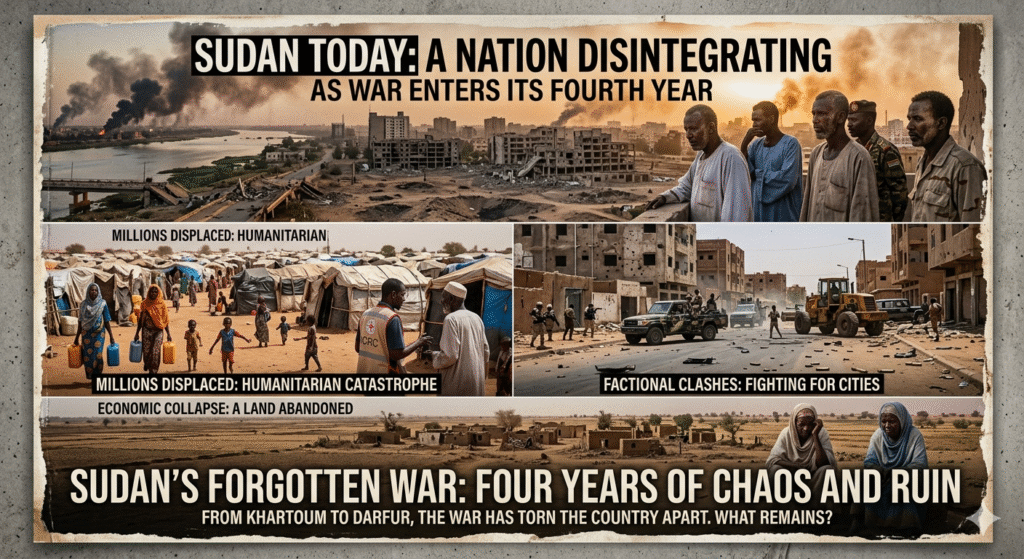
The attack on el-Obeid this week is not an aberration. It is the grim reality of a conflict that has entered its fourth year, killing an estimated 400,000 people, displacing 14 million, and pushing 19.5 million Sudanese into acute food insecurity . From the shattered streets of Khartoum to the burning villages of Darfur, Sudan has become what UN officials now call the world’s most severe humanitarian catastrophe.
Here is a comprehensive look at Sudan today—a nation disintegrating by the day.
Part 1: The Drone War—Terror from Above
Over the past two weeks, the nature of Sudan’s conflict has shifted dramatically. The war, once defined by tank battles and street-to-street fighting, has increasingly become a war waged by remote control.
On June 5, a drone struck residential neighborhoods in el-Obeid, North Kordofan, killing five civilians. Hours later, as victims’ families gathered at the city’s cemetery, another drone targeted the funeral itself—killing four more and wounding seven . Subsequent strikes hit near the Sudanese Armed Force’s Fifth Infantry Division headquarters, killing 13 additional civilians. A food truck entering the city was also struck; the driver died instantly .
The Emergency Lawyers Group, which documented the attacks, attributed them to the paramilitary Rapid Support Forces (RSF). The Sudanese Doctors Network condemned the strikes, noting that targeting civilians, service facilities, and food transport vehicles constitutes “a serious violation of international humanitarian law” .
The scale of drone warfare in Sudan is staggering. According to the UN Office of the High Commissioner for Human Rights, drone strikes accounted for at least 880 civilian deaths between January and April 2026—more than 80 percent of all conflict-related civilian fatalities recorded during that period .
Both sides are using drones. The RSF has targeted Khartoum International Airport and military installations, disrupting all flights in the capital . The SAF has intensified drone operations against RSF-held areas, particularly in Nyala, South Darfur, targeting fuel depots, ammunition storage facilities, and air defense systems .
Sudan’s civilian population has become a testing ground for drone warfare tactics, with no sanctuary safe from the buzzing sound of approaching death.
Part 2: Tribal Inferno in Darfur—350 Dead in Five Days
While the drone war dominates headlines, an older and more visceral form of violence has erupted in South Darfur. Between May 30 and June 3, fierce clashes between the Salamat and Bani Halba tribes killed at least 350 people, injured 220, and destroyed nine villages .
The spark? A dispute over the theft of a vehicle and livestock—a trigger that, in normal times, might have been resolved through local mediation. But these are not normal times.
South Darfur Governor Bashir Marsal revealed a devastating truth: many of the combatants belong to the RSF and have used heavy weaponry provided by the paramilitary group. “Their tribal loyalty is stronger than their loyalty to their military unit,” Marsal said, suggesting commanders have lost control over their forces .
He blamed the RSF leadership for fueling the violence by supplying tribal groups with heavy weapons. The latest clashes mark the third outbreak of violence between the Salamat and Bani Halba tribes since Sudan’s civil war began in April 2023 .
The intercommunal violence is compounding an already catastrophic situation. The UN Office for the Coordination of Humanitarian Affairs reported that clashes in Central and South Darfur have forced families to flee across the border into neighboring Chad . Humanitarian activities serving approximately 21,000 people in Central Darfur have been suspended .
The violence has also spread to West Kordofan, where a suspected cholera outbreak continues to claim lives. As of June 1, more than 300 suspected cases and 77 reported deaths had been recorded .
Part 3: The Humanitarian Abyss—Numbers That Defy Comprehension
The statistics emerging from Sudan have become almost impossible to process. Each new report seems to shatter previous records for human suffering.
Hunger: Approximately 19.5 million people—two in every five Sudanese—face high levels of acute food insecurity. This includes around 135,000 people in catastrophic conditions characterized by extreme food shortages and an elevated risk of death. Fourteen areas across Greater Darfur and Greater Kordofan are at risk of famine .
Displacement: About 14 million people have been forced from their homes—the world’s largest displacement crisis. Of these, nearly 9 million are internally displaced within Sudan .
Children: The UN projects that 825,000 children under five will suffer from severe acute malnutrition this year. Save the Children reports that nutrition clinics in Gedaref state—once known as Sudan’s breadbasket—are treating rising numbers of severely malnourished children .
Health System Collapse: Thirty-seven percent of health facilities across Sudan’s 18 states are non-functional. Those still operating face critical shortages of medicines, therapeutic foods, and fuel .
Economic Ruin: The UN Development Programme reports that the conflict has set Sudan’s economy back by more than 30 years. If the war continues until 2030, the extreme poverty rate could exceed 60 percent, affecting 52 million people .
The humanitarian response is desperately underfunded. The UN’s $2.9 billion appeal for 2026 is only 22 percent funded nearly halfway through the year .
Part 4: The Battlefield—Stalemate and Fragmentation
The military situation has evolved into a war of attrition, with front lines hardening into de facto territorial division between the SAF and RSF .
The Kordofan region has become the principal theater of military operations. Major escalations have been reported in and around el-Obeid, Dilling, Kadugli, and Babanusa as both sides contest strategic positions and key supply routes . The SAF has reportedly reclaimed vital centers in Khartoum and Gezira State, transitioning from a defensive posture to a counter-offensive .
The RSF, meanwhile, is showing signs of internal strain. Recent weeks have witnessed the defection of several senior commanders to the SAF. Analysts attribute this to tensions in the RSF’s decentralized alliance structure, which is coming under pressure amid resource constraints and shifts in territorial control .
The RSF has reportedly undertaken a broad restructuring of its command leadership aimed at strengthening internal cohesion and preventing further defections . But the damage may already be done.
Part 5: Foreign Intervention—The Proxy War Intensifies
Sudan’s tragedy is not solely homegrown. The country has become a battleground for competing regional powers.
Sudan has accused Ethiopia and the United Arab Emirates of facilitating recent drone attacks—allegations both countries deny. Ethiopia, in turn, has accused the SAF of supporting the Tigray People’s Liberation Front .
The UAE has reportedly escalated logistics to the RSF via the Ethiopian border, though this has failed to alter the war’s trajectory . According to analysts, mercenaries from 17 nations are fighting on Sudanese soil, making this one of the most internationalized civil wars in recent history .
The Sudanese Armed Forces, however, are not without powerful allies. On June 2, SAF leader General Abdel Fattah al-Burhan visited Ankara, where he was received by Turkish President Recep Tayyip Erdogan with full head-of-state protocol .
Analysts describe the visit as a strategic pivot by Khartoum to break its regional isolation. Türkiye has emerged as Sudan’s “most critical strategic partner,” with discussions reportedly extending beyond the current conflict to long-term cooperation frameworks for post-war reconstruction .
The so-called “Somali model”—a security framework based on military training, institutional capacity building, and defense industry integration—is now being discussed for Sudan .
Part 6: Diplomatic Efforts—Stalled and Fragmented
International efforts to end the war have continued, but prospects for a breakthrough remain remote.
From June 3-5, the Quintet—comprising the African Union, IGAD, the League of Arab States, the European Union, and the United Nations—held consultations with Sudanese political stakeholders in Addis Ababa. A joint statement issued by the US, European nations, and international organizations reaffirmed that “there can be no military solution to this crisis” .
The statement called for a “civilian-led political process” and expressed support for the Quintet’s preparations for a comprehensive, inclusive Sudanese civilian-led dialogue. However, the statement notably did not announce any concrete breakthroughs or timelines .
UN Secretary-General’s Personal Envoy for Sudan, Pekka Haavisto, has been shuttling between Doha, Abu Dhabi, and Riyadh, urging regional actors to use their influence to reduce violence and curb the flow of arms .
But meaningful negotiations between the warring parties remain non-existent. Burhan has traveled to Saudi Arabia, Oman, and Bahrain in recent weeks, but there is no indication that direct talks with RSF leader Mohamed Hamdan “Hemedti” Dagalo are imminent .
Part 7: The Human Cost—Stories from the Ground
Behind the statistics are individual stories of unimaginable suffering.
In Gedaref state, once Sudan’s breadbasket, 12-month-old Omer is one of about 50 babies treated for severe acute malnutrition in the past month at a Save the Children nutrition clinic. His mother, Reem, a mother of ten, feeds him therapeutic milk every two hours.
“The war has made life harder for us all as there is less food due to less farming and more people,” Reem told Save the Children .
Up to one million people arrived in Gedaref at the peak of displacement from Khartoum, adding a third to the population. About 200,000 displaced people remain there, straining resources to the breaking point .
Save the Children staff at the clinic treated more than 1,400 children for severe acute malnutrition last year, with 38 dying of hunger-related causes. They expect numbers to rise rapidly as the lean season begins, before the harvest in October .
In el-Obeid, a city of 400,000, residents live under the constant threat of drone strikes. The attack on the cemetery sent a chilling message: nowhere is safe, not even the rituals of death and mourning.
Part 8: Regional Spillover—A Crisis Without Borders
Sudan’s implosion is destabilizing an already fragile region.
The UN reports that intercommunal violence in Darfur has forced families to flee across the border into Chad, adding to that country’s already massive refugee population .
The Blue Nile State remains volatile, with continued clashes between the SAF and an alliance of RSF and Sudan People’s Liberation Movement-North forces in Kurmuk, Geissan, and Bau localities .
South Sudan, still recovering from its own civil war, is hosting hundreds of thousands of returning South Sudanese who had been living in Sudan. The influx is straining resources and raising fears of renewed instability.
The conflict has also created conditions for armed groups from neighboring countries to operate with impunity along Sudan’s porous borders, raising the risk of broader regional conflagration.
Part 9: The Cholera Threat—Disease in the Time of War
As if war and hunger were not enough, Sudan is also battling disease outbreaks.
In West Kordofan, a suspected cholera outbreak continues to spread, with more than 300 suspected cases and 77 reported deaths as of June 1 . The UN Office for the Coordination of Humanitarian Affairs warned that the risk of cholera and other waterborne diseases increases during the rainy season, which began this month.
Attacks on essential infrastructure—including water treatment facilities and pumping stations—have made it more difficult for civilians to access clean water, exacerbating the risk of disease .
Health partners are responding, but they are hamstrung by shortages of critical supplies and resources. The same funding crisis that affects food aid is also affecting disease response .
Part 10: The Future—No End in Sight
As Sudan enters its fourth year of war, the question on everyone’s lips is: how does this end?
The military situation is stalemated. Neither side appears capable of delivering a knockout blow. The RSF has lost the strategic initiative and regressed into a defensive posture, but the SAF has not been able to dislodge them from key positions .
The political track is stalled. Sudanese civilian stakeholders have issued calls for peace, but without buy-in from the warring parties, these remain aspirational.
The humanitarian situation continues to deteriorate. Each month of fighting pushes more Sudanese closer to famine, more children closer to death, and more families closer to the breaking point.
The international community remains engaged but fragmented. The Quintet’s efforts are commendable, but absent unified pressure—including sanctions and arms embargoes—the warring parties have little incentive to negotiate.
UN High Commissioner for Human Rights Volker Türk put it bluntly: “The parties to the conflict have repeatedly used drones to strike civilian objects and critical infrastructure, exacerbating humanitarian conditions amid growing shortages of food and essential services” .
Conclusion
Sudan today is a nation disintegrating in slow motion. The drone strikes on el-Obeid, the tribal massacres in Darfur, the starving children in Gedaref, the cholera spreading through West Kordofan—these are not isolated tragedies. They are symptoms of a deeper collapse.
The 400,000 estimated dead represent more than a number. They are fathers, mothers, children, neighbors, dreams, and futures erased.
The 14 million displaced represent more than a statistic. They are families who have lost everything—homes, livelihoods, communities, hope.
The 19.5 million facing hunger represent more than a data point. They are human beings who wake up each morning not knowing if they will eat that day.
The international community’s response—22 percent funded, fragmented, and slow—represents a collective failure of imagination and will. As Save the Children’s Sudan Country Director Mohamed Abdiladif warned: “The international community cannot look away. We urgently need increased funding and access to deliver life-saving nutrition and healthcare to children before this crisis spirals even further out of control” .
For now, the guns remain hot, the drones remain in the sky, and the people of Sudan remain trapped between warring factions that have shown little regard for their lives. The fourth year of Sudan’s war offers no cause for optimism—only for urgent, sustained, and coordinated action before the nation disintegrates entirely.
