

MOGADISHU — June 13, 2026
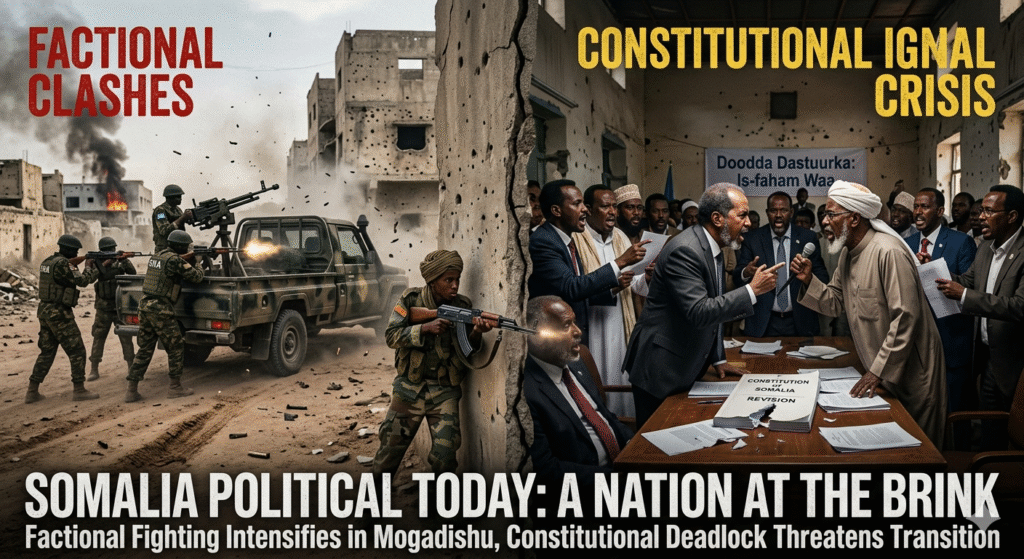
Just after midnight on June 3, the silence of Mogadishu’s Abdiaziz district was shattered by the crack of automatic weapons fire and the thump of mortar rounds. Within hours, heavily armed militias aligned with opposition leaders were exchanging fire with Somali National Army forces across multiple neighborhoods, turning residential streets into urban battlefields .
The violence marked the most dramatic escalation yet in a political crisis that has been building for months—one that now threatens to undo decades of fragile state-building. At its heart lies a fundamental dispute over presidential term limits, electoral reform, and the very nature of Somalia’s democracy. As President Hassan Sheikh Mohamud approaches the one-month mark of his controversially extended term, the country stands at a precipice .
Here is a comprehensive analysis of Somalia’s political crisis today.
Part 1: The Constitutional Amendment That Changed Everything
The current crisis traces directly to March 4, 2026, when Somalia’s bicameral Federal Parliament approved amendments to chapters five through 15 of the provisional constitution. The amendments covered federal relations, branches of government, public finance, security, and transitional provisions .
Crucially, the changes extended the terms of both the Federal Parliament and the Federal Government President from four to five years. The Speaker of the House of the People, Sheikh Adan Mohamed Nur, confirmed that the extension would apply to incumbent office holders—meaning President Mohamud’s mandate would continue for one year beyond its original expiry date of May 15, 2026 .
On March 8, President Mohamud signed these amendments into law, completing the constitutional review process. For the president and his supporters, this was a legitimate democratic reform, paving the way for a transition from clan-based indirect elections to a one-person, one-vote system. For his opponents, it was nothing less than a power grab .
Part 2: The Opposition’s Rejection
The amendments drew swift and forceful condemnation from opposition leaders. The Somali Future Council—an opposition coalition that includes the leaders of Puntland and Jubaland, former Presidents Sharif Sheikh Ahmed and Mohamed Abdullahi Farmaajo—criticized the changes for lacking political consensus .
Their argument rested on constitutional legitimacy. The 2012 Provisional Constitution, which has served as Somalia’s foundational legal document since the restoration of central government, established a four-year term for the presidency. The opposition maintains that fundamental constitutional changes require broader consultation and cannot be imposed unilaterally .
The stakes could not be higher. With his term having expired on May 15, the opposition declared it would no longer recognize Mohamud’s legitimacy. High-level talks facilitated by the United States and the United Kingdom, held in Mogadishu from May 13 to 15, ended in a stalemate with no resolution on the electoral model or the president’s mandate .
Part 3: The Battle for Mogadishu—June 3-4, 2026
The political deadlock exploded into violence on the night of June 3. Opposition leaders had called for peaceful demonstrations against the term extension, scheduled for June 4. As they moved into Mogadishu to participate, clashes erupted .
Fighting was reported across multiple districts: Howlwadaag, Abdiaziz, Wadajir, and Hodan. Residents reported sleepless nights, the sound of heavy machine guns and rocket-propelled grenades, and columns of smoke rising over the capital .
Former Prime Minister Hassan Ali Khaire, a prominent opposition figure, claimed government forces attacked his residence. “Mohamud has directed a sustained and indiscriminate military assault with the apparent objective of killing me,” he posted on X .
Former President Sharif Sheikh Ahmed, whose home near Lido Beach also came under fire, was equally defiant: “If the President and his soldiers think that we are afraid or that we will flee, we are not going to run away” .
The government framed its response differently, describing a “large-scale security operation” against “heavily armed militias who launched mortar attacks on some neighborhoods of the capital.” It accused opposition leaders of leading a coup attempt, though it provided no evidence .
By June 4, the fighting had subsided, mediated by clan elders. The casualty figures remain disputed, but AFP journalists reported civilian casualties, and the violence displaced thousands of residents from affected areas .
Part 4: The Federal Fragmentation—Three States Suspending Ties
The political crisis is not confined to Mogadishu; it reflects a deeper fragmentation of the Somali state. Three federal member states have now suspended relations with the central government .
Puntland and Jubaland were the first to break ties, citing the unconstitutional extension of the president’s mandate. Then, following the constitutional amendments, South-West state also suspended relations with Mogadishu, becoming the third federal member state to do so .
The dispute with South-West escalated dramatically. After the regional parliament re-elected President Abdiaziz Hassan Mohamed (Laftagareen) under the state’s constitutional framework, the federal government refused to recognize the result. Federal forces subsequently took control of Baidoa, the administrative capital of South-West state. Laftagareen resigned, and the federal government appointed Ahmed Mohamed Hussein, the state’s former finance minister, as interim president .
For a country still recovering from decades of civil war, the parallel governance structures are alarming. As one analysis noted, “Somalia has long shown signs of a fracturing state. The breakaway region of Somaliland declared its independence in 1991. In recent years, two states—Puntland and Jubaland—have started to operate independently from Mogadishu” .
Part 5: The Electoral Debate—One Person, One Vote vs. Clan Consensus
At the core of the political dispute is a fundamental disagreement about how Somalis should choose their leaders .
President Mohamud advocates for a transition to universal suffrage—a one-person, one-vote system that would replace the indirect clan-based model. Somalia has not held a direct national election since a 1969 coup, followed by decades of military rule and civil war. Since a central state was reestablished in 2012, leaders have been elected through a system where clan elders choose the parliament, which then selects the president .
Critics of the clan-based system argue it is corrupt and exclusionary. “This system is too dirty and keeps people out,” one lawmaker, Mohamed Ibrahim Moalimuu, told Al Jazeera. He added that parliamentary seats could be bought for anywhere from $100,000 to $1.3 million .
Opposition leaders reject the move toward direct voting as illegal and argue it is a pretext to entrench the president’s power. They also point to practical obstacles: militant group Al-Shabaab controls significant portions of the country, making nationwide universal suffrage logistically impossible .
The irony is that Mohamud now finds himself in a position similar to his predecessor. In 2021, former President Farmaajo extended his term by more than a year, arguing that it was necessary to change Somalia’s electoral system. He ultimately failed to achieve that change .
Part 6: International Intervention—Failed Talks and Urgent Pleas
The international community has watched Somalia’s drift toward crisis with growing alarm. On June 1, a coalition of 15 countries—including the United Kingdom, France, Germany, Italy, and Sweden—along with the European Union and the United Nations Transitional Assistance Mission in Somalia, issued a joint statement calling for urgent dialogue .
“We call on all sides to resume dialogue as soon as possible and to swiftly reach a consensus on an election roadmap in the interest of the Somali people,” the statement read .
The international partners offered to assist in Somali-led talks if requested. But they were also clear about the consequences of failure: “In this delicate moment, we urge all Somali leaders to prioritise the national interest and refrain from any actions that may lead to an escalation of tensions” .
The Intergovernmental Authority on Development (IGAD) also weighed in, expressing “deep concern over reports of violence in Mogadishu” and calling on all parties to “exercise maximum restraint” .
Yet the high-level talks that concluded on May 15, the very date the president’s original term expired, ended without resolution. The diplomatic track remains stalled, and no new negotiations are scheduled .
Part 7: The Security Vacuum—Al-Shabaab’s Opportunity
Analysts warn that the political crisis carries grave security consequences. Every moment spent on factional fighting and constitutional disputes is a moment not spent fighting Al-Shabaab, the Al-Qaeda-affiliated militant group that controls large swaths of the countryside .
The diversion of attention and resources is already evident. Political disputes “distract from counterinsurgency efforts against al-Shabab,” security experts warn. And they draw resources away from a looming humanitarian catastrophe: more than 6 million Somalis face crisis levels of hunger amid severe drought and devastating foreign aid cuts .
The timing could hardly be worse. The African Union Support and Stabilization Mission in Somalia (AUSSOM) is already operating under funding constraints, and the UN Security Council is scheduled to hold a private meeting on Somalia this month to assess the situation .
Part 8: The Farmaajo Intervention—A New Dialogue Effort
In a potentially significant development, former President Mohamed Abdullahi Farmaajo announced on June 7 that he would lead a dialogue initiative to try to resolve the political deadlock .
Farmaajo, who himself extended his term amid similar controversy in 2021, may have unique credibility to bridge the divide. His intervention comes as both sides appear entrenched, and no other mediation efforts have gained traction.
Whether his initiative will succeed remains to be seen. The core disagreements—over the president’s mandate, the electoral model, and the legitimacy of the constitutional amendments—remain unresolved, and neither side has shown willingness to compromise.
Part 9: The Road Ahead—Fragile Stability or Further Fracture?
As June 13, 2026, draws to a close, Somalia’s political trajectory hangs in the balance. Several scenarios are possible:
Continued Stalemate: Neither side concedes, the political crisis continues, and the country drifts without a clear electoral roadmap or legitimate government. This scenario benefits no one except Al-Shabaab.
Renewed Dialogue: Farmaajo’s initiative or renewed international mediation brings the parties back to the table. A compromise emerges—perhaps a reduced extension, a shared transitional government, or a sequenced electoral process.
Further Fragmentation: More federal member states suspend relations with Mogadishu. Puntland and Jubaland move toward effective autonomy. Somaliland’s pursuit of recognition gains momentum, especially following Israel’s reported recognition in December 2025 .
The latter scenario is particularly concerning. President Mohamud recently described Israel’s recognition of Somaliland as “one of the darkest days in the history of Somalia,” but his government has limited ability to reverse it .
Conclusion
Somalia today is a nation caught between democratic aspiration and political fragmentation. President Mohamud’s goal of moving to universal suffrage is, on its face, a democratic advance. But his method—unilaterally extending his term through constitutional amendments opposed by key stakeholders—has undermined the legitimacy of that goal.
The opposition’s rejection of the extension is, on its face, a defense of constitutional order. But their willingness to mobilize armed militias in Mogadishu’s streets has risked the very stability they claim to protect.
As the UN, IGAD, and Somalia’s international partners have repeatedly stressed, the only path forward is dialogue. The alternative—continued stalemate, further fragmentation, and a resurgent Al-Shabaab—is a future no Somali wants.
The question now is whether Somalia’s political leaders can place the national interest above personal and factional ambitions. The signs are not encouraging. But as former President Farmaajo launches his dialogue initiative, and as international pressure mounts, there may still be a narrow window to pull the country back from the brink.
For the residents of Abdiaziz, who spent the night of June 3 huddled in their homes as gunfire echoed through the streets, the political crisis is not abstract. It is the sound of mortar rounds landing near their children’s bedrooms. It is the sight of armed forces deploying to their neighborhoods. It is the fear that the gains of the past decade—the tentative stability, the rebuilding of institutions, the return of normal life—could be lost in a matter of days .
The choices made in the coming weeks will determine whether those fears are realized—or whether Somalia finds a way forward.
