

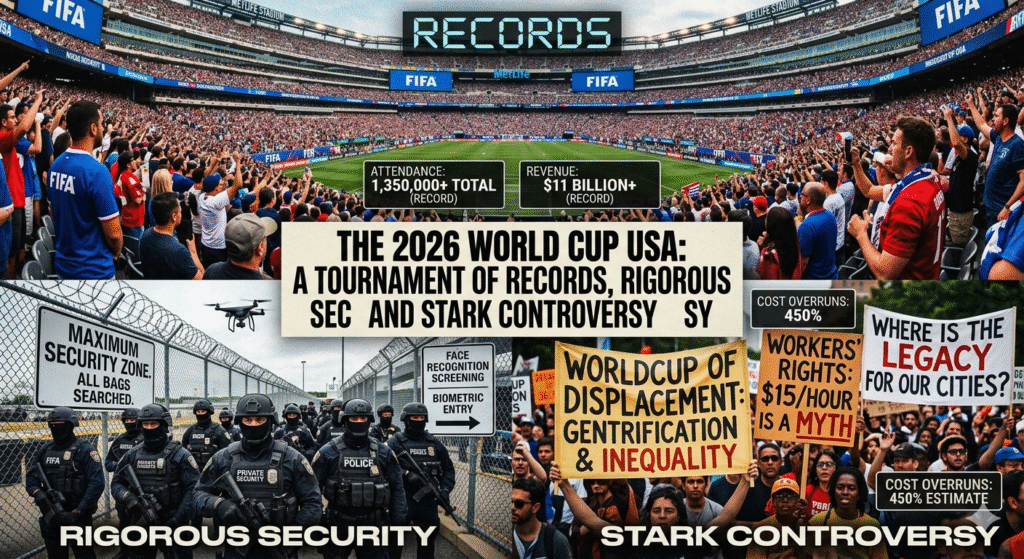
Here is a comprehensive look at the World Cup in the USA today.
The wait is finally over. As the sun sets on Thursday, June 11, 2026, the eyes of the sporting world will turn to the iconic Estadio Azteca in Mexico City for the opening ceremony of the FIFA World Cup 2026 . However, it is the United States that finds itself at the epicenter of what is being called the most logistically complex and controversial sporting event in history. From the sprawling mega-stadiums to the high-stakes political battles at border control, the 2026 World Cup is a story of breathtaking ambition colliding with harsh geopolitical realities.
Part 1: The Colossal Scale of a Three-Nation Tournament
The 2026 edition is not just another World Cup; it is a structural revolution in the sport. For the first time, the tournament is co-hosted by three nations—the United States, Canada, and Mexico—spanning 16 cities across the vast North American continent . The format has expanded dramatically from 32 to 48 teams, resulting in a packed schedule of 104 matches over 39 days .
The United States serves as the primary stage, with 11 host cities: Atlanta, Boston, Dallas, Houston, Kansas City, Los Angeles, Miami, New York/New Jersey, Philadelphia, Seattle, and the San Francisco Bay Area . The tournament will conclude with the final on July 19 at the MetLife Stadium in New York New Jersey . This is the first time the United States has hosted the tournament since 1994, and the scale is incomparably larger .
Part 2: The Staggering Economic Bet
If the stadiums are the engine, money is the fuel. FIFA estimates that the tournament could generate a staggering $17.2 billion in economic output for the United States alone . With an estimated 6.5 million total attendees expected, including millions of international visitors, the hospitality sector is projected to see a massive windfall .
While Dallas is projected to lead the revenue charts with an estimated $1.8 billion boost, Los Angeles is expected to welcome nearly 180,000 visitors specifically for the games at SoFi Stadium . However, a report by Allianz Research tempers the excitement, suggesting that while specific sectors—namely airlines and hotels—will see massive gains (with room rates jumping 15-20%), the overall macroeconomic boost to the US GDP might be a modest 0.1% quarterly growth once “crowding-out effects” are accounted for .
Part 3: Security: The Unprecedented Fortress
Homeland security is the dominant theme of this World Cup. Given the heightened global tensions and the “soft target” nature of sporting events, US authorities have launched the most complex security operation in football history .
Congress has allocated $625 million specifically for security enhancements to host cities, plus an additional $500 million to combat drone threats . Over 400 law enforcement agencies, federal bodies, and private firms are coordinating to protect stadiums, training camps, and the tens of thousands of hotel rooms . The White House has established a specific task force to ensure seamless coordination between federal, state, and local police forces . Beyond standard counter-terrorism measures, officials are also actively screening for health threats, including monitoring the ongoing Ebola outbreak in Central Africa to prevent any cross-border transmission to mass gatherings .
Part 4: The Controversy: Visas, Denials, and Detentions
While the infrastructure is ready, the doors to the United States have not swung open as widely as FIFA might have hoped. The Trump administration’s strict immigration policies have created a harsh spotlight on the tournament just as it kicks off.
The most high-profile incident involves Omar Artan, a Somali referee who was selected as an official for the World Cup—a historic first for his nation. Despite holding a valid visa, Artan was denied entry at a Florida airport and deported . Initially, the move was opaque, but a US official later told the BBC that Artan was denied due to “association with suspected members of terror organisations” . Artan, who was named Africa’s referee of the year in 2025, vehemently denies the claims, stating he knows nothing about the militant group Al Shabab .
The turbulence extended beyond officials. The Iraqi national team faced a nightmarish entry. While star striker Aymen Hussein endured a grueling seven-hour interrogation at customs, the team’s official photographer was detained for 10 hours and ultimately deported . Meanwhile, players from the Haitian team—a nation subject to specific travel bans—have struggled for weeks to secure the necessary paperwork to join their squad .
Iran’s participation has also been a diplomatic minefield. Amid ongoing hostilities between the nations, US officials insisted on strict vetting of the Iranian delegation to ensure no individuals linked to the Islamic Revolutionary Guard Corps (IRGC) entered the country, forcing Iran to alter its training plans .
Part 5: The Field of Play: USMNT in the “Group of Death”
Amidst the geopolitical drama, the football is finally ready to speak. For the US Men’s National Team (USMNT), the path to glory is arduous. Drawn into Group D, the Americans face a punishing schedule .
- USA vs. Paraguay (June 12, Los Angeles): The US opens against the physical, combative South American side. It is a high-pressure home opener .
- USA vs. Australia (June 19, Seattle): The pacey and organized Socceroos will test the US backline .
- USA vs. Türkiye (June 25, Los Angeles): Ranked 22nd in the world, the Turkish side will likely pose the most significant tactical threat in the group .
With the expanded format, the top two teams advance automatically, but the US will be desperate to secure early points to avoid the scramble for the “best third-place” spots in the knockout rounds . Other powerhouses are scattered across the bracket, with Argentina beginning their title defense against Algeria, England facing Croatia, and hosts Mexico kicking off the tournament against South Africa .
Part 6: The Final Verdict
The 2026 World Cup in the USA is a study in extremes. It promises the most spectacular football spectacle ever produced, with world-class infrastructure and billions in revenue. Yet, it is unfolding under the shadow of the strictest security cordon and the most controversial immigration vetting in the event’s modern history.
For the fans pouring into Los Angeles, Dallas, and New York, it will be a summer of celebration. For the officials and players who have been turned away at the tarmac, it is a summer of heartbreak and political friction. As the US prepares to showcase itself to the world, the world is discovering that entry is not guaranteed—even for the beautiful game.
