

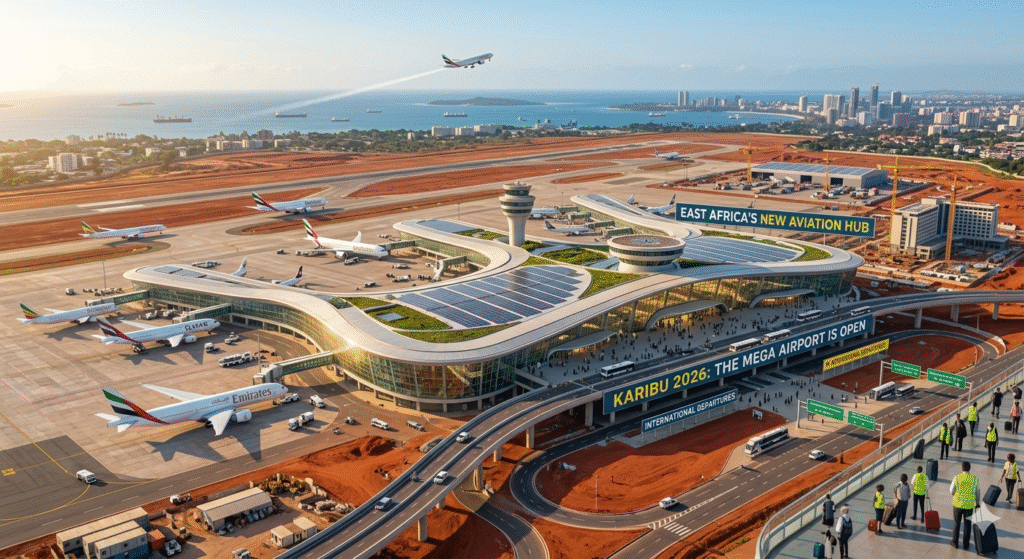
East Africa is in the midst of an unprecedented aviation boom. From Ethiopia’s plans for the continent’s largest airport to Kenya’s multi-billion-dollar expansion of its main hub, governments across the region are betting big on air infrastructure. These projects promise to transform travel, boost tourism, and reshape the economic landscape of one of Africa’s fastest-growing regions.
But critics are asking a pointed question: who will fill these terminals? As national airlines struggle with mounting losses and grounded fleets, the gap between infrastructure ambition and airline reality has never been wider.
Here is a comprehensive look at East Africa’s new airport projects shaping the region today.
Part 1: Ethiopia’s $125 Billion Bet — The Bishoftu Mega Airport
The most audacious aviation project in East Africa is unfolding just 40 kilometers southeast of Addis Ababa. In January 2026, Ethiopian Prime Minister Abiy Ahmed officially launched construction of Bishoftu International Airport — a facility designed to become the largest in Africa .
The numbers are staggering. The total investment is approximately $125 billion. Upon full completion, the airport will handle 110 million passengers annually — more than four times the capacity of Dubai International Airport’s current passenger volume. Phase one, scheduled for completion in four years, will accommodate 60 million passengers annually .
The scale of the project reflects Ethiopia’s ambition. The current main airport, Addis Ababa Bole International Airport, has a maximum capacity of just 25 million passengers annually. Bishoftu will represent a 340 percent increase in capacity .
Phase one alone includes:
- Two massive passenger terminals
- Two parallel runways
- A parking apron for 180 aircraft
- An on-site hotel
- A cargo terminal capable of handling 1.5 million tons annually
- An aircraft maintenance center
The project also includes significant transportation infrastructure: a modern highway connecting the new airport to Addis Ababa and a 38-kilometer high-speed railway linking the facility to the capital .
What makes Ethiopia’s bet different from its neighbors is the strength of its anchor airline. Ethiopian Airlines, consistently profitable and Africa’s largest carrier, provides the traffic that will fill those terminals. As one aviation analyst noted, only Bishoftu appears “economically justified, given the financial strength of the country’s anchor airline” .
Part 2: Kenya’s JKIA Transformation — From Overcrowded Gateway to Airport City
Kenya’s main aviation gateway, Jomo Kenyatta International Airport (JKIA) in Nairobi, is bursting at the seams. Designed to handle 7.5 million passengers annually, the airport now processes over 8 million — operating well above its intended capacity .
The response is a comprehensive expansion and modernization plan unveiled in March 2026 by Transport Cabinet Secretary Davis Chirchir .
The centerpiece is a new passenger terminal designed to accommodate an additional 10 million travelers annually, with room for future growth. The Kenya Airports Authority will upgrade the existing runway and add a partial parallel taxiway, two rapid-exit taxiways, and a runway-end exit — significantly improving aircraft efficiency at the single-runway airport .
Beyond the terminal and runway improvements, the plan includes:
- An Airport City — a mixed-use development featuring office buildings, hotels, conference centers, and commercial spaces
- An Export Processing Zone (EPZ) — targeting time-sensitive and export-oriented industries, attracting businesses in logistics, trade, manufacturing, and services
- Digitized passenger services — modernizing check-in, security screening, immigration, and baggage handling
- Upgraded road access — improving connectivity and easing traffic congestion around the airport
The transformation follows a controversial path. Kenya had previously awarded a $1.8 billion expansion contract to India’s Adani Group, but the deal was canceled following the indictment of Gautam Adani and senior officials for alleged corruption in the United States .
The government has since announced that construction of a completely new “world-class airport” will begin in 2026, though details remain scarce. President William Ruto has described the project as essential for supporting Kenya’s tourism sector and business community .
Part 3: The Security and Tech Upgrade — E-Gates at JKIA
While the mega-projects grab headlines, significant upgrades are already underway at JKIA. The government has allocated Sh2.8 billion (approximately $24 million) to install e-gates and an Advanced Passenger Information System (APIS) at the airport .
The system uses facial recognition technology and biometrics to automate passenger processing. Travelers will no longer need to wait in long queues for immigration stamps; the system will identify passengers electronically, enhancing both efficiency and security .
The project will later expand to Moi International Airport in Mombasa, then to all ports of entry across the country .
The Parliamentary Committee on National Administration and Internal Security has raised questions about the Sh700 million already spent on the project, demanding a detailed expenditure breakdown. Immigration Principal Secretary Dr. Belio Kipsang defended the spending, stating: “We are making critical progress at JKIA. The e-gates are already here and installation is ongoing” .
Part 4: Uganda’s Twin Approach — Entebbe Upgrade and Kabalega New Build
Uganda is pursuing a two-pronged airport strategy. The first component is the expansion of Entebbe International Airport, the country’s main gateway. The second is the construction of an entirely new facility: Kabalega International Airport in Hoima, in the country’s oil-rich western region .
Together, these projects will cost nearly $1 billion , largely financed through external debt .
Kabalega Airport is strategically located near Uganda’s emerging oil fields, reflecting the government’s vision of diversifying the economy beyond traditional sectors. The airport is designed to support oil and gas operations while also serving as an alternative international gateway.
However, the financial health of Uganda’s national carrier, Uganda Airlines, raises concerns. The airline has accumulated approximately $300 million in losses , with grounded aircraft straining operations despite continued government support .
Part 5: Tanzania’s Capital Connection — Msalato International Airport
Tanzania has borrowed approximately $329 million to build Msalato Airport near Dodoma, the country’s capital .
Once completed, Msalato will become Dodoma’s only international airport, joining Julius Nyerere International Airport in Dar es Salaam, Kilimanjaro International Airport, and the recently completed Arusha International Airport as Tanzania’s major aviation gateways .
The project follows a $314 million upgrade of Julius Nyerere International Airport, demonstrating the government’s commitment to aviation infrastructure.
Yet Tanzania faces the same challenge as its neighbors: its national carrier, Air Tanzania, has struggled financially, with losses rising 64 percent to $34 million in the year ending June 2024 .
Part 6: Rwanda’s Qatar-Led Partnership — Bugesera International Airport
Rwanda’s approach to airport development is unique: it has partnered with Qatar Airways , which will hold a 60 percent stake in the $2 billion Bugesera International Airport .
Bugesera, located south of Kigali, is expected to become Rwanda’s largest airport and a key regional hub. The partnership with Qatar Airways provides not only capital but also operational expertise and guaranteed traffic — the airline will have a strong incentive to route passengers through the facility.
RwandAir, the national carrier, continues to face capacity constraints, with four of its 14 aircraft currently grounded. Little is known about the airline’s financial position, but experts estimate it faces challenges similar to its regional peers .
Part 7: The Airline-Airport Paradox
Aviation experts have raised a fundamental concern about East Africa’s airport boom: airports do not create traffic—airlines do.
“Building a hub airport while the anchor airline is loss-making and strategically unsettled would invert cause and effect, and risk creating an expensive underutilised national asset,” said Dick Omondi, an aviation commentator and former head of marketing at Kenya Airways .
The argument is compelling. Delta Airlines made Hartsfield-Jackson Atlanta International Airport the world’s busiest not by building a massive terminal first, but by building a world-class airline over decades of disciplined network growth .
Yet the counter-argument is equally valid: airlines cannot thrive without functional airports. As Sean Mendis, former chief operations officer of Africa World Airlines, notes: “The reality is that neither side can build an [aviation] hub without the cooperation of the other. The airline drives the process while an airport facilitates it” .
Part 8: Regional Connectivity — New Routes Bridging Borders
While governments focus on mega-airports, private airlines are quietly improving regional connectivity. Safarilink Aviation launched a new daily service linking Nairobi, Kisumu, and Entebbe in early 2026 .
The route operates through Wilson Airport in Nairobi, Kisumu International Airport, and Entebbe International Airport, offering travelers seamless same-day connections across the three cities. Introductory fares have been set at $150 from Nairobi to Entebbe and $110 from Kisumu to Entebbe .
The new route is designed to cater to both business and leisure travelers, providing faster and more reliable alternatives to road travel while improving access between key economic and tourism hubs.
“This is not only about providing dependable and convenient travel options for our passengers, but also supporting tourism growth, commercial exchange and the long-standing social and economic ties across East Africa,” said Safarilik CEO Alex Avedi .
The route also strengthens onward connections: passengers arriving in Entebbe can connect through Nairobi to Kenya’s coastal destinations such as Diani, Lamu, and Malindi, as well as to Zanzibar .
Part 9: Tourism as the Driving Force
Behind every airport investment is the same driver: tourism. East Africa’s tourism industry, worth billions annually, depends on reliable air access. Visitors traveling to the Masai Mara, Serengeti, Zanzibar, and Rwanda’s mountain gorillas typically visit multiple countries in a single trip — making regional connectivity essential .
Kenya’s tourism sector remains a major economic driver, attracting visitors to destinations such as the Masai Mara, Amboseli National Park, Diani Beach, and Lamu . Tanzania’s northern circuit, featuring Serengeti, Ngorongoro, and Kilimanjaro, draws similar volumes. Rwanda’s gorilla trekking permits generate hundreds of millions annually.
Modern terminals, expanded runways, and improved passenger services are increasingly viewed as essential tools to compete with other global destinations. For travelers, these investments promise smoother arrivals, shorter transfer times, and better access to domestic and regional flights .
Part 10: The Funding Challenge
The scale of investment required is staggering. Ethiopia’s Bishoftu project alone carries a $125 billion price tag — more than the GDP of many African nations. Kenya’s JKIA transformation requires billions more. Uganda’s two airports approach $1 billion.
Governments are pursuing a mix of funding sources: external debt, public-private partnerships, and strategic partnerships with foreign carriers, as Rwanda has done with Qatar Airways .
The cancellation of the Adani deal in Kenya highlighted the risks of PPPs. Finding trustworthy partners with deep pockets and clean records remains a challenge. As one official noted, Kenya is “still seeking a contractor to upgrade the airport through a public-private partnership, describing the project as long overdue” .
Part 11: What Passengers Will Notice
For travelers flying through East Africa, the changes will be tangible:
Shorter queues: The e-gates at JKIA will automate immigration processing, reducing wait times dramatically .
Better connections: New routes like Safarilink’s Nairobi-Kisumu-Entebbe service will make multi-country itineraries easier .
More space: New terminals at JKIA, Bishoftu, and other airports will relieve overcrowding.
Modern amenities: Airport cities will offer hotels, conference centers, shopping, and dining .
Business opportunities: Export processing zones adjacent to airports will attract time-sensitive industries, creating jobs and economic activity .
Part 12: The Verdict — Boom or Bubble?
East Africa’s airport boom represents both opportunity and risk. The opportunity is clear: modern, efficient airports can attract tourism, facilitate trade, and position the region as a global aviation hub. The risk is equally clear: expensive, underutilized airports burdened by debt.
The success or failure of these projects will depend on whether the airlines catch up to the infrastructure. Ethiopian Airlines is already there — profitable, growing, and ready to fill Bishoftu’s terminals. Kenya Airways is struggling — returning to losses in 2025 after a brief profit rebound in 2024, with prolonged fleet groundings cutting capacity by 20 percent .
Uganda Airlines, Air Tanzania, and RwandAir face similar challenges. Their governments are investing billions in airports while their national carriers bleed millions.
As Omondi concludes: “Airports, by their nature, are passive. They do not create traffic. Airlines do. Without a stable anchor airline running banked schedules, high frequencies, and reliable connections, a new airport risks being a stranded asset – impressive, expensive, and underutilised” .
The next few years will determine whether East Africa’s aviation boom becomes a model for the continent — or a cautionary tale.