

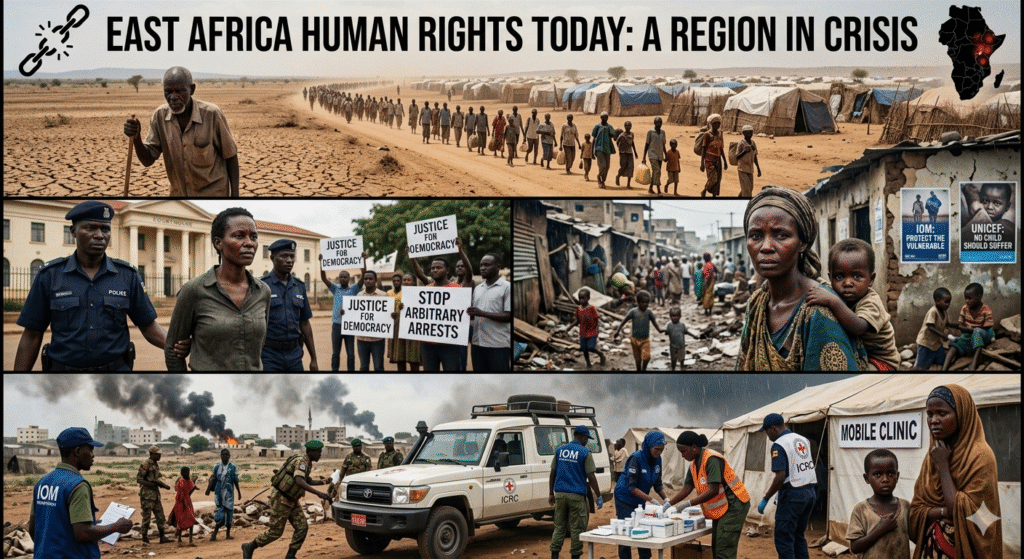
As the East African Court of Justice (EACJ) prepares to mark its 25th anniversary in November 2026, the fundamental rights it was established to protect are facing unprecedented challenges across the region . From the shores of Lake Victoria to the highlands of Ethiopia, a troubling pattern has emerged: political repression, enforced disappearances, digital censorship, and violent conflict are converging to create what human rights organizations are calling a regional emergency .
The past six months have witnessed deepening political repression, armed conflict, and a depressing state of civic space across the East and Horn of Africa. These cross-cutting issues reinforce one another, with civilians bearing the heaviest burden of violence, displacement, and governance failures .
Here is a comprehensive examination of East Africa’s human rights landscape today.
Part 1: The Abduction Crisis
Perhaps the most disturbing trend in the region is the normalization of enforced disappearances. A wave of abductions has swept across East Africa, targeting political opponents, activists, journalists, and even government officials’ family members.
In Kenya, a state-funded rights group has documented that at least 80 people have been abducted in the past six months . The disappearances began following anti-tax hike protests in June 2025 and have continued unabated. Most victims are eventually released following public pressure, but the psychological terror—and the message it sends about state power—remains.
The crisis hit close to the heart of government when Public Service Cabinet Secretary Justin Muturi publicly alleged that Kenya’s National Intelligence Agency was behind the abduction of his son, Leslie, on June 22, 2025 . In a detailed statement to police, Muturi recounted desperately calling the Inspector-General of Police, the Interior Minister, the DCI head, and intelligence officials—none of whom could help. It took a direct call from President William Ruto to secure his son’s release .
Even foreign nationals have not been safe. Prominent Tanzanian activist Maria Sarungi Tsehai was abducted by armed men in Nairobi in April 2026. The Law Society of Kenya eventually arranged her release, but the incident raised alarming questions about cross-border repression . Her organization, Change Tanzania, believes she was taken by Tanzanian security agents “operating beyond Tanzania borders to silence government legitimate criticism” .
Kenya has a history of enabling foreign governments to abduct individuals on its soil. Last year, Ugandan opposition leader Kizza Besigye was allegedly kidnapped in Nairobi by Ugandan security officials and taken across the border for trial by court martial. The Ugandan government said Kenya helped them; the Kenyan government denied it .
Part 2: Torture and the East African Court of Justice
On June 2, 2026, a human rights lawyer from Uganda and a journalist from Kenya jointly filed a petition before the East African Court of Justice seeking strong action against the Government of Tanzania . Their crime? They were both abducted and tortured in Tanzania, allegedly by police and government agents .
The petition asks the regional court to make punitive financial orders not only against Tanzania but also against the governments of Uganda and Kenya for failing to investigate and remedy violations committed against their own citizens. It also targets the East African Community CEO for failing to meet the demands of her office regarding the case .
The case represents a growing trend: citizens turning to regional judicial mechanisms when national systems fail to protect them.
Part 3: Legal Assault on Civil Society
Governments across East Africa have responded to instability and dissent with increasingly sophisticated legal restrictions on fundamental freedoms .
In Uganda, Parliament passed the Protection of Sovereignty Bill on May 5, 2026, threatening to severely limit foreign funding to civil society organizations . Just days before the January 2026 elections, Uganda’s National Bureau for NGOs suspended at least seven prominent human rights organizations .
In Kenya, the Computer Misuse and Cybercrimes Amendment Act of 2025 criminalizes online dissent . South Sudan’s Cybercrimes and Computer Misuse Act 2026 does the same. These legal tools, often justified on national security grounds, have created a climate of fear that stifles public participation and directly endangers those who dare to speak out .
Press freedom rankings for Djibouti, Eritrea, Ethiopia, Rwanda, and Sudan remain among the lowest globally due to the routine misuse of national security laws . In Somalia, the National Intelligence and Security Agency has been implicated in harassment, arrests, and intimidation of independent media .
Part 4: Elections as Instruments of Repression
Rather than strengthening democracy, electoral cycles across the sub-region have frequently entrenched authoritarian control .
Uganda’s January 2026 elections were marred by crackdowns on opposition figures, activists, and protesters, including treason charges against opposition leaders . Tanzania’s October 2025 post-election period saw similar repression. A Tanzanian Commission of Inquiry report, released in April 2026, acknowledged root causes of post-election violence as economic, political, and governance failures but largely exonerated authorities while blaming protesters, social media, and “external actors” for coordinating chaos .
Similar patterns are emerging ahead of elections in Burundi (2027), Ethiopia (June 2026), and South Sudan (December 2026), with documented harassment of opposition figures and politically motivated prosecutions .
Part 5: Gender-Based Violence and Femicide
On June 1, 2026, hundreds of protesters marched through Kenya’s capital, Nairobi, carrying an empty coffin and waving “End Femicide and Pedicide” placards . They brought the city center to a standstill, blocking a main street with a billboard bearing the names of more than 500 victims.
At least 69 women have been killed in Kenya since January 2026 alone, according to data compiled by data firm Odipo Dev and media outlet Africa Uncensored . The Kenyan government has also recorded 10,581 missing children over the past 16 months, including 1,952 abductions and 173 trafficking cases .
The worst year on record in Kenya was 2024, with an average of 14 women killed every month . Femicide is not recognized as a distinct crime under Kenyan law, a gap that activists say contributes to cases going undocumented and others “lagging in the judicial system” .
“It is traumatic, I don’t know if I am next,” activist Racheal Mwikali told AFP . Julie Ochieng displayed the obituary of her 28-year-old daughter, Kristabel Anyango, who she said was killed after trying to leave a toxic relationship. “If you are tired of them, just let them go. Stop killing women,” she pleaded .
FIDA Kenya, a women’s rights organization, says half its 70 weekly cases are linked to physical and sexual violence by partners .
Part 6: The Maasai Land Dispute
In Tanzania’s Arusha Region, 25 members of the Maasai community remain in detention after exercising their rights to freedom of expression and peaceful assembly .
On June 7, 2025, a security operation consisting of approximately 700 people—police, park rangers, military, and other security forces—arrived at Loliondo to implement government plans to seize 1,500 square kilometers of communal Maasai land . On June 9, soldiers used force to disperse community members who had gathered to protest the demarcation exercise, removing beacons marking the boundaries of land the Maasai lay claim to.
According to eyewitnesses, security forces started shooting at protesters with firearms and used teargas . Many sustained injuries, some bullet wounds. Before the day of the protest, around 20 Maasai community members were arbitrarily arrested—some as they were meeting to discuss the government’s plans.
The 25 detainees were falsely charged with the murder of a policeman, even though they were arrested before the policeman was killed . The statement of offense has since been amended four times, now listing conspiracy to murder with additional accused persons.
Amnesty International has called for the Tanzanian government to suspend the land seizure plans until the Maasai community has given their free, prior, and informed consent through meaningful consultation .
Part 7: Armed Conflict and Displacement
Prolonged and escalating conflicts remain the most acute driver of human suffering and regional instability .
In the Democratic Republic of Congo, armed groups continue to perpetrate killings, abductions, and attacks on civilians and humanitarian infrastructure. A drone strike in Goma on March 11, 2026, killed civilians and UNICEF humanitarian worker Karine Buisset .
In Sudan, ongoing fighting between the Sudanese Armed Forces and Rapid Support Forces has triggered mass displacement, extrajudicial killings, sexual violence, and deliberate civilian targeting, leaving millions in severe food insecurity . The UN Human Rights Council has condemned atrocities and extended the mandate of the Independent Fact-Finding Mission.
South Sudan saw January 2026 protests met with force, prompting the UN Commission on Human Rights to extend its mandate in March 2026 amid fears of renewed widespread conflict .
Spillover effects are evident across Ethiopia (violence in Amhara, Oromia, and Tigray regions) and Somalia . The Human Rights Watch World Report found that government forces in Ethiopia’s Amhara region committed widespread attacks against medical professionals, patients, and health facilities .
Part 8: Human Trafficking and Smuggling
East Africa remains a critical source, transit, and destination region for human trafficking and smuggling. A comprehensive review published in March 2026 examined the gender equality and social inclusion dimensions of these crimes across Ethiopia, Eritrea, Somalia, Sudan (as source countries), and Kenya (as a transit/destination country) .
The review found consistent evidence that women, girls, refugees, internally displaced persons, and diverse minority groups face greater risks in migration and are more vulnerable to trafficking .
The numbers are staggering. An estimated 6.3 million refugees are hosted across the East African region, placing enormous strain on host communities and creating conditions that traffickers exploit .
Part 9: Digital Rights and Online Censorship
The digital space—once celebrated as a democratizing force—has become a new battleground for human rights in East Africa.
Kenya’s Computer Misuse and Cybercrimes (Amendment) Act of 2025 and South Sudan’s Cybercrimes and Computer Misuse Act 2026 criminalize online dissent, giving authorities broad powers to arrest citizens for social media posts .
In a remarkable case highlighting the fragility of digital rights, lawyers from three East African states are seeking two related petitions over Uganda’s Chief of Defence Forces, General Muhoozi Kainerugaba, whose controversial social media posts they say “violate regional and international laws” .
The complainants—including lawyers from Uganda, Kenya Law Society’s Gloria Kimani, and Jebra Kambole from Tanzania Law Society—want the EAC Assembly of Heads of State and the East African Court of Justice to determine the legality of threats of use of force on foreign territory made via the general’s X account .
In October 2022, the general said he would “overrun” neighboring Kenya’s capital, Nairobi, causing a diplomatic spat that forced President Yoweri Museveni to apologize to Kenya .
Part 10: Human Rights Defenders Under Fire
Human rights defenders (HRDs) and journalists are operating under extreme risk across the region.
In the Democratic Republic of Congo, despite the existence of a national law protecting HRDs enacted in 2023, 45 human rights defenders lost their lives between 2023 and 2025 . As a positive development, AfricanDefenders/DefendDefenders facilitated the formal launch of a national HRD coalition on April 30, 2026, aimed at strengthening coordination and streamlining protection support for at-risk defenders .
Underpinning all violations across the region is a pervasive culture of impunity that allows abuses to recur with little, weak, or no accountability. Documented patterns of abductions, torture, extrajudicial killings, and excessive force against peaceful protesters have gone largely uninvestigated in Burundi, Ethiopia, Kenya, South Sudan, Sudan, Tanzania, and Uganda .
Part 11: The East African Court of Justice’s Role
Amid this grim landscape, the East African Court of Justice has emerged as a crucial—if limited—avenue for accountability.
On March 3, 2026, the UNHCR Representative to the African Union and UNECA paid an official visit to the EACJ to strengthen cooperation on refugee protection, access to justice, and regional judicial responses to forced displacement .
Discussions focused on enhancing cooperation to ensure protection-sensitive adjudication of refugee and asylum cases, improving access to justice for refugees and internally displaced persons, and reinforcing the role of regional courts in upholding human rights .
“Regional judicial institutions are vital partners in protecting the rights of refugees and advancing durable, rights-based solutions,” Mr. Hervé Kaute, the UNHCR representative, said .
Part 12: The Precedent-Setting Case Against Tanzania
On May 18-19, 2026, former Kenyan Chief Justice Willy Mutunga, Senior Counsel Martha Karua, and four other activists were detained without explanation at Julius Nyerere International Airport in Dar es Salaam, had their passports confiscated, and were subsequently deported back to Kenya .
Their crime? They were in Tanzania as part of an international observer mission to attend and monitor the treason trial of opposition leader Tundu Lissu .
The group has now filed a case at the East African Court of Justice against the Tanzanian government, demanding a public apology, general and special damages for mental anguish, reputational harm, and travel costs. They also seek the removal of “refused entry” notations from their passports and a court order restraining Tanzania from further infringements on the free movement of East African citizens .
The case argues that Tanzania violated multiple provisions of the EAC Treaty, including those guaranteeing the rule of law, good governance, transparency, and the right to free movement .
The outcome could set a major precedent for the enforcement of regional rights within the EAC .
Part 13: Looking Ahead—Recommendations for Change
Human rights organizations have issued urgent recommendations to address the crisis :
Democratic Principles: Ensure truthful electoral participation, end politically motivated prosecutions, and protect freedoms of peaceful assembly and expression during election periods.
Repeal Restrictive Laws: Cybercrimes and sovereignty legislation must be repealed or amended; administrative harassment of civil society must cease.
End Attacks on Defenders: Attacks and impunity for violations against human rights defenders and media must end, with full implementation of African Commission resolutions.
Accountability Mechanisms: Each African member state should have effective accountability mechanisms for violations, including excessive force, abductions, torture, and extrajudicial killings, with full justice and reparations for victims.
Fulfill Charter Commitments: All states parties must fulfill their commitments under the African Charter on Human and Peoples’ Rights by prioritizing the protection of human rights defenders and civil and political rights .
Conclusion
East Africa today stands at a crossroads between democratic aspiration and authoritarian retrenchment. The documented patterns of abductions, torture, extrajudicial killings, digital censorship, and electoral repression represent not isolated incidents but a coordinated assault on the fundamental rights guaranteed by the East African Community Treaty and the African Charter on Human and Peoples’ Rights.
The East African Court of Justice, as it marks 25 years of existence, has a crucial role to play in upholding the rule of law. Cases pending before it—from the torture of Ugandan and Kenyan citizens in Tanzania to the deportation of observers and the land rights of Maasai communities—will test whether regional judicial mechanisms can provide accountability when national systems fail.
Yet courts alone cannot protect human rights. As the Human Rights Watch report concluded, despite widespread abuses, African people are resisting and pushing back against autocratic rule—mobilizing on social media and in streets to demand an end to the abuses and bad governance that has contributed to divisions and conflict among communities .
The question is whether their demands will be heard—and answered—before the crisis deepens further.