

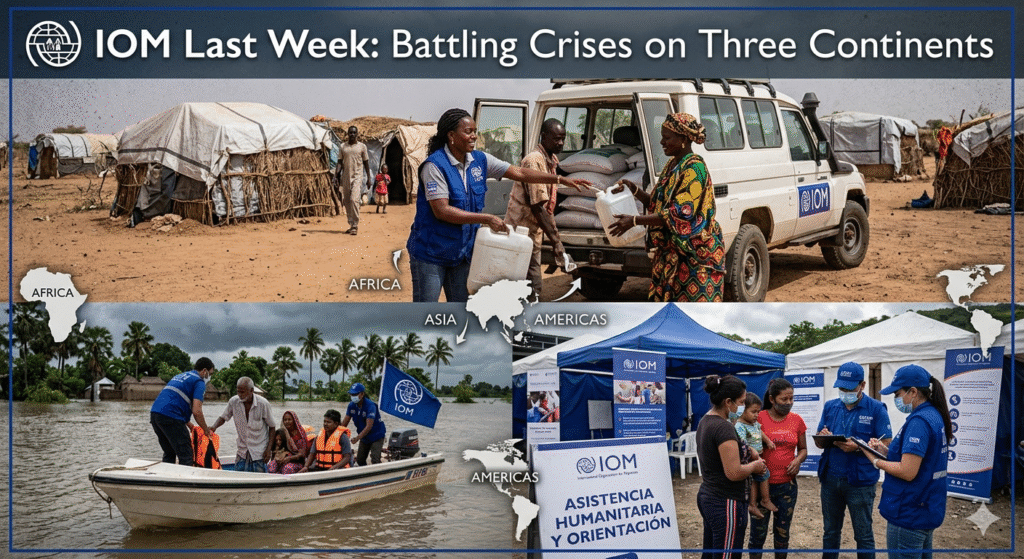
Over the past seven days, the International Organization for Migration (IOM) has been operating at maximum capacity across three continents, responding to simultaneous humanitarian emergencies that have displaced millions. From the record-breaking displacement crisis in Haiti to the war-driven evacuations from Iran and Lebanon, and the ongoing repatriation of stranded migrants from Libya, the UN migration agency has demonstrated both its global reach and its resource constraints.
Here is a comprehensive look at the IOM’s operations around the world last week.
Part 1: Haiti — A Record 1.5 Million Displaced
The most alarming development came on June 5, when the IOM released its latest Displacement Tracking Matrix report for Haiti. Nearly 1.5 million persons are currently displaced in the Caribbean nation — the highest figure ever recorded and a dramatic escalation of a crisis that shows no signs of abating .
More than half of the displaced are women and girls, reflecting a humanitarian catastrophe driven by escalating violence that continues to force families from their homes across both urban and rural areas .
“The displacement crisis is entering an even more alarming phase,” said Gregoire Goodstein, IOM Chief of Mission in Haiti . “The crisis is no longer confined to specific neighborhoods or regions. As violence spreads into areas once considered safe, more and more people are being forced to flee repeatedly, often with nowhere left to turn.”
The numbers tell a story of rapid deterioration. In May alone, renewed violence in the notorious Cité Soleil slum displaced more than 18,000 people within days, pushing the number of internally displaced persons in Port-au-Prince above 300,000 for the first time on record . Most fled to overcrowded spontaneous sites or sought safety with already vulnerable host communities.
Just weeks earlier, armed attacks in Haiti’s South-East Department displaced more than 5,000 people in a region previously considered a refuge for those escaping insecurity elsewhere in the country . This illustrates a worrying shift: communities that once offered safety are increasingly becoming displacement epicenters themselves.
The growing displacement crisis is being compounded by continued forced returns. Since the beginning of 2026, more than 110,000 Haitians have been forcibly returned to the country, including women, children, and other vulnerable groups . Upon return, many arrive with no resources and limited support, often to communities already struggling to absorb new arrivals or to areas affected by armed group activity.
Across displacement sites and host communities, people report critical shortages of shelter, food, clean water, healthcare, and psychosocial support . Children, pregnant women, persons with disabilities, and female-headed households remain among the most vulnerable. Overcrowded living conditions and limited access to services are increasing protection risks, including exploitation and abuse.
With the Atlantic hurricane season now underway, humanitarian concerns are mounting. Flooding and severe weather could further worsen already fragile living conditions, particularly in overcrowded displacement sites where many people lack adequate shelter and access to basic services .
Despite insecurity and challenging operating conditions, the IOM continues to deliver life-saving assistance in some of Haiti’s most affected areas, providing emergency shelter, healthcare, psychosocial support, water, sanitation and hygiene services, relief items, and site management assistance .
Part 2: Iran — Evacuating Migrants Caught in War
As the conflict between Israel, the United States, and Iran entered its fourth month, the IOM has been working to evacuate vulnerable migrants caught in the crossfire. On June 5, the agency confirmed that it is helping some migrants leave Iran and has received requests to assist hundreds more .
Migrants in Iran are highly vulnerable amid heavy bombardment and mass displacement, lacking the support structures relied on by Iranian nationals. David John, IOM’s director of resettlement and movement management, told reporters in Geneva that the agency “stands ready to support migrants and other third-country nationals caught in the crisis” .
“We have already assisted some migrants to return home from Iran,” John said. “The requests now are in the hundreds (and) the number is increasing by the day” . He warned that assistance requests from migrants’ home countries could soon be “in the thousands.”
The war, which erupted on February 28 with US-Israeli attacks on Iran, has cascaded throughout the region, drawn in global powers, and sparked a major oil shock . The UN refugee agency reported that as many as 3.2 million people have been displaced in Iran . Some were refugee families who were “particularly vulnerable, given their already precarious situation and limited support networks.”
Iran is the largest refugee-hosting country globally, with a large migrant population including millions of Afghans and hundreds of thousands of Iraqis . The IOM’s ability to assist these populations is severely constrained by funding shortages.
John stressed that the main barrier to evacuation assistance was “resources.” “We remain confident in our ability to facilitate the repatriation and evacuation of migrants, if we have the resources to do so,” he said. “These evacuation operations are costly” — he estimated that helping evacuate 200 people costs somewhere between $600,000 and $700,000 .
Salvador Gutierrez, the IOM’s chief of mission in Iran, confirmed that migrant workers have already figured among the civilian casualties, underscoring “the urgency of providing safe and organised repatriation options” .
The IOM has also been approached by some embassies in Lebanon, which has been heavily impacted by the war, enquiring about help evacuating their nationals. Mathieu Luciano, IOM’s chief of mission in Lebanon, speaking from Beirut, noted that at this stage, assistance focuses on helping to “prepare for possibly evacuation, rather than direct requests yet for evacuations” .
The conflict has heavily impacted Lebanon, where authorities reported 687 people killed by Israeli attacks, while more than 800,000 people have been displaced. The IOM estimates that “at least 30,000 migrants are now displaced” out of the approximately 200,000 who live in Lebanon .
Part 3: Nigeria — Major Repatriation from Libya
In a major humanitarian operation on June 2, the IOM received 182 Nigerian migrants repatriated from Libya under its Assisted Voluntary Return and Reintegration (AVRR) programme .
The returnees arrived at the Murtala Muhammed International Airport in Lagos aboard a chartered Buraq Airline flight at approximately 8:15 p.m. . Most had been held in detention camps in Benghazi after embarking on perilous migration journeys in search of better opportunities.
The demographic breakdown of the returnees is striking: 108 adult females and 45 adult males, bringing the total number of adults to 153. The flight also conveyed 17 children (seven females and 10 males) as well as 12 infants (eight females and four males) . In total, there were 123 females and 59 males among the returnees.
Perhaps most concerning, two of the returnees were unaccompanied minors who returned without their parents or guardians — children who had been stranded alone in Libyan detention centers .
Ali Ibrahim, IOM Subhead in Lagos, described the harrowing reality many faced: “Many left in search of opportunity, but instead faced hardship, uncertainty and for some, exploitation” .
Upon arrival, returnees received immediate assistance including health screening, counselling, and reception support. Eligible beneficiaries will also have access to reintegration programmes designed to help them rebuild their lives, including skills acquisition training, small business grants, and psychosocial services .
The repatriation was carried out in collaboration with the Federal Government of Nigeria and with funding support from the European Union . According to the IOM, more than 65,700 Nigerians have been safely returned from various countries over the past decade, while over 52,200 have benefited from reintegration assistance .
Data provided by the agency revealed a sharp increase in irregular migration casualties, with 7,625 Nigerians voluntarily evacuated from North Africa between January and June 2026 alone . The IOM further disclosed that repatriation exercises have now been scaled up to weekly operations across major entry points, including Kano and Lagos, alongside daily commercial arrivals of rescued Nigerians through the Nnamdi Azikiwe International Airport in Abuja .
Part 4: Gaza — Escalation and Deterioration
The situation in Gaza has also demanded the IOM’s urgent attention. On June 6, the agency reported that “the Gaza Strip is witnessing an escalation and deterioration in the field situation,” noting that during Eid al-Adha, a displacement site in Khan Younis was targeted .
In a post on the X platform, the IOM added that “our partners continue to work on the front lines.” It noted that the Palestinian Housing Council provided 18 tents to families whose homes were destroyed through the IOM’s Common Supply Line program .
Medical sources in the Gaza Strip announced on June 5 that the death toll from the Israeli aggression had risen to 72,961 martyrs and 173,092 wounded since October 7, 2023 . The total number of martyrs since the ceasefire on October 11 has risen to 951, and the number of wounded to 2,984, while 782 bodies have been recovered .
On June 5, ten Palestinian civilians were killed in a massacre targeting tents of displaced people near the passport office in Gaza City .
Part 5: Myanmar — Strengthening Anti-Trafficking Cooperation
On June 6, Union Minister for Social Welfare, Relief and Resettlement Dr. Soe Win received a delegation led by Mr. Daihei Mochizuki, Chief of Mission of the IOM, at the ministry’s guest hall .
During the meeting, they exchanged views on the signing of a Memorandum of Understanding between the ministry and IOM, cooperation in anti-human trafficking prevention and rehabilitation activities, and visa arrangements and domestic travel permissions for foreign staff .
The meeting reflects the IOM’s ongoing work to strengthen institutional frameworks for protecting migrants and combating trafficking across Southeast Asia.
Looking Ahead: Resource Challenges
Across all these operations, a common thread emerges: the IOM is stretched thin. From the mass displacement in Haiti to the war evacuations in Iran and Lebanon, from the repatriation flights from Libya to the emergency response in Gaza, the agency is operating on a shoestring budget relative to the scale of need.
The warning from David John, IOM’s director of resettlement and movement management, about the cost of evacuation operations — $600,000 to $700,000 for just 200 people — underscores the financial constraints that limit the agency’s ability to respond .
As the IOM continues its work on the front lines of the world’s most pressing migration crises, the question remains whether international funding will match the growing humanitarian need. For the 1.5 million displaced in Haiti, the migrants trapped in war-torn Iran, the children detained in Libyan camps, and the families sheltering in tents in Gaza, the answer cannot come soon enough.