

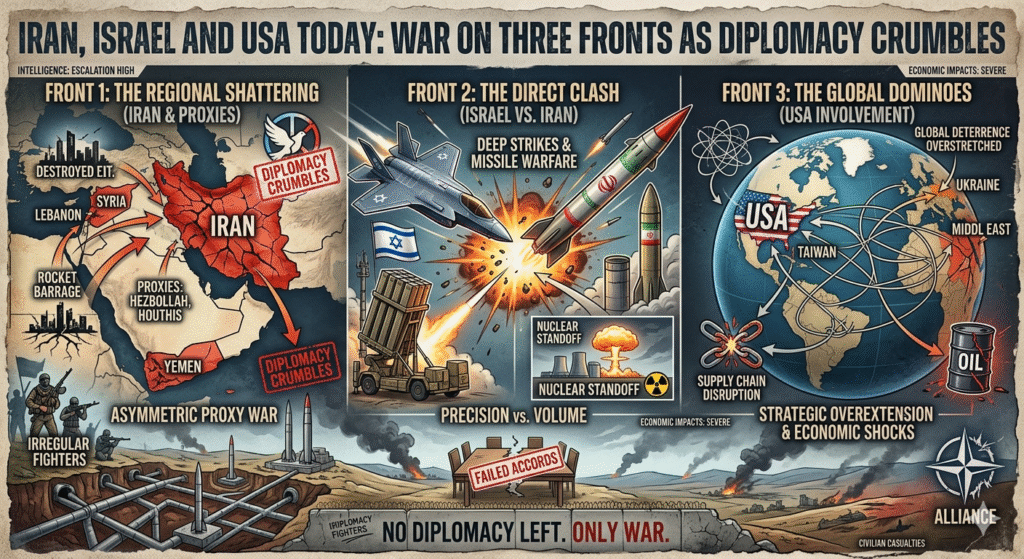
June 6, 2026 — Day 99 of the Conflict
On the 99th day of a war that has already reshaped the Middle East, the United States, Iran, and Israel remain locked in a triangular confrontation that shows no sign of resolution. Over the past 48 hours, American forces have struck Iranian radar installations, Iran has fired missiles toward Gulf Arab states, Hezbollah has rejected a US-brokered ceasefire, and diplomatic negotiations have ground to a complete halt.
This is not a conflict moving toward peace. It is a conflict settling into a grinding, multi-front stalemate—with the Strait of Hormuz as its strategic heart, Lebanon as its bleeding edge, and frozen Iranian assets as its diplomatic choke point.
Part 1: The Strait of Hormuz — A Shooting Gallery
The narrow waterway at the mouth of the Persian Gulf has become the central battlefield of the US-Iran conflict. On Friday, June 5, US forces shot down four Iranian one-way attack drones heading toward the strait, according to US Central Command .
In what it described as a “defensive action,” the US military responded by striking Iranian coastal surveillance radar sites in Goruk and on Qeshm Island, off Iran’s southern coast . These facilities were used by Iran to track maritime traffic in the strait—traffic that has been severely disrupted since Tehran closed the waterway to vessels affiliated with the United States and Israel on February 28 .
The escalation did not stop there. US Central Command reported that Iran fired seven ballistic missiles toward Kuwait and Bahrain on Friday. American forces intercepted six of the missiles; the seventh reportedly failed to hit its target . The Kuwaiti Army confirmed that a barrage of missiles and drones had been fired toward its territory .
Iran, for its part, claimed that its navy fired warning shots at US destroyers in the Gulf of Oman—a claim that US Central Command flatly denied. “Iranian forces did NOT attack or fire at U.S. Navy warships,” the command stated on X. “Doing so would be a gross violation of the ceasefire” .
Despite these military exchanges, the US has continued to shepherd commercial vessels through the strait. According to The New York Times, US forces helped coordinate the passage of more than 100 commercial vessels through the Strait of Hormuz in May . The majority of these ships reportedly switched off their transponders to avoid detection, underscoring the perilous nature of transit through the waterway.
Part 2: Diplomacy at a Standstill — Iran’s Three Demands
The military escalation is the backdrop against which diplomatic efforts have completely stalled. On Friday, Mohsen Rezaei, a senior military adviser to Iran’s Supreme Leader Mojtaba Khamenei, delivered a stark assessment in an exclusive CNN interview from Tehran.
“The negotiations are at a deadlock, and Trump must break this deadlock,” Rezaei said .
Rezaei laid out three specific demands that Iran says must be met before any progress can be made:
First, Trump must make decisions “independently of Israel”—a clear signal that Tehran views Washington’s closest ally as a obstacle to any deal .
Second, the United States must stop its naval blockade in the Strait of Hormuz. Washington has maintained a blockade of Iranian vessels and ports despite announcing an extension of the ceasefire in April—a move Rezaei called “a betrayal of diplomacy” and “a declaration of war” .
Third, and most critically, the United States must release billions of dollars in frozen Iranian assets. Multiple reports place the figure at approximately $24 billion . Rezaei described the release of these assets as “a test that America must pass, and the path will be opened” .
Iranian officials have reportedly linked progress on any interim agreement to the immediate release of 50 percent of these frozen funds as proof of US commitment . Washington has been reluctant to give up what it views as a key source of leverage in the negotiations .
Part 3: Trump’s Open Hand — and Iran’s Closed Fist
President Donald Trump has offered a dramatically different assessment of the diplomatic landscape. On Thursday, Trump told reporters at the White House that he would be open to meeting with Supreme Leader Mojtaba Khamenei if the two sides reach a peace deal .
“I don’t want to meet, but if I did, I would be honored to meet him,” Trump said, adding that Khamenei was “probably a professional” who, in some circles, “has a very good reputation actually” .
The president also claimed that breakthroughs could be on the horizon, telling Fox News that his “red line” for restarting the war would be if US troops were killed . When pressed on why Iran was not more inclined to reach a deal, Trump told NBC News that Iranian leaders are “strong” and “proud.”
“They’re strong, they’re proud, there are things they never thought they’d be doing that they’re going to have to do. They’ve got no choice, and it takes a little while,” Trump said .
But Rezaei flatly rejected the prospect of any meeting between Trump and Khamenei. “This will not happen,” he told CNN. “Right now, we are in the first stage of negotiations, and Mr. Trump has brought the negotiations to a standstill” .
The gap between the two sides could not be wider. Trump sees a deal within reach; Iran sees a negotiating partner that has repeatedly violated ceasefire commitments. According to Rezaei, there have been three betrayals: the first during the 12-day war in June 2025, the second during the “Ramadan war” this year, and the third—and most brazen—when the US imposed a naval blockade one day before a two-week ceasefire was set to expire .
Part 4: Lebanon — The Deal-Breaker
Complicating any US-Iran agreement is the war in Lebanon, where Iran’s most powerful proxy—Hezbollah—continues to fight Israeli forces despite a US-brokered ceasefire proposal.
Iran has made a ceasefire between Israel and Hezbollah a condition for any peace deal with Washington . As Iranian Foreign Minister Abbas Araghchi told Lebanese TV station Al Mayadeen on Thursday: “This war will end only when it ends in Lebanon as well. The end of the war on Lebanon must be accompanied by the withdrawal of Israeli forces from the territories they have occupied” .
But Hezbollah has rejected the US-brokered pact between Israel and the Lebanese government, arguing that the deal does not provide for an Israeli withdrawal from southern Lebanon and that Hezbollah itself was not party to the negotiations .
Hezbollah Secretary-General Naim Qassem was blunt in his rejection. “Demanding that we adhere to an agreement that calls for the withdrawal of our armed forces is a shameless act that signifies surrender, defeat, and the fulfillment of the enemy’s objectives,” he said .
On Friday, Hezbollah carried out two attacks on Israeli troops in south Lebanon, including near the recently captured Beaufort Castle—a strategic hilltop fortress captured by Israeli forces during their recent offensive . Israel has continued its military operations in response, bombing towns across southern Lebanon and killing the head of Hezbollah’s engineering unit, Abed Harb, according to the Israel Defense Forces .
Part 5: The Human Toll
The numbers are staggering. According to the Lebanese Ministry of Public Health, at least 3,526 people have been killed and 10,733 wounded in Israeli attacks on Lebanon since the conflict escalated in early March . More than one million people have been displaced from their homes .
Residents of Gaza, northern Israel, and even Kuwait have also come under fire this week—despite US-arranged ceasefires that President Trump himself described as involving “shooting in a more moderate manner” rather than a total halt to hostilities .
The United Nations World Food Programme warned on Friday that the conflict is pushing millions of people closer to hunger due to rising fuel and transport costs .
Part 6: Lebanon’s President Rebukes Iran
In a remarkable development, Lebanon’s President Joseph Aoun publicly criticized Iran on Friday, accusing the Islamic Republic’s Revolutionary Guards of using Lebanon as a “bargaining chip” in negotiations with the United States.
“This is unacceptable,” Aoun told CNN .
Araghchi fired back on social media on Saturday: “Listening to President Aoun, one might think Iran has occupied one-fifth of Lebanese territory, turned one-quarter of the Lebanese people into refugees, and is bombing Lebanon daily” .
The exchange highlights growing friction between Tehran and Beirut even as Iran publicly declares its support for Hezbollah. “Hezbollah has made great sacrifices in the recent war and it is our ally,” Rezaei said. “Therefore, we support Hezbollah and remain firmly committed to our obligations toward it” .
Part 7: The Nuclear Question Lingers
Missing from much of the recent diplomatic discussion is Iran’s nuclear program—which Trump has repeatedly identified as his top priority. “The one guarantee that I have to have is that there will be no nuclear weapons,” Trump has said .
But Iranian officials have been clear that uranium enrichment is non-negotiable. Iranian parliament deputy speaker Hamid-Reza Haji Babaei said on Friday that Trump had failed to understand that Iran’s “most powerful atomic bomb” was the Strait of Hormuz—a pointed reminder that Tehran views its strategic position, not its nuclear capabilities, as its primary source of leverage .
Part 8: What Comes Next
As Day 99 of the conflict gives way to Day 100, several factors will determine the trajectory of the war.
The timeline: Israeli media has reported that the United States sent a message to Pakistan—one of the mediators—demanding a reply from Iran by the weekend and a signing ceremony in Geneva next week. It remains unclear what the consequences would be if Iran fails to abide by those terms .
Iran’s military capacity: President Trump acknowledged on Friday that Iran still retains roughly 21 to 22 percent of its missile arsenal—a significant capability despite months of US and Israeli strikes .
The regional front: Iran has warned that it would “drag the war” beyond the Persian Gulf if Washington resumes full-scale conflict . Rezaei cautioned Israel against following through on threats to resume strikes against Beirut, saying: “Today we again warn this sinister regime to leave Lebanon. They should know that Lebanon will be an inseparable part of any agreement and any ceasefire” .
The frozen assets: If Washington is unwilling to release Iranian funds, the diplomatic impasse will continue. If it does release them, Iran may be willing to move forward—but critics argue that doing so would reward Tehran’s aggression and fund its proxies across the region.
Conclusion
One hundred days into a war that began with US and Israeli strikes on Iranian soil, the Middle East is no closer to peace. The Strait of Hormuz remains a shooting gallery, Lebanon remains a proxy battlefield, and the diplomatic track remains frozen over disagreements about assets, alliances, and the role of Iran’s proxies.
Mohsen Rezaei put the choice before Washington in stark terms: the United States will either receive a “hard slap” or be forced to accept Tehran’s terms . President Trump, for his part, continues to project optimism that a deal is within reach.
For the more than 3,500 dead in Lebanon, the millions displaced across the region, and the global economy grappling with disrupted oil supplies and rising prices, the war grinds on. And on Day 99, there is no end in sight.