

JERUSALEM — June 2, 2026
The past 24 hours have delivered a whiplash of contradictions for the State of Israel. On one hand, U.S. President Donald Trump announced a ceasefire agreement with Hezbollah, claiming the fighting would stop “for ETERNITY.” On the other hand, Israeli air defense systems were scrambling at 1:35 AM to intercept projectiles fired from Lebanon, and Prime Minister Benjamin Netanyahu was publicly vowing that military operations would continue “according to plan.”
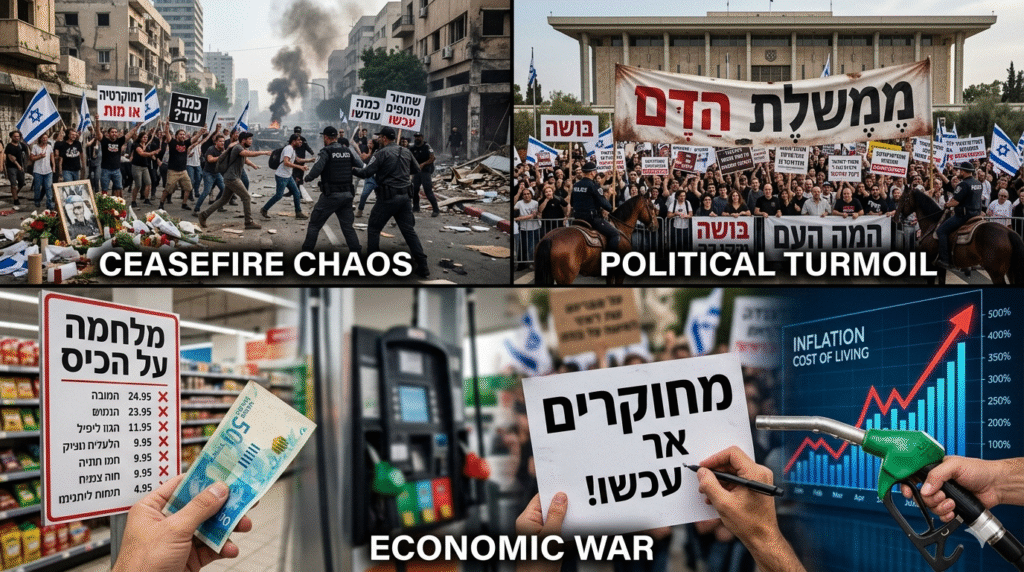
Welcome to Israel today—a nation caught between a superpower’s diplomatic pressure, a fragile and violated truce, a looming election that polls show Netanyahu is losing, a new Mossad chief taking office amid controversy, and an economy buckling under the weight of a multi-front war.
Here is the complete picture of Israel on June 2, 2026.
The Ceasefire That Wasn’t: Trump vs. Netanyahu
The day’s drama began with an explosive announcement from Washington. In a series of Truth Social posts late Monday, President Trump declared he had brokered a breakthrough .
“There will be no Troops going to Beirut, and any Troops that are on their way, have already been turned back,” Trump wrote. He went further, claiming direct engagement with the enemy: “Likewise, through highly placed Representatives, I had a very good call with Hezbollah, and they agreed that all shooting will stop — That Israel will not attack them, and they will not attack Israel” .
Trump’s message was unambiguous: the northern front was de-escalating, and he had personally secured the deal.
But within hours, Netanyahu’s office issued a sharp counter-statement. The Prime Minister acknowledged speaking with Trump but made clear that Israel’s hand had not been forced. “If Hezbollah does not cease attacking our towns and our citizens, Israel will strike terrorist targets in Beirut,” Netanyahu warned .
He emphasized that Israel’s policy regarding Hezbollah “had not changed” and that planned military operations in southern Lebanon would proceed regardless of Washington’s diplomatic overtures .
The contradiction could not have been starker. The American president claimed the war was winding down. The Israeli prime minister suggested it was just getting started.
Northern Skies Remain Active
If a ceasefire was supposed to be in effect, nobody told Hezbollah.
At 1:35 AM local time on Tuesday, air raid sirens blared across multiple communities in northern Israel. The Israeli military announced that its air defense forces had intercepted “two projectiles that crossed from Lebanon into Israeli territory” .
In a separate incident, the military identified “a suspicious aerial target” near the Lebanese border that later fell inside Israeli territory. Fortunately, no injuries were reported in either event .
The attacks represent the latest violations of what was supposed to be a stable truce. Israel and Hezbollah first agreed to a ceasefire in mid-April, brokered by the United States following the outbreak of hostilities on March 2, when Hezbollah fired rockets into Israel in support of Iran . But that agreement has been “repeatedly violated,” with intermittent exchanges of fire continuing for six weeks .
The situation on the ground remains volatile. Hezbollah has increasingly employed fiber-optic-guided drones against Israeli forces—technology that has already caused casualties among IDF soldiers and proven difficult to counter even for advanced air defense systems. These drones have primarily been used during daylight hours, but experts warn that if Hezbollah equips them with thermal cameras, they will be able to operate at night as well .
For residents of northern Israeli communities like Metula, Misgav Am, and Margaliot, life has become unbearable. According to local leaders, the ongoing threat of rockets, missiles, UAVs, and now explosive drones has transformed daily existence into a survival calculus .
The Beirut Strikes That Weren’t
One of the most revealing moments of the crisis came when Israel reportedly prepared to escalate dramatically—only to be pulled back by Washington.
According to reports, Israeli leadership had made a decision on June 1 to launch airstrikes on Beirut’s southern suburbs, a Hezbollah stronghold. The strikes were “emergency called off” following direct intervention from President Trump, who explicitly opposed any escalation of the Lebanon conflict .
The episode has ignited a firestorm of criticism inside Israel. Political opponents have seized on the incident as evidence that Netanyahu has lost control of the country’s sovereign military decision-making .
Naftali Bennett, a right-wing security hawk and former prime minister who is expected to challenge Netanyahu in upcoming elections, delivered a scathing assessment: “The location is different, the story is the same. A government that has lost control of Israeli sovereignty” .
Centrist opposition leader Yair Lapid went further, posting a sarcastic one-word verdict on X: “A full protectorate”—accusing Netanyahu of allowing the United States to dictate Israeli military policy as if the Jewish state were an American client territory .
Even Gadi Eisenkot, a former IDF chief of staff now running for prime minister, called Trump’s intervention “unreasonable” and said, “There has never been an Israeli prime minister who accepted such a humiliating demand” .
The English-language Jerusalem Post editorialized that Israel had “found itself in the humiliating position of having to seek American approval to defend its own citizens” .
UN Security Council Emergency Session
The international community is also weighing in heavily against Israel’s operations. An emergency session of the United Nations Security Council was convened on Monday, where multiple nations condemned Israeli military actions in Lebanon .
Lebanon’s representative to the UN, Ahmad Arafa, told the council that Israel, through “widespread destruction of infrastructure and residential homes in southern Lebanon, has caused extensive suffering, fear, and harm to Lebanese civilians” .
China’s ambassador, Fu Cong, expressed concern over “escalating tensions” and called for “the complete withdrawal of Israeli forces from southern Lebanon.” Russia’s ambassador, Vassily Nebenzia, went further, describing the situation as a “Gaza scenario” unfolding in Lebanon. He alleged that the April 17 ceasefire brokered by Washington had “become a cover for Israeli aggressive actions against Lebanon” .
France also joined the criticism, with its representative stating that “nothing can justify the continuation and expansion of Israeli military operations in Lebanon, which have led to thousands of civilian casualties, widespread displacement, and deeper occupation of Lebanese territory” .
The diplomatic isolation is significant. Even as the United States backs Israel diplomatically, the chorus of international condemnation is growing louder.
New Mossad Chief Takes Over
Amid the chaos on the northern front, a significant leadership transition occurred inside Israel’s intelligence community.
The High Court of Justice on Monday approved the appointment of Roman Gofman, Prime Minister Netanyahu’s military secretary, as the next head of the Mossad intelligence agency. Gofman will serve a five-year term, taking over from outgoing director David Barnea on Tuesday .
The appointment was not without controversy. The court had to reject two petitions challenging Gofman’s suitability, both related to the so-called “Elmakias affair.” The case involved the recruitment of Uri Elmakias, then a minor who operated social media news channels covering Arab countries. Elmakias was arrested in May 2022 and charged with serious security offenses related to obtaining and publishing classified military information. The charges were later dropped after more than a year and a half of house arrest .
The petitions alleged that Gofman, who commanded one of the units involved, had “abandoned the minor after his recruitment and denied knowledge of the operation following his arrest.” Even Israel’s attorney general, Gali Baharav-Miara, urged the court to overturn the appointment, citing “integrity concerns” .
However, a majority of the court ruled that the case did not reveal “any integrity flaw that would disqualify Gofman,” finding no evidence of deliberate wrongdoing or ethical breach .
The transition comes at a critical time. The Mossad has been central to Israel’s intelligence efforts against Iran, Hezbollah, and Hamas. Gofman inherits an agency operating in an environment of unprecedented multi-front threats.
The Economic Toll: War Comes With a Price Tag
Beyond the battlefield and the diplomatic arena, the war is exacting a brutal toll on Israel’s economy.
On Monday, the Knesset passed the 2026 national budget by a narrow vote of 62 to 55. The total budget stands at 699 billion shekels (approximately $222 billion USD), with a fiscal deficit target of 4.9% of GDP .
The defense budget tells the story of the war. Military spending has been set at 143 billion shekels, representing an increase of more than 120% compared to pre-war levels in 2023. An additional 60 billion shekels has been allocated as a special reserve for war-related expenses, bringing the total supplementary defense budget to at least 380 billion shekels (about $124 billion)—approximately 2% of GDP .
Prime Minister Netanyahu acknowledged the staggering cost in a video statement: “This war is costing a tremendous amount. Therefore, we need a special budget, including tens of billions of shekels to strengthen defense spending” .
The economic outlook has darkened considerably. Before the outbreak of the Iran conflict in late February, the Bank of Israel had projected economic growth of 5.2% for 2026. That forecast has now been slashed. Some economists predict growth as low as 3% if the war continues through the end of the month .
Fitch Ratings has maintained Israel’s sovereign credit rating at ‘A’ but revised the outlook to negative. The agency expects the actual fiscal deficit to reach 5.7% of GDP this year, exceeding the government’s 4.9% target, primarily because military expenditures are likely to exceed official projections .
The war is also fueling inflation. Global oil prices surged more than 3% on Monday as Israel expanded its military operations in Lebanon . WTI crude rose to $90.05 per barrel, while Brent crude reached $93.46. These increases are filtering through to Israeli consumers, with analysts raising inflation forecasts for the coming year .
The Bank of Israel is expected to hold its benchmark interest rate at 4% when it meets this week—providing no relief to borrowers—as it balances the need to contain inflation against the need to support a war-strained economy .
The Political Earthquake: Elections on the Horizon
Perhaps most significantly for Netanyahu personally, the war is colliding with a political calendar that looks increasingly hostile.
The Knesset has already passed a preliminary reading of a bill to dissolve itself, setting the stage for early elections. Polls show Netanyahu trailing his challengers, with voters expressing fatigue after years of political instability and now a costly, multi-front war .
Critics both inside and outside his coalition have accused the prime minister of escalating the Lebanon conflict for political gain. Some analysts suggest that the recent military focus on capturing strategic positions in southern Lebanon—such as the symbolic Beaufort Ridge—is designed to create a “victory narrative” that Netanyahu can take to voters .
“There is a strong suspicion that Netanyahu is escalating the conflict to position himself as the defender of Israeli security ahead of the election,” one local media analysis noted. “He wants to go to the polls as a wartime leader, not as a prime minister who presided over the October 7 failures” .
But the political calculus is fraught with risk. If the northern front remains active and Israeli casualties mount, the “victory narrative” could quickly transform into an electoral disaster. And if Trump’s ceasefire ultimately holds—over Netanyahu’s objections—the prime minister will have to explain why he was overruled by Washington on a matter of national security.
Conclusion: A Nation at the Crossroads
Israel on June 2, 2026, is a nation standing at a crossroads.
On one path lies further escalation—deeper incursions into Lebanon, potential strikes on Beirut, and a widening conflict that could draw in Iran and its proxies across the region. This path offers the possibility of degrading Hezbollah’s capabilities once and for all, but at the cost of more Israeli casualties, greater economic damage, and deeper international isolation.
On the other path lies de-escalation—accepting the Trump-brokered framework, pulling back from the brink, and focusing on the diplomatic track. This path offers relief for northern residents, stability for the economy, and renewed international legitimacy. But it also carries the risk of allowing Hezbollah to regroup and leaving the northern threat unresolved.
The next 48 hours will be critical. Israeli warplanes remain in the air. Hezbollah’s drones remain on the border. And in Washington and Jerusalem, two leaders with very different visions for the endgame are struggling for control.
One thing is certain: for the residents of northern Israel, for the soldiers on the border, and for a nation watching its economy bleed and its politics fragment, the uncertainty is the hardest part. They wait for clarity that does not come, while the rockets and the diplomatic cables fly overhead.
