

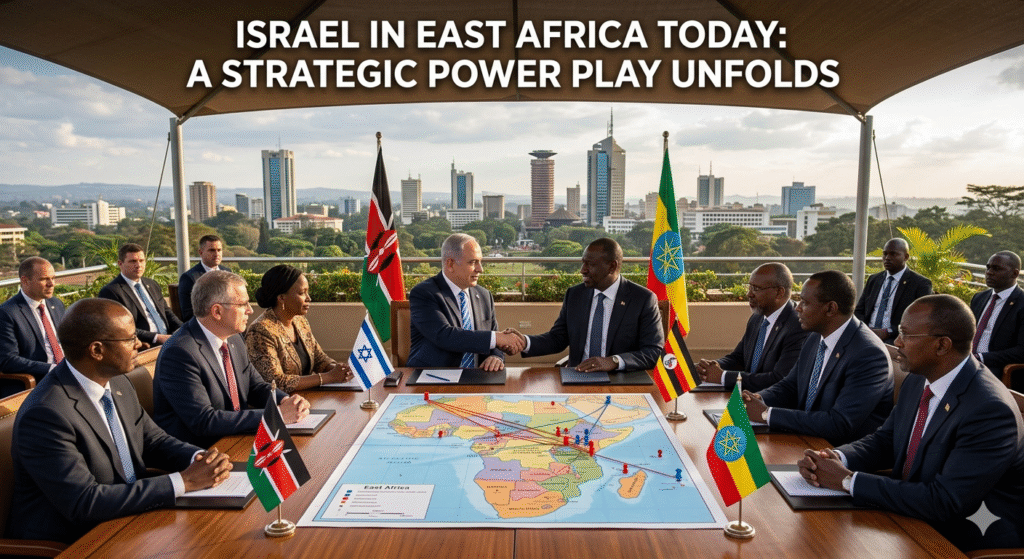
As the sun rises over the Red Sea on this last day of May 2026, a quiet but profound geopolitical transformation is taking shape across East Africa. From the highlands of Ethiopia to the shores of Somaliland, Israel is executing one of the most ambitious strategic pivots in its modern history. The Jewish state, having weathered a devastating war with Iran and its proxies, is now looking southward—not merely for diplomatic allies, but for a fundamental reconfiguration of its regional standing in a multipolar world.
What emerges from the past week’s events is a picture of calculated expansion: Israel is leveraging its technological prowess, its agricultural innovations, and its military intelligence capabilities to forge deep partnerships across the Horn of Africa. But this expansion comes with significant costs—diplomatic condemnation, regional tensions, and the revival of old rivalries that threaten to destabilize an already fragile part of the continent.
The Somaliland Gambit: A Diplomatic Earthquake
The most consequential development in recent months remains Israel’s historic decision, on December 26, 2025, to become the first nation in the world to formally recognize the self-declared Republic of Somaliland as a sovereign state . This move, which sent shockwaves through the Arab League and the African Union, is now bearing fruit.
Today, sources confirm that a comprehensive trade and investment agreement between Israel and Somaliland is expected imminently. Somaliland President Abdirahman Mohamed Abdullahi has been explicit about what his nation offers: “Somaliland is a very rich country in resources—minerals, oil, gas, marine, in agriculture, energy and other sectors. We have meat, we have fish, we have minerals, and [Israel needs] them. So trade can start from these main sectors… the sky is the limit” .
In return, Abdullahi has made clear that Somaliland seeks access to Israeli technology and, perhaps more significantly, military cooperation. The president has already accepted an invitation to visit Israel from Prime Minister Benjamin Netanyahu, and Israeli Foreign Minister Gideon Sa’ar made a landmark visit to Hargeisa on January 6, 2026 .
The strategic value of this relationship cannot be overstated. Somaliland sits astride the Gulf of Aden, controlling access to the Bab el-Mandeb Strait—one of the world’s most critical maritime chokepoints. Israeli investments in the Berbera Port have transformed it into a potential logistical hub for military operations in the region . For a nation that depends on Red Sea shipping lanes for its economic survival, this foothold is invaluable.
Yet the diplomatic fallout has been severe. Ahmed Aboul-Gheit, secretary-general of the League of Arab States, issued a blistering condemnation just last week, describing any rapprochement with Somaliland as “legally null and void and an unacceptable provocation to both the Arab and Islamic world.” The statement warned that such efforts aimed at expanding influence in the Horn of Africa “risk exacerbating tensions and instability in the region” .
Somalia, the internationally recognized government from which Somaliland broke away decades ago, has seen its diplomatic position severely weakened. With limited control over its own territory and facing a persistent insurgency from Al-Shabaab, Mogadishu is in no position to counter the Israel-U.S. strategic push effectively .
Ethiopia: The Start-Up Nation’s New Partner
While Somaliland grabs headlines, the quiet deepening of Israeli-Ethiopian relations may prove equally significant over the long term. This week, in an exclusive interview with The Jerusalem Post, Ethiopian Ambassador Tesfaye Yitayeh painted a picture of a relationship entering a new and more sophisticated phase .
“Our bilateral relationship is very good,” Yitayeh said, emphasizing that the ties stretch back thousands of years to the days of King Solomon and the Queen of Sheba. But the modern relationship, formalized in 1956, is now focused squarely on technology, investment, and innovation .
The agricultural cooperation between the two nations has become a model for development partnership. Through MASHAV, Israel’s international development agency, Israeli agronomists have trained hundreds of Ethiopian experts in drip irrigation, horticulture, and water management. The results are tangible: Ethiopia has become an exporter of avocados to the European market, a direct outcome of Israeli technical assistance .
But it is in technology where the most ambitious plans are unfolding. Ethiopia is explicitly looking to emulate Israel’s “Start-Up Nation” model as it builds its own artificial intelligence sector. The Ethiopian government has already established a national AI center and plans to open an AI-focused university within the next two years. “Israel is much advanced in using artificial intelligence,” Yitayeh acknowledged. “So Ethiopia again will learn a lot in this regard as well” .
Israeli technology companies are reportedly showing strong interest in Ethiopia’s digital economy, logistics sector, and even the cybersecurity infrastructure for a new major airport under construction southeast of Addis Ababa. The Holon Institute of Technology and the Ethiopian Science and Technology University, along with Ben-Gurion University and Addis Ababa University, have established partnerships involving joint research, academic exchanges, and scholarship programs .
Israeli Ambassador to Ethiopia Avram Nigusse reinforced this message earlier this month, telling Fana Media Corporation that Israel intends to further deepen investment and technology cooperation, particularly in cybersecurity, information technology, and modern medical infrastructure .
The Energy Dimension: Ethiopia’s Renaissance Dam
One of the most underappreciated dimensions of Israeli engagement with East Africa involves energy. The Grand Ethiopian Renaissance Dam (GERD), which Ethiopia formally inaugurated in late 2025, is already transforming the country’s energy landscape—and with it, the region’s geopolitical calculus.
The dam alone adds more than 5,000 megawatts of electricity annually, positioning Ethiopia as “the electric powerhouse in the Horn of Africa or East Africa,” according to Ambassador Yitayeh . Ethiopia has already begun exporting electricity to Kenya, Tanzania, Sudan, and Djibouti, with future supply plans extending to South Sudan and Somalia.
For Israel, a nation that has struggled with energy security and is seeking to reduce its dependence on volatile Middle Eastern suppliers, a stable, friendly electricity provider in the Horn of Africa is an attractive proposition. The cheap energy supply from the GERD is also attracting foreign manufacturers to Ethiopian industrial parks, creating economic linkages that could eventually draw Israeli companies into the country’s growing industrial sector.
The Rwanda Connection: A Celebration of Shared Resilience
Just three days ago, on May 28, 2026, the Kigali Convention Centre hosted a celebration of Israel’s 78th Independence Day that revealed much about the evolving partnership between the Jewish state and one of East Africa’s most dynamic economies .
Rwandan Foreign Minister Olivier Nduhungirehe, speaking at the event, drew explicit parallels between the two nations’ histories: “Both our peoples understand the painful consequences of hatred, extremism and genocide. Both nations have faced existential threats and emerged with determination, dignity and hope” .
The centerpiece of Rwanda-Israel cooperation is agriculture—specifically, the Rwanda-Israel Horticulture Centre of Excellence, which serves as a training hub for cutting-edge horticultural practices. Even more ambitious is the Gabiro Agribusiness Hub, a large-scale project set to transform more than 15,000 hectares in Rwanda’s Eastern Province into an integrated agricultural ecosystem .
But the partnership extends beyond farming. Israeli Ambassador Einat Weiss, speaking at the same event, emphasized plans to expand cooperation into emerging fields such as artificial intelligence, renewable energy, climate resilience, and smart agriculture. “The friendship between Israel and Rwanda is not merely diplomatic,” Weiss declared. “It is strategic, positioning the two nations as states of excellence in their respective regions. Our nations demonstrate to the world that even after profound tragedy, it is possible to rebuild, to innovate and to inspire” .
The Iranian Rivalry: A Proxy Battlefield
Israel’s push into East Africa cannot be understood in isolation from its broader regional competition with Iran. The two adversaries, fresh from a direct military confrontation in the Middle East, are now extending their rivalry into African soil .
Iran, recognizing the threat posed by Israel’s growing footprint, has accelerated its own outreach to the continent. In July 2023, then-President Ebrahim Raisi made a landmark visit to Kenya, Uganda, and Zimbabwe—the first official contact by an Iranian president with Africa in 11 years . Tehran is reportedly exploring the use of proxy actors, including Shiite groups in Nigeria and elsewhere, to counter Israeli influence.
Analysts warn that this competition could lead to a more militarized Africa policy from both sides. “The intensifying competition and security risks in Africa will disrupt investment and fund transfers to the region,” warns Huriye Yıldırım Çınar, writing for Daily Sabah. “The potential spillover of the Iran-Israel conflict into the Gulf states and their potential involvement in a regional war poses a significant risk to aid and investments from Gulf countries to Africa in recent years” .
For East African nations, this competition presents both opportunities and dangers. Countries like Ethiopia, Rwanda, and Kenya can leverage their positions to extract concessions from multiple suitors. But they also risk being drawn into conflicts not of their making.
The Ethiopian Jewish Bridge
One unique element of Israel’s East African strategy is the Ethiopian Jewish community in Israel. Numbering over 150,000, these citizens of Ethiopian origin maintain strong emotional, cultural, and family ties to their ancestral homeland. They are entitled to a special visa waiver—an Ethiopian Origin ID—that allows them to stay in Ethiopia beyond the usual three-month tourist limit .
This community serves as a living bridge between the two nations. Ambassador Yitayeh noted that many Israelis of Ethiopian origin regularly travel back to visit “the places where their ancestors were farming, were praying, where the graveyards are” . Tourism, the ambassador believes, still has enormous untapped potential, and discussions have begun regarding a possible full visa waiver agreement between the two countries.
The Arab League’s Condemnation
Not everyone is welcoming Israel’s expanding role in East Africa. The Arab League’s recent statement condemning Somaliland’s overtures to Israel reflects deep anxieties across the Arab world about Israeli encroachment into what has traditionally been viewed as a sphere of influence.
The League’s statement stressed that such efforts “constitute a flagrant assault on the unity, sovereignty and territorial integrity of Somalia and an unacceptable infringement on the sovereignty of a member state of the League of Arab States, the African Union, and the United Nations” .
Egypt, in particular, views Israel’s engagement with Ethiopia through the lens of its own concerns about Nile water security. While the two countries have maintained diplomatic relations for decades, Cairo remains wary of any external actor that might bolster Ethiopia’s position in the ongoing GERD negotiations.
The View from Turkey
Turkey, which has built a substantial presence in Somalia—including its largest overseas military base—views Israel’s moves with deep suspicion. The Ankara Declaration, brokered by Turkey to ease tensions between Ethiopia and Somalia, represented an effort to manage regional conflicts without external interference. Israel’s recognition of Somaliland, from Ankara’s perspective, undermines these efforts .
“Israel’s decision to recognize Somaliland, which was met with significant international condemnation, can be interpreted as part of this strategy” of limiting Turkish influence in the region, according to analysis . The increased frequency of Israeli official visits to Ethiopia—a country with which Turkey has developing relations—is seen as a direct challenge.
The Economic Impact of War
Despite the strategic gains, the recent war between Israel and Iran has imposed real costs on East African economies. Ambassador Yitayeh acknowledged that “the war has always played a very negative role in economic development and attracting investment” .
The price of fuel has skyrocketed, affecting not only investment flows but the daily lives of ordinary people. Fertilizer shortages, caused by supply chain disruptions, threaten agricultural production across a region already vulnerable to food insecurity. Ethiopian Airlines was forced to suspend flights to Israel for more than a month after Israeli airspace closures during the war, a significant blow to a key revenue source .
Looking Ahead: What the Rest of 2026 Holds
As 2026 progresses, several developments bear watching. The anticipated trade agreement between Israel and Somaliland will likely be finalized in the coming weeks, and President Abdullahi’s visit to Israel—though no date has been set—will mark a significant diplomatic milestone .
In Ethiopia, the establishment of the AI university and further academic exchanges with Israeli institutions are expected to proceed. The potential visa waiver agreement, if finalized, could significantly boost tourism and people-to-people contact .
Ethiopia’s quest for access to the sea—a long-standing strategic objective—may also intersect with Israeli interests. Some analysts suggest that Israel’s recognition of Somaliland could be linked to Ethiopia’s own aspirations for a Red Sea port, though this remains speculative .
Finally, the competition with Iran in East Africa is likely to intensify. As one analyst noted, “The region is likely to be a site of intense competition among foreign powers in an increasingly multipolar world. Its closeness to the Red Sea—an important artery of global trade—and its proximity to West Asia (the Middle East) are major static or constant factors” .
Conclusion: A High-Stakes Gambit
Israel’s engagement with East Africa today represents one of the most ambitious foreign policy initiatives in the nation’s history. It is driven by multiple imperatives: the need for new allies in a hostile region, the desire for economic partnerships that leverage Israeli technology, the strategic requirement for Red Sea access, and the competition with Iran for influence across the continent.
The early results are impressive. In Rwanda, agricultural transformation is underway. In Ethiopia, a tech partnership with vast potential is taking shape. In Somaliland, a strategic foothold on a critical waterway has been established.
But the costs are also apparent. The Arab League’s condemnation is not merely rhetorical—it reflects genuine anger and concern across the Muslim world. The competition with Iran threatens to introduce new conflicts into a region already plagued by instability. And the economic disruptions caused by the broader Middle Eastern war remind us that no engagement with Israel comes without geopolitical baggage.
For East African nations, the calculus is different: Israel offers technology, investment, and security cooperation that few other partners can match. In a multipolar world where the United States, China, Turkey, and the Gulf states are all vying for influence, Israeli engagement represents another option—another potential path to development and security.
Whether this grand strategic gambit succeeds or fails will depend on factors far beyond any single nation’s control: the trajectory of the Iran conflict, the stability of East African states, the reactions of regional powers like Egypt and Turkey, and the ability of Israelis and East Africans to translate diplomatic enthusiasm into lasting economic partnership.
For now, as the month of May 2026 draws to a close, the Israeli flag flies a little higher across the Horn of Africa. And in Jerusalem, Tel Aviv, and the corridors of power in Washington, officials are watching closely to see what comes next.
