

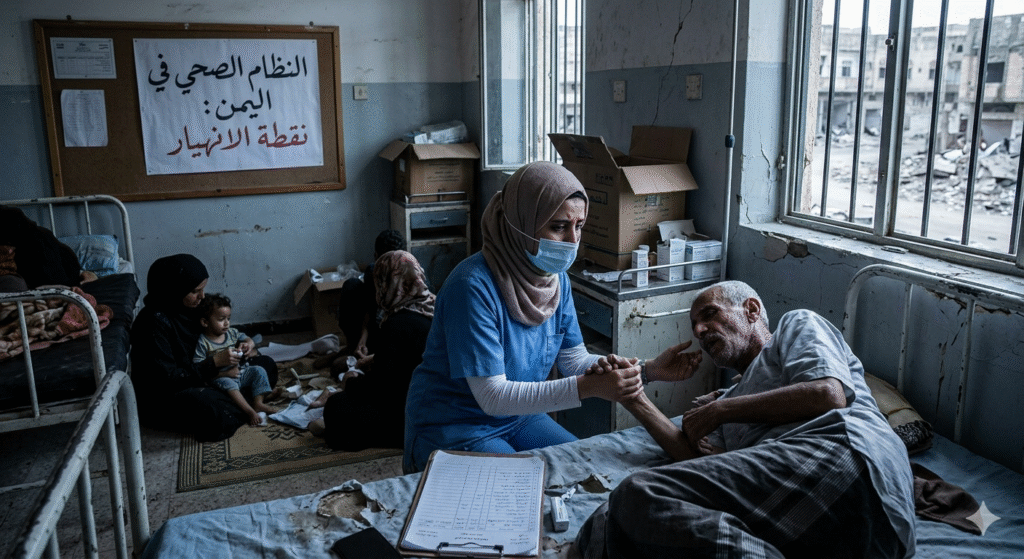
Introduction: A Nation Fighting for Survival on Two Fronts
As May 2026 draws to a close, Yemen remains one of the most severe humanitarian emergencies on Earth—a distinction it has held for far too long. After more than a decade of civil war, the country’s health infrastructure lies in ruins, its people are caught between the relentless advance of infectious diseases and the slow strangulation of a collapsed economy, and the international funding that once kept the system afloat is rapidly drying up. With reports that 184 people have died in a recent cholera outbreak spanning just three weeks, and hospitals forced to treat four patients in a single bed, the situation facing Yemen’s health system is nothing short of catastrophic. This article examines the state of health in Yemen today across five critical dimensions.
Part 1: A System in Ruins
The foundation of Yemen’s health crisis is structural collapse. According to the United Nations Office for the Coordination of Humanitarian Affairs (OCHA), an estimated 19.3 million people are in urgent need of healthcare. This staggering figure exists because the physical infrastructure simply is not there.
Official figures indicate that 40% of health facilities are either only partially functioning or completely out of service. Only 59.3% remain fully operational. This means that for millions of Yemenis, the nearest clinic might be hours away—or might have closed its doors entirely.
Dr. Syed Jaffar Hussain, WHO Representative in Yemen, delivered a blunt assessment in February: “Yemen’s health system is stretched to its limits. Without sustained and timely funding, preventable diseases will spread unchecked, health facilities will be forced to scale down services, and the most vulnerable communities will pay the highest price”. In May, those words proved prophetic.
Part 2: The Cholera Catastrophe
The most immediate and deadly manifestation of the health crisis is the resurgence of cholera. On May 17, the Houthi-run health ministry declared a state of emergency in the capital Sanaa, warning it was “unable to contain this disaster” and launching an appeal for urgent international assistance.
The numbers are terrifying. Between April 27 and May 17, at least 184 people died from the waterborne disease, with more than 11,000 suspected cases diagnosed across the country. This represents a dramatic escalation from just a week earlier, when the International Committee of the Red Cross (ICRC) had reported 115 deaths and 8,500 cases.
Hospitals are completely overwhelmed. Dominik Stillhart, ICRC director of operations, painted a harrowing picture: “There are up to four cholera patients in one single bed. There are people in the garden, and some even in their cars with the IV drip hanging from the window”.
The outbreak is not new to 2026. WHO data from the first quarter (January 1 to March 29) already recorded 3,177 suspected cases and three confirmed deaths, placing Yemen as the fifth most affected country globally for cholera, behind only the Democratic Republic of Congo, Afghanistan, Mozambique, and South Sudan.
The UN Humanitarian Coordinator in Yemen, Jamie McGoldrick, warned that “these numbers will increase in the weeks and months ahead”.
Part 3: Malnutrition and Maternal Mortality
Beyond the infectious disease outbreaks, Yemen faces a silent, grinding crisis of malnutrition. According to the latest Integrated Phase Classification (IPC) analysis, 18.3 million people are acutely food insecure—a number that has continued to deteriorate, with districts shifting from crisis to emergency levels.
The impact on children is catastrophic. Over 2.2 million children under five years of age are acutely malnourished, including 516,157 suffering from severe acute malnutrition (SAM) —the most dangerous form of hunger that requires urgent medical treatment. Without access to timely nutrition services, these children remain highly vulnerable to preventable and life-threatening infections.
An additional 1.3 million pregnant and breastfeeding women are also expected to be malnourished in 2026. Malnutrition in pregnant women increases the risk of pregnancy-related complications, poor birth outcomes, and infant health issues—perpetuating a cycle of poor health across generations.
The collapse of maternal health services compounds this tragedy. Approximately 662,000 pregnant women require life-saving reproductive health services, including 340,000 needing emergency obstetric care. With 40% of health facilities non-functional and skilled birth attendants in short supply, countless women are giving birth without access to emergency care.
Part 4: The Funding Collapse
The health system’s collapse is not just a result of war damage—it is increasingly a result of donor fatigue. Challenging operating conditions and funding cuts since 2025 have forced humanitarian organizations to scale back critical programs across the country.
The World Health Organization is appealing for US$38.8 million to deliver life-saving emergency health assistance to 10.5 million people in 2026. The United Nations Population Fund (UNFPA) requires US$71.9 million to deliver critical reproductive health services and gender-based violence prevention programs. As of March 2026, only US$9 million had been received—leaving an 87% funding gap.
Doctors Without Borders (MSF) has documented the real-world consequences. In parts of Hajjah and Al Hudaydah governorates, funding cuts have already forced health providers to halt activities or reduce services, leaving facilities understaffed and short of essential supplies.
As nearby facilities close, parents must travel longer distances to reach remaining hospitals. Often, their children’s condition has already become critical by the time they are finally able to reach a facility. Iris Gonzales, an MSF pediatrician in Abs, explained: “As funding for health care shrinks, access to early diagnosis and treatment becomes more limited, meaning many of these conditions could have been detected and treated before becoming severe”.
Part 5: The Human Toll
Behind the statistics are real people. MSF reports that in 2025, its teams at Abs General Hospital admitted more than 4,300 pediatric cases—a 20% increase from 2024. In both Abs General Hospital and Al Qanawis Mother and Child Hospital, there have been 5,138 neonatal admissions and 3,927 malnutrition cases.
The financial cost of seeking treatment has also increased. Families often need to pay for long-distance transport, fuel, or multiple connections to reach the nearest functioning facility. For some households, these expenses come in addition to other indirect costs: family members may have to lose a day’s income to accompany a patient.
One mother and caretaker named Jumaa told MSF: “To come to the hospital is not an easy thing. Let alone the expensive transportation cost which we cannot afford most of the time. The clinic nearby closed a while ago, and the remaining ones do offer services but they are too expensive for us”.
Conclusion: A Preventable Tragedy Unfolding
The health crisis in Yemen today is not inevitable. Cholera is preventable with clean water and sanitation. Malnutrition is treatable with adequate nutrition support. Maternal deaths are preventable with skilled birth attendance and emergency obstetric care. Yet prevention requires resources—resources that are not arriving in sufficient quantity or speed.
The WHO has warned: “Every delay in funding translates into lost opportunities to save lives”. With the cholera outbreak accelerating, with 184 dead in just three weeks, with hospitals treating four patients to a bed, and with funding gaps exceeding 80%, Yemen is watching a preventable tragedy unfold in real-time.
The international community faces a choice: fund the response and save lives, or watch as one of the worst humanitarian emergencies of our time grows even worse. For the 2.2 million malnourished children, the 184 cholera victims already lost this month, and the 19.3 million people without access to healthcare, the time for action was yesterday.
