

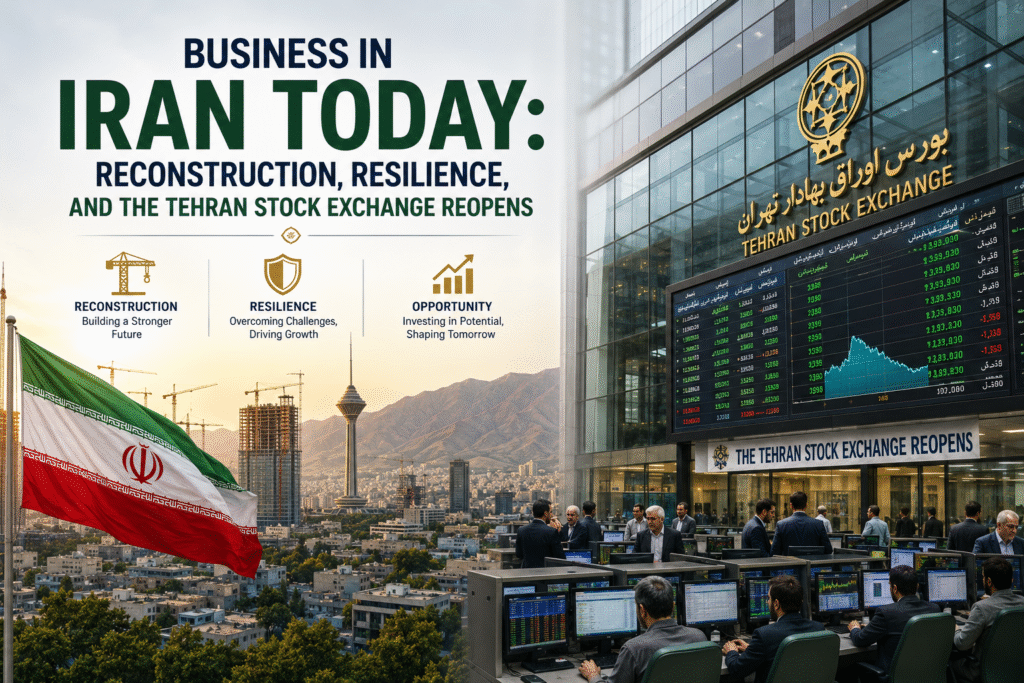
Introduction: A Fragile Peace and the Return to Commerce
As May 2026 draws to a close, Iran’s business landscape stands at a precarious but pivotal crossroads. After nearly three months of suspension, the Tehran Stock Exchange (TSE) has cautiously reopened its doors, signaling a tentative return to economic normalcy following a devastating 39-day war with the United States and Israel . While the guns have largely fallen silent, Iran now faces the monumental task of post-war reconstruction amidst a severe budget crunch, an inflation rate exceeding 70%, and a crippling US naval blockade .
However, amid the rubble of war-damaged infrastructure, there are distinct signs of strategic resilience. The government is actively courting foreign investment, unveiling new financial mechanisms to bypass sanctions, and domestic industrialists are being praised for keeping essential supply chains running . This article examines the state of business in Iran today, covering the stock market reopening, the oil blockade, new investment opportunities, and the high-stakes diplomatic negotiations that could shape the country’s economic future.
Part 1: The Tehran Stock Exchange Reawakens
After an 80-day war-imposed hiatus—one of the longest closures in recent history—the Tehran Stock Exchange (TEDPIX) resumed trading on May 19, 2026 . The reopening was heavily controlled to prevent a catastrophic sell-off. Authorities imposed a 3% daily fluctuation cap on most shares and temporarily barred market makers from placing sell orders to stabilize the market .
The initial results were cautiously positive. TEDPIX added approximately 44,000 points on the second day of reopening, closing the week above 3,758,000 . However, this represents a significant drop from the all-time high of nearly 4,500,000 seen at the start of 2026. Notably, 42 major companies—representing about 35-36% of the market’s total capitalization—remain suspended, including giants like Khuzestan Steel and Fajr Petrochemical, due to direct war damage .
Economist Mehdi Haghbaali noted that while the reopening went better than expected, the underlying reality is grim. With inflation eating away at the rial’s value and trade severely disrupted, the real price of shares has diminished .
Part 2: The Naval Blockade and the Oil Standoff
Perhaps the single most disruptive factor to Iran’s economy today is the US naval blockade in the Strait of Hormuz and the Sea of Oman. Iranian President Masoud Pezeshkian made a rare and direct admission on May 18, acknowledging that the country has “run into problems” exporting oil .
“They blocked the route and we are not exporting oil. We cannot export oil easily,” Pezeshkian stated, dismissing domestic claims that the nation had circumvented the restrictions .
Despite the blockade, the International Energy Agency (IEA) reports that Iran is still exporting approximately 1.4 million barrels per day (bpd) . This is a significant decrease from pre-war levels, but it highlights a shadow fleet of tankers continuing to evade detection. However, satellite imagery shows a massive traffic jam of supertankers unable to offload, with 23 vessels recently spotted clustered around Kharg Island—Iran’s main export terminal .
Part 3: Domestic Industry Holds the Line
Amid the geopolitical turbulence, Iran’s domestic industrial base has shown unexpected resilience. During the 23rd meeting of the Iran Chamber of Commerce (ICCIMA) held on May 17, Chamber head Samad Hassanzadeh praised local entrepreneurs for stepping up during the war .
“Entrepreneurs in the country, under these difficult circumstances, have shown up in all economic arenas, and despite the great damage caused to facilities and infrastructure, they have continued the production of essential goods and needed products without interruption,” Hassanzadeh stated .
The meeting specifically addressed the stability of critical industrial chains, including steel and petrochemicals. While these sectors have been hit hard—with several major players delisted from the stock exchange temporarily—the physical supply of goods within the country has not entirely collapsed. This resilience is buying the government time to negotiate better terms on the global stage.
Part 4: A New Push for Foreign Investment
Paradoxically, while facing a naval blockade, Iran is aggressively rolling out the red carpet for foreign capital. The Organization for Investment, Economic and Technical Assistance of Iran (OIETAI) has published a new list of investment opportunities to attract international investors .
In the first board meeting of the Iranian year (starting March 21, 2026), Tehran approved 35 foreign investment projects worth $126 million . These projects span diverse sectors, including renewable energy (specifically solar power plants), pharmaceuticals, maritime transport, and housing . The investors hail from a wide geographic range, including Russia, China, Pakistan, and even European countries like Spain.
To further sweeten the pot, the Ministry of Economic Affairs announced a policy shift to upgrade private sector bank guarantees to sovereign guarantees . This mechanism is designed to lower the perceived risk for foreign lenders, potentially opening up credit lines for major infrastructure projects despite ongoing international financial restrictions.
Part 5: Reconstruction Funding and the Role of the Rial
The war has destroyed critical energy and industrial infrastructure, necessitating a massive reconstruction effort. However, the government’s room to maneuver is limited by a severe budget deficit exacerbated by the blockade.
To manage the crisis, the rial has been allowed to float downward, making export-oriented companies (like cement and copper producers) more attractive on the stock exchange . However, this has crushed the purchasing power of ordinary citizens, with the inflation rate officially pegged above 70% as of late April .
Economists warn that while the reopening of the stock market restores investor confidence, the creation of “real value” depends on peace. Without a lifting of sanctions, exporters will continue to face operational difficulties, and rising inflation will erode any nominal stock market gains .
Part 6: The Nuclear and Sanctions Negotiations
The ultimate variable for Iranian business today is diplomacy. Reports are circulating of a new US proposal delivered via Pakistan, which reportedly includes significant financial concessions from Washington . According to journalist Alex Marquardt, the terms may include waivers on Iranian oil sales, the gradual unfreezing of assets, and a reconstruction fund for Iran .
Conversely, Iran has transmitted its own “red lines” back to the US. Tehran is demanding a complete removal of sanctions, the return of all frozen assets, the lifting of the naval blockade, and war reparations for damages incurred during the 39-day conflict .
For the business community, the difference between war and peace is the difference between a 3% daily trading limit on a struggling bourse and a potential surge in foreign direct investment. As the head of ICCIMA noted, the nation hopes that authorities act with “expert prudence” in negotiations to achieve “lasting peace” and economic stability .
Part 7: The Logistics Nightmare
Trade logistics remain the biggest headache for importers and exporters. With the Strait of Hormuz effectively closed to conventional commercial traffic, shipping costs have skyrocketed. Insurance premiums for vessels entering the Gulf have reached astronomical levels.
Official data suggests that OPEC’s total production fell by 9.57 million barrels per day during the two months of war, underscoring how the conflict has choked the entire region’s supply chains . For Iranian non-oil exporters—particularly in agriculture and textiles—getting goods to markets in Asia and Europe now requires complex, time-consuming transshipment routes that cut deeply into profit margins.
Part 8: The Reconstruction Opportunity
Despite the current tight credit conditions, the Iranian government sees a massive opportunity in post-war reconstruction. The approved $126 million in foreign investment is just the beginning.
The government is prioritizing the import of raw materials needed to rebuild damaged infrastructure. However, this creates a delicate balancing act: the need to import building materials fuels demand for foreign currency, which puts further pressure on the rial, fueling the very inflation the government is trying to curb .
For savvy investors willing to navigate the complex regulatory environment—potentially using the new sovereign guarantee framework—Iran today offers a distressed market with the potential for massive post-peace returns. The pharmaceutical and food production sectors, which are largely insulated from direct war damage and serve the domestic market, have already seen a bounce in their stock valuations .
Conclusion: A Breather Before the Storm or the Dawn of Recovery?
Business in Iran today is a study in contrasts. On the trading floor of the Tehran Stock Exchange, there is relief and a marginal green ticker. In the boardrooms of the Chamber of Commerce, there is praise for industrial resilience. And in the corridors of power, there is a flurry of diplomatic activity aimed at unlocking frozen assets and lifting the blockade.
Yet, the hard numbers do not lie: inflation is rampant, the rial is weak, and a third of the stock market remains closed for repairs. Iran is currently operating in a “controlled environment,” where the state has stepped in to prevent market collapse. The true test for Iranian business will come in the next 30 days. If the naval blockade is lifted and sanctions relief is tangible, Iran could see one of the fastest economic rebounds in recent history. If negotiations stall, the fragile reopening of the stock market may be remembered only as a brief respite in a longer economic winter.