

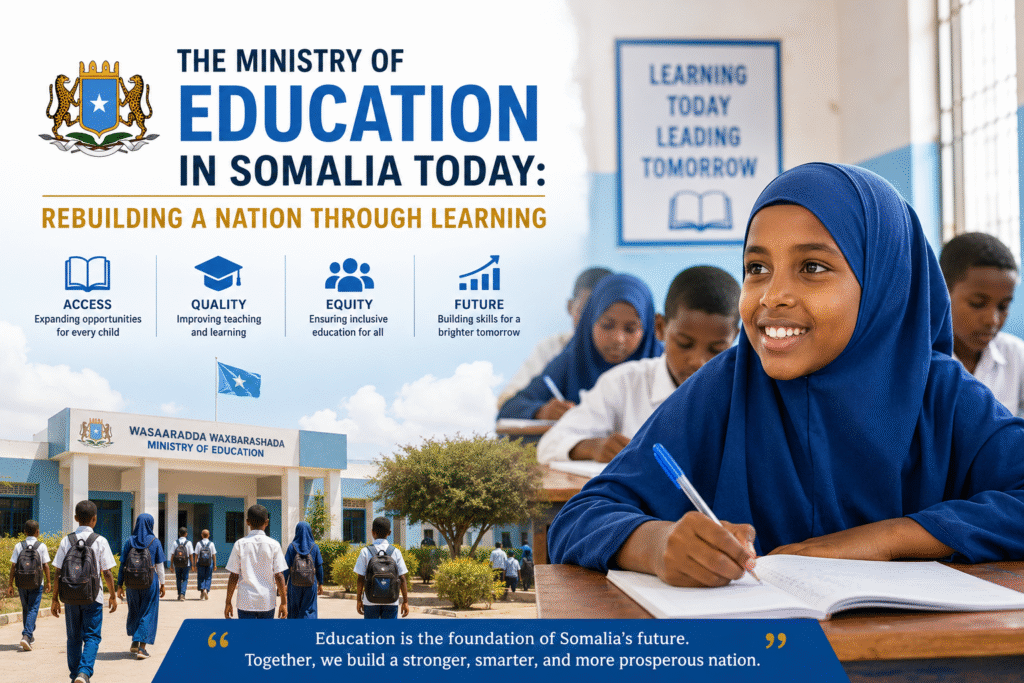
Introduction: From Ashes to Ambition
For nearly three decades, Somalia’s education system lay in ruins—a casualty of civil war, state collapse, and neglect. Schools were destroyed, teachers went unpaid, and an entire generation grew up without formal learning. Today, that narrative is being rewritten. The Ministry of Education, Culture and Higher Education (MoECHE) is orchestrating one of the most ambitious education reconstruction efforts on the African continent. From recruiting 12,000 teachers and launching a new curriculum development center to preparing nearly 40,000 students for national exams and pursuing international partnerships, the Ministry is laying the foundation for Somalia’s long-term human capital development. This article examines the state of the Ministry of Education in Somalia today, covering teacher recruitment, curriculum reform, examination systems, infrastructure development, international partnerships, and persistent challenges.
Part 1: Leadership and Vision – Minister Farah Sheikh Abdulkadir
At the helm of Somalia’s education transformation is Dr. Farah Sheikh Abdulkadir, the Minister of Education, Culture and Higher Education. Appointed to lead one of the most challenging portfolios in the federal government, Abdulkadir has articulated a clear vision: a unified, quality education system accessible to all Somali children regardless of gender, location, or economic status.
In April 2026, the Minister issued a stark warning about the sector’s fragmentation. Speaking to media, he noted that while the decentralized federal system had enabled communities and private actors to expand access—particularly in areas long underserved by the state—limited regulation had led to inconsistencies. Different institutions adopted their own curricula and examination systems, at times undermining education quality .
“Sometimes it has a negative impact, and sometimes a positive one,” Abdulkadir acknowledged, calling for harmonization of core elements of the education system to raise standards nationwide .
The Minister has also been active on the international stage. In February 2026, he received the Director-General of the Arab League Educational, Cultural and Scientific Organization (ALECSO) in Mogadishu, discussing priorities including teacher training, curriculum development, technical and vocational education, literacy programs, and digital transformation .
Part 2: Teacher Recruitment – 12,000 by 2026
The most significant achievement of the Ministry in the past year has been the dramatic expansion of the teaching workforce. Prime Minister Hamza Abdi Barre announced in February 2026 that the government had already recruited and deployed 6,000 trained teachers in less than two years—a staggering increase from the roughly 900 teachers who were on the federal payroll when the administration took office .
“In just two years, we recruited and deployed 6,000 trained teachers on the path to reaching 10,000 across our nation, from bustling cities to the most remote communities,” Barre said. “We are pressing forward to reach 12,000 government-employed teachers by 2026” .
Equally significant is how these teachers are being paid. For the first time in Somalia’s history, teacher salaries are now fully financed through domestic revenue rather than foreign aid . Barre described this as a milestone of sovereignty: “That is not just policy, it is pride. It is sovereignty in action. Our teachers are no longer overlooked; they are honored as the heartbeat of our country and the builders of tomorrow” .
Yet the scale of the challenge remains enormous. Barre acknowledged that Somalia would ultimately require an estimated 120,000 teachers to fully meet national demand—ten times the current target . Education specialists caution that while expanding the teaching workforce is critical, long-term gains depend on sustained investment in school infrastructure, curriculum modernization, and teacher training.
Minister Abdulkadir has also raised concerns about teacher qualifications, announcing plans to introduce formal training and a licensing system that would allow only certified educators to teach in schools. “One of the worrying issues is that anyone can enter a school and be called a teacher without sufficient qualifications… this does not happen elsewhere in the world,” he said .
Part 3: Curriculum Reform – The New Development Center
On April 21, 2026, Prime Minister Hamza Abdi Barre laid the foundation stone for a new Curriculum Development Center in Mogadishu, a facility designed to improve the quality of education and modernize the sector nationwide .
“A quality curriculum is the foundation of education, and this center will play a vital role in shaping the knowledge of future generations,” Barre said at the ceremony .
The facility is expected to serve as a hub for designing and updating national curricula, helping ensure that education standards keep pace with global trends and local development priorities. Officials say it will strengthen coordination between policymakers, educators, and institutions .
The need for curriculum harmonization is urgent. Minister Abdulkadir has called for a unified national curriculum, warning that the current decentralized system has led to fragmentation. Different schools and regions have adopted varying curricula, making it difficult to ensure consistent quality or compare student performance across the country .
The Ministry is also working to strengthen coordination with Federal Member States, recognizing that education implementation—like many sectors in Somalia—is shared between the federal government and regional administrations.
Part 4: National Examinations – 40,000 Students in June 2026
A key function of the Ministry of Education is the administration of national examinations, which serve as a critical benchmark for student achievement and a gateway to higher education.
On May 20, 2026, the Ministry announced that national secondary school examinations for the 2025-26 academic year will be held from June 20 to 25, 2026 . Nearly 40,000 students from federal member states and the Banadir region are expected to sit for the exams this year, representing a significant increase from previous years .
Last year, 38,471 students took the national secondary school examinations, according to the Ministry. The consistent growth in exam candidates reflects expanded access to education across the country.
The Ministry also announced that eighth-grade examinations for primary schools in the Banadir region will be held from June 15 to 18, 2026 .
The growth in examination candidates is part of a broader trend. According to government figures cited by Prime Minister Barre, fewer than one in four Somali children were in school when the current government assumed office. Enrollment has since expanded, with national Grade 12 examination candidates rising from 7,000 to 39,000. Students in Las’anood also sat national exams for the first time in three decades .
Part 5: Higher Education – Nearly Half a Million Students
Somalia’s higher education sector has also experienced remarkable growth. Government figures show nearly 250,000 graduates and 200,000 current students are now registered within Somalia’s higher education system .
This expansion has been driven primarily by the private sector, which has filled the void left by the collapse of the public university system. However, the Ministry retains responsibility for higher education oversight, including accreditation, quality assurance, and policy direction.
A comprehensive e-Readiness Assessment of Somali Higher Education Institutions conducted in April 2026 by SomaliREN provides a baseline of digital readiness across the sector. Covering 50 institutions, the assessment evaluated ICT infrastructure, human resources, governance, budgeting, data security, and emerging technologies .
The assessment found that institutions are distributed across readiness Tiers 1–3, with no institution reaching Tier 4 (aspirational benchmark). While progress has been made in connectivity and basic system deployment, digital readiness remains uneven and fragile due to persistent constraints in reliability, financing, governance, and operational capacity .
A central conclusion is that many structural challenges—high connectivity costs, fragmented systems, and weak sustainability—cannot be addressed through isolated institutional efforts. Instead, the report advocates for a system-level delivery model, positioning SomaliREN as a platform for shared services, pooled procurement, and coordinated digital infrastructure development .
Part 6: Educational Inequality – The Persistent Gaps
For all the progress, the Ministry of Education faces deeply entrenched structural inequalities. A rigorous academic study published in May 2026 in Cogent Education examined the determinants of school participation among 18,212 children aged 6–18 years using nationally representative microdata from the 2022 Somalia Integrated Household Budget Survey .
The findings are sobering. Girls, nomadic children, internally displaced children, and those in food-insecure households face pronounced attendance penalties. The largest gaps are found in Hirshabelle, Jubaland, and Southwest states .
Key statistics from the study and Ministry data reveal:
- 94% of primary and 99% of secondary enrollments are concentrated in urban areas, leaving rural and nomadic populations severely underserved
- The national Gender Parity Index stands at 0.82 in primary education and 0.73 in secondary education, dropping to as low as 0.61 in some Federal Member States
- In fragile, conflict, and violent settings globally, girls are 2.5 times more likely to be out of school compared to girls in non-affected contexts
- An estimated 3.8 million internally displaced persons are concentrated around major urban centers, with displaced children facing particular barriers to school access
The study found that remittances are positively associated with school participation and partially buffer the negative effects of food insecurity and displacement, but do not fully offset structural exclusion . These findings highlight the intersecting nature of educational disadvantage in fragile settings and the need for targeted, multi-dimensional interventions.
Part 7: International Partnerships – ALECSO and Digital Transformation
The Ministry of Education is actively pursuing international partnerships to accelerate reform. In February 2026, Minister Abdulkadir met with ALECSO Director-General Dr. Mohamed Ould Amar in Mogadishu to strengthen institutional partnership in education, culture, and capacity-building .
The discussions addressed current priorities and needs, exploring ways to support national programs aimed at improving education quality, modernizing curricula, and strengthening institutional structures—particularly in ICT .
The Minister emphasized that the next phase requires qualitative initiatives focusing on:
- Teacher training and professional development
- Curriculum development and modernization
- Technical and vocational education to build workforce skills
- Literacy programs to address high illiteracy rates
- Digital transformation in educational institutions
For its part, ALECSO affirmed readiness to provide specialized training workshops, deploy experts to support educational policy development, and contribute to sectoral strategic plans aligned with national development priorities .
The Ministry is also working with the World Bank and other international partners under the Eastern Africa Regional Digital Integration Project as a time-bound opportunity to catalyze sustainable, sector-wide digital transformation through coordinated interventions .
Part 8: The Global Education Futures Index – A Sobering Assessment
Despite progress, Somalia’s education system remains critically underprepared for the challenges of the 21st century. The Global Education Futures Readiness Index (GEFRI) assesses countries across five dimensions: Infrastructure, Human Capital, Innovation, Governance, and Access & Parity .
Somalia’s composite score is 15.80 out of 100, placing the country at the 2nd percentile worldwide and ranking 176th globally .
The dimension scores reveal specific weaknesses:
- Governance: 10.06 (3rd percentile) – Policy execution and regulatory capacity remain weak, leaving reforms fragmented and hard to sustain
- Access & Parity: 0.00 (8th percentile) – Gender parity leans toward boys in secondary pathways, signaling persistent barriers for girls
- Infrastructure: 22.86 (8th percentile) – Limited electricity and internet coverage constrain classrooms, preventing large-scale digital instruction
- Human Capital: 23.92 (8th percentile) – Literacy and tertiary enrollment gaps thin the talent pipeline
- Innovation: 22.16 (6th percentile) – Sparse R&D investment and a small research workforce slow experimentation
The GEFRI report notes that because many indicators are imputed, these findings should be treated as provisional until more reported data arrives. Nevertheless, the assessment underscores the scale of the challenge facing the Ministry of Education.
Part 9: Decentralization and Federal Challenges
The governance of education in Somalia is complicated by the federal system. The Ministry of Education, Culture and Higher Education (MoECHE) provides national policy direction, curriculum oversight, and quality assurance, while Education Management Information System (EMIS) units in each Federal Member State are responsible for implementation .
This decentralized governance model allows adaptation to local needs but also creates uneven outcomes, as state-level capacity varies widely in infrastructure, teacher deployment, and budget allocation .
Minister Abdulkadir has acknowledged these challenges. While the decentralized system enabled communities and private actors to expand access, he noted that limited regulation has led to fragmentation . He stressed the need to harmonize core elements of the education system and establish stronger oversight mechanisms.
The Minister also highlighted that higher education remains a federal government responsibility despite the broader decentralization of the sector, creating a unique governance arrangement where the federal Ministry retains direct oversight of universities and tertiary institutions .
Part 10: The Road Ahead – Priorities for 2026 and Beyond
As the Ministry of Education looks toward the remainder of 2026 and beyond, several priorities emerge.
First, teacher recruitment must continue. With 6,000 teachers recruited and a target of 12,000 by end of 2026, the Ministry has made impressive progress, but the estimated need of 120,000 teachers means this is a multi-decade endeavor .
Second, curriculum harmonization is urgent. The new Curriculum Development Center, launched in April 2026, provides the institutional infrastructure for creating a unified national curriculum, but actual implementation will require coordination with Federal Member States and significant technical capacity .
Third, digital transformation must accelerate. The e-Readiness Assessment of higher education institutions reveals that no institution has achieved Tier 4 readiness, and system-level solutions are needed to address high connectivity costs and fragmented systems .
Fourth, gender parity must improve. With a Gender Parity Index as low as 0.61 in some Federal Member States, targeted interventions are needed to keep girls in school, particularly at the secondary level .
Fifth, infrastructure investment is critical. Limited electricity, internet coverage, and classroom space constrain access and quality. The Ministry will need sustained capital investment to expand school infrastructure, particularly in rural and underserved areas .
Finally, data systems must be strengthened. The Ministry is working to establish a national education data system to improve planning and track student progress, recognizing that evidence-based policymaking requires reliable data .
Conclusion: A Ministry at the Heart of Nation-Building
The Ministry of Education in Somalia today is far more than a government department—it is the institutional engine of a nation’s rebirth. In less than two years, the Ministry has overseen the recruitment and deployment of 6,000 teachers, the launch of a national curriculum development center, the preparation of nearly 40,000 students for secondary examinations, and the expansion of higher education to nearly half a million students.
Yet the challenges remain staggering. Only one in four Somali children was in school when the current government took office. Girls in some regions are almost three times less likely to attend secondary school than boys. The education system ranks at the 2nd percentile globally. And the estimated need for 120,000 teachers dwarfs the 12,000 the Ministry aims to recruit by 2026.
The Ministry cannot solve these challenges alone. It requires sustained political commitment from the federal government, cooperation from Federal Member States, investment from international partners, and—perhaps most importantly—a shift in social norms that prioritizes education for all children, regardless of gender or location.
What is undeniable is the direction of travel. After decades of collapse, Somalia’s education system is being rebuilt—brick by brick, teacher by teacher, student by student. The Ministry of Education is at the center of that transformation, and its success or failure will determine not just the future of Somali education, but the future of Somalia itself.
