

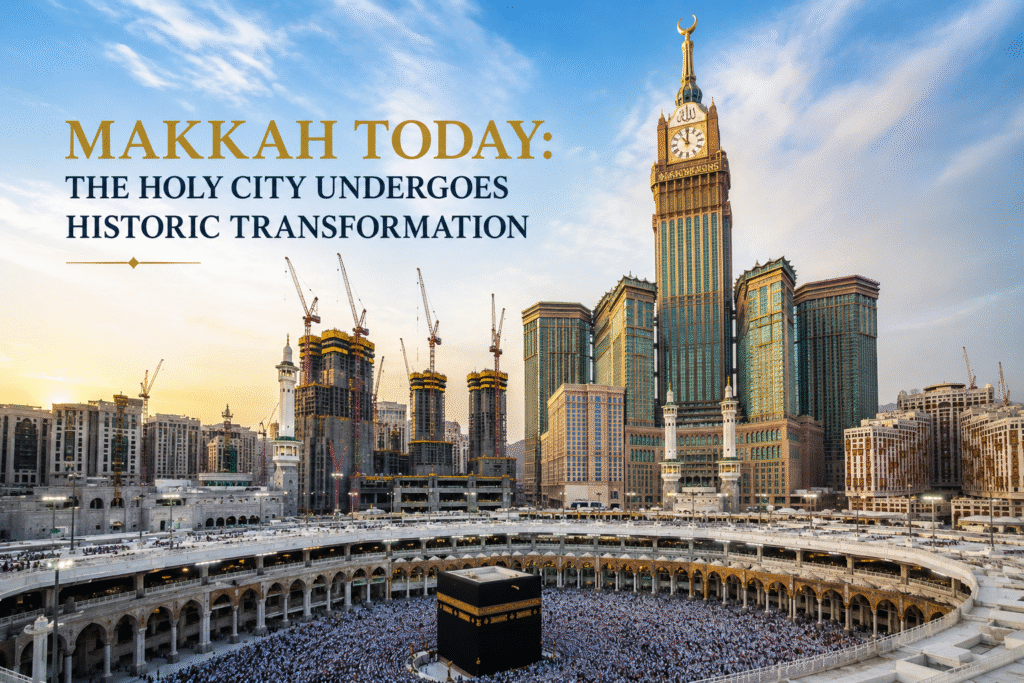
Introduction: A City Reimagined
As the sun rises over the rugged Hejaz mountains and casts its golden light upon the Grand Mosque, Makkah today is a city in the midst of historic transformation. With the 1447 AH (2026) Hajj season fast approaching, the holy city is deploying unprecedented infrastructure, security, and organizational measures to accommodate millions of faithful from around the globe. From massive urban development projects valued at over a billion dollars to cutting-edge crowd management technologies and strict anti-fraud crackdowns, Makkah is being reengineered for a new era of pilgrimage. Yet, as always, the city balances this relentless modernization with its timeless spiritual essence. This article examines the state of Makkah today, covering major development projects, operational updates for Hajj, weather conditions, and security efforts.
Part 1: The Masar Destination – A $1.1 Billion Urban Landmark
Perhaps the most significant physical transformation underway in Makkah is the Masar Destination project—a landmark urban development that is reshaping the approach to the Grand Mosque.
In early May 2026, Umm Al Qura for Development and Construction announced the awarding of contracts worth SAR 4.1 billion ($1.1 billion) for two superstructure development packages within the Masar Destination . The project, which extends over 1.2 million square meters, is designed as an integrated gateway leading directly to the Grand Mosque, located approximately 550 meters from Masjid al-Haram .
Package A, valued at SAR 3.2 billion, was awarded to Mobco and includes four hospitality towers and two commercial centers across six plots in zone one of the project . Package B, worth SAR 899 million, was awarded to BEC Arabia and includes three hospitality towers on two plots in zone three . Both packages are scheduled for completion within 30 months.
A central feature of the development is a 3.6-kilometer pedestrian boulevard designed to offer direct access to the Grand Mosque for pilgrims and tourists alike, integrating retail, hospitality, and transportation connectivity . The project’s proximity to the Haramain High Speed Railway station—approximately 100 meters away—ensures seamless rail connectivity across Saudi Arabia, linking pilgrims from Jeddah, Medina, Riyadh, and other cities.
This $267 million hotel tower component alone, comprising about 500 hotel units, reflects the Kingdom’s strategy under Vision 2030 to expand pilgrimage capacity significantly in the coming decades .
Part 2: The Third Saudi Expansion – Engineering Marvel of the Grand Mosque
While the Masar Destination transforms the approach to the Grand Mosque, the mosque itself has undergone its own historic expansion. The Third Saudi Expansion of the Grand Mosque, one of the largest expansion projects in the mosque’s history, continues to play a central role in serving worshippers .
The expansion covers approximately 1,214,000 square meters and features a cooling capacity of 90,000 tons to maintain a comfortable atmosphere throughout the year . The scale of the facilities is staggering:
- More than 25,000 carpets covering the vast prayer spaces
- 17,000 Zamzam water dispensers ensuring easy access to blessed water
- 11,436 restrooms and ablution areas
- 1,300 speakers ensuring clear sound across all levels
- 458 drinking fountains and 428 escalators
- 28 elevators, 80 doors, and 120 prayer areas
The design facilitates smooth entry, exit, and movement across the ground, first, second, mezzanine, and rooftop levels, allowing accommodation of large numbers of worshippers during peak periods. The General Authority for the Care of the Affairs of the Two Holy Mosques emphasized that field teams operate around the clock to ensure full readiness of facilities and services .
This expansion represents a major enhancement in integrated services, providing a spiritually enriching environment built to high engineering and operational standards .
Part 3: Hajj 1447 AH – Operational Directives for Pilgrim Congestion
With the Hajj season approaching, Saudi authorities have issued specific operational directives aimed at managing crowd flow and easing the burden on pilgrims. On May 19, 2026, Saudi Arabia’s Islamic Affairs, Dawah and Guidance Ministry issued a directive to shorten the waiting period between the adhan (call to prayer) and the iqamah (commencement of prayer) in all mosques frequented by pilgrims in Makkah, the central area, and the holy sites .
Under the new directive:
- For Fajr prayer, the interval was set at 15 minutes
- For Dhuhr, Asr, Maghrib, and Isha prayers, the interval was reduced to 5 minutes
- The combined Friday sermon and prayer should not exceed 15 minutes
Sheikh Abdullatif Al Alsheikh, General Supervisor of the Ministry’s Haj, Umrah and Visitation Works, explained that this measure aims to “facilitate smoother movement in and around mosques and to create a suitable environment for pilgrims to perform their rituals with ease and tranquility” .
The directive is part of the ministry’s operational plan to serve pilgrims during the Haj season, responding to the increasing number of pilgrims in the central area and the holy sites, reflecting the Kingdom’s exceptional care for the Two Holy Mosques and their visitors .
Part 4: Service Modernization – The “Pulse of Business in the Holy Capital” Report
Complementing the physical infrastructure developments, the Makkah Chamber of Commerce and Industry has issued a comprehensive report titled “Pulse of Business in the Holy Capital,” prepared by the Makkah Center for Economic Information and Studies .
The report outlines several key focus areas for ongoing development:
- Modernizing Hajj and Umrah systems
- Expanding logistics and transportation networks
- Strengthening smart infrastructure
- Promoting environmental sustainability in the Holy City
According to the report, authorities are focusing on these projects to improve service quality, increase operational efficiency, and enhance the overall experience of pilgrims arriving from around the world. The report emphasizes that Makkah is pursuing a development model that balances modernization with the preservation of the city’s Islamic and historical identity .
Chairperson of the Makkah Chamber Abdullah Saleh Kamel said the report forms part of broader efforts to provide data and analysis supporting future development initiatives, while Secretary-General Thamer bin Ahmed Baazeem noted this is the first in a planned series of specialized reports intended to support decision-making among development and service entities in Makkah .
Part 5: Weather and Climate – Heat and Rain Ahead
As pilgrims prepare for the coming months, weather conditions remain a critical consideration. According to the National Center for Meteorology (NCM), Saudi Arabia is expected to see heavy to very heavy rainfall in parts of the south and Makkah region in May 2026, alongside a broader rise in temperatures .
The seasonal outlook covering May, June, and July indicates above-average rainfall during the first two months before conditions stabilize in July. Visual maps indicate that the highest rainfall anomalies will be concentrated in the southwestern regions during May and June .
In June, rainfall activity is expected to remain above average particularly over Jazan and Asir, extending into Al-Baha and the highlands of Makkah, including Taif, where moderate to heavy rainfall is forecast .
Regarding temperatures, the NCM forecasts that average temperatures will exceed normal levels, with probabilities of above-average temperatures reaching up to 80% in some regions. The highest increases are expected to reach up to 1.0°C above average in parts of southwestern Makkah .
In the immediate term, current weather forecasts for Makkah show daytime highs reaching 45°C on May 23, with generally sunny conditions and lows around 27°C . Authorities have issued weather warnings for parts of the Makkah region, including Al-Muwayh and Khulais, where active winds may stir up dust and reduce horizontal visibility .
Part 6: Security Crackdown – Combating Fraudulent Hajj Services
As demand for Hajj services surges, so too does the risk of fraudulent operators. In a significant enforcement action, security patrols in Makkah arrested four Indonesian residents for committing fraud by posting misleading advertisements on social media offering fake Hajj services .
Authorities stated that forged Hajj cards and tools used in the fraudulent activities were found in their possession. The suspects were detained, legal measures were taken against them, and they were referred to the Public Prosecution .
Public Security urged everyone to comply with Hajj regulations and instructions and report violations by calling 911 in Makkah, Madinah, Riyadh, and eastern regions and 999 in all other regions of the Kingdom . This crackdown reflects the Kingdom’s determination to protect pilgrims from exploitation and ensure that only authorized, legitimate service providers operate during the holy season.
Part 7: Vision 2030 – The Strategic Framework
All of these developments—the Masar Destination, the Grand Mosque expansion, service modernization, and enhanced security—are components of Saudi Arabia’s broader Vision 2030 strategy. The Kingdom aims to significantly expand pilgrimage capacity, enabling more Muslims from around the world to undertake Hajj and Umrah .
The government has been accelerating large-scale hospitality and infrastructure developments in both Makkah and Madinah to support this demand, which is expected to grow steadily over coming decades. By increasing the supply of quality accommodations near the Grand Mosque, the Kingdom aims to elevate visitor experiences and reduce travel pressures during peak pilgrimage seasons .
This strategy also includes digital transformation initiatives, smart infrastructure, and environmental sustainability—all designed to accommodate growing numbers of pilgrims while preserving the city’s sacred character .
Part 8: Transportation Connectivity – The Haramain Railway Integration
A critical enabler of Makkah’s transformation is its integration with the Haramain High Speed Railway. The Masar Destination’s location—approximately 100 meters from the railway station—ensures seamless rail connectivity across Saudi Arabia .
Pilgrims arriving by air from cities such as Cairo, Jakarta, Karachi, London, and Manila can transfer quickly to the Haramain High Speed Railway or directly to hotels near the Grand Mosque . This streamlined connectivity enhances the overall tourism infrastructure of Saudi Arabia, encouraging repeat visits and extended stays that combine spiritual travel with cultural exploration.
The railway connects Makkah to Jeddah, Medina, King Abdulaziz International Airport, and King Abdullah Economic City, dramatically reducing travel times between the holy cities and making multi-city pilgrimage itineraries more feasible than ever before.
Part 9: Preserving Islamic Identity Amid Modernization
Despite the breakneck pace of development, Makkah’s authorities emphasize that modernization does not come at the expense of the city’s sacred character. The Makkah Chamber’s report explicitly states that the city is pursuing a development model that balances modernization with the preservation of Makkah’s Islamic and historical identity .
This balance is evident in the architectural design of new developments, which respect traditional Islamic aesthetics while incorporating modern engineering. The Third Saudi Expansion, for example, maintains the visual harmony of the Grand Mosque while adding vast new prayer spaces and advanced cooling systems.
The General Authority for the Care of the Two Holy Mosques reaffirmed its commitment to developing services and improving the visitor experience, reflecting the leadership’s dedication to mobilizing all capabilities to serve pilgrims .
Part 10: The Road Ahead – What to Expect
As the 1447 AH Hajj season approaches, several developments bear watching:
Increased Pilgrim Capacity: With the Third Expansion fully operational and Masar Destination coming online, Makkah can accommodate significantly more pilgrims than ever before. This aligns with Vision 2030’s goal of expanding Umrah capacity to 30 million pilgrims annually by 2030.
Enhanced Digital Services: The service modernization report highlights ongoing digital transformation initiatives, suggesting that pilgrims can expect more streamlined visa processing, accommodation booking, and crowd navigation tools in the coming years .
Strict Enforcement: The arrest of fraudulent Hajj service providers signals that authorities will aggressively pursue those who exploit pilgrims. This enforcement is likely to intensify as the Hajj season peaks .
Weather Preparedness: With forecasts indicating above-average temperatures and potential heavy rainfall in May and June, authorities have likely activated heat mitigation strategies and flood preparedness measures .
Conclusion: A City Transformed, A Spirit Undimmed
Makkah today is a city of breathtaking contrasts. Ancient mountains cradle a metropolis of soaring towers and cutting-edge infrastructure. Millions of pilgrims from every corner of the globe converge on a single point, united by faith, while authorities deploy billion-dollar projects and real-time crowd management systems to ensure their safety and comfort.
The Third Saudi Expansion, with its 1.2 million square meters and 90,000-ton cooling capacity, stands as an engineering marvel worthy of Islam’s holiest site . The Masar Destination, with its $1.1 billion investment and pedestrian boulevard leading directly to the Grand Mosque, promises to transform how pilgrims experience the approach to the Haram . The Hajj operational directives, shortening prayer intervals and streamlining Friday sermons, reflect meticulous planning for the millions who will soon arrive .
Yet for all this transformation, Makkah’s essence remains unchanged. It is still the place where hearts turn in prayer, where Ibrahim and Ismail raised the foundations of the Kaaba, and where millions seek forgiveness and mercy. The cranes and concrete may reshape the city’s skyline, but they cannot alter its soul.
As the 1447 AH Hajj season dawns, Makkah stands ready—not merely as a destination, but as a living testament to Islam’s enduring vitality and the Kingdom’s commitment to serving the faithful. The holy city today is, more than ever, a place where ancient faith and modern capability meet.
