

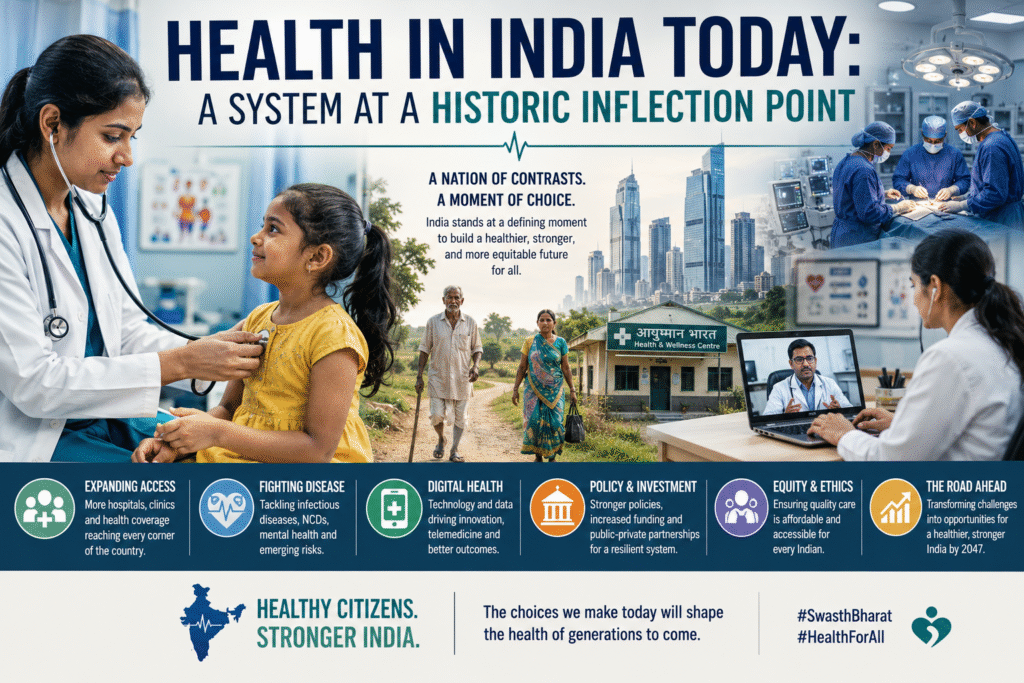
Introduction: Crossing the ₹1 Lakh Crore Threshold
For the first time in India’s history, the Union Budget 2026-27 allocated more than ₹1 lakh crore to the health sector. The Ministry of Health and Family Welfare received ₹1,06,530.42 crore—a 10% increase over the previous year and a staggering 194% rise over the past twelve years. This landmark funding signals a decisive shift in policy priorities, recognizing healthcare not merely as a social welfare obligation but as a strategic pillar of economic growth. Yet as India’s health spending finally begins to approach international benchmarks, the country faces a profound epidemiological transition: non-communicable diseases (NCDs) now account for nearly 65-74% of all deaths, threatening to cost the economy an estimated $6 trillion over the next decade. This article examines the state of health in India today across its most critical dimensions.
Part 1: Budget 2026 — A Record Allocation with Strategic Focus
The Union Budget 2026-27, presented by Finance Minister Nirmala Sitharaman on February 1, 2026, marked a watershed moment for Indian healthcare. Beyond the headline allocation, the budget introduced several transformative initiatives.
The Pradhan Mantri Jan Arogya Yojana (PM-JAY)—the world’s largest public health insurance scheme—received ₹9,500 crore, providing coverage of up to ₹5 lakh annually per eligible household to over 12 crore vulnerable families. The National Health Mission (NHM) saw its allocation rise to ₹39,390 crore, while the PM-Ayushman Bharat Health Infrastructure Mission (PM-ABHIM) received a dramatic 67.66% increase, from ₹2,845 crore to ₹4,770 crore.
Equally significant was the launch of Biopharma SHAKTI (Strategy for Healthcare Advancement Through Knowledge, Technology and Innovation)—a ₹10,000 crore initiative over five years to build domestic production capacity for biologics and biosimilars. This reflects a growing recognition that healthcare security requires manufacturing sovereignty.
Part 2: The NCD Crisis — 65% of Deaths and a $6 Trillion Warning
India today faces an epidemiological double burden. While the country has made remarkable progress in maternal and child health—increasing life expectancy from 49.7 years in 1973 to 70.3 years in 2023—it now confronts a surging tide of non-communicable diseases.
NCDs now account for 57% of deaths according to official statistics, though industry bodies place the figure closer to 65%, projecting it could reach 74% by 2030. Cardiovascular diseases, diabetes, obesity, and cancers are driving this transformation, fueled by urbanization, changing diets, sedentary lifestyles, and an aging population.
The economic implications are staggering. NATHEALTH, the healthcare industry body, estimates that NCDs will cost India $6 trillion over the next decade in lost productivity and healthcare expenditures. Dr. Azad Moopen, Founder of Aster DM Healthcare, warned: “With a population exceeding 1.4 billion and a rising prevalence of chronic conditions, pressures on India’s healthcare system are intensifying”.
In response, the government continues to implement the National Programme for Prevention and Control of Non-Communicable Diseases (NP-NCD), focusing on early identification of high-risk individuals. Industry bodies have called for tax deductions of up to ₹10,000 for preventive health check-ups to encourage early detection and reduce the burden of advanced disease.
Part 3: Mental Health — NIMHANS 2.0 and Regional Expansion
One of the most significant announcements in Budget 2026 was the recognition of mental health as a national priority. Finance Minister Sitharaman announced the establishment of NIMHANS 2.0—a new national institute for mental healthcare in North India, noting that the region currently lacks a premier national mental health institution.
Additionally, the National Mental Health Institutes in Ranchi and Tezpur will be upgraded to serve as Regional Apex Institutions. “To give fillip to our commitment to mental health and trauma care, and to ease the financial burden of medical emergencies on families, particularly the poor and vulnerable, we are undertaking targeted interventions across institutions, infrastructure and workforce,” Sitharaman said.
These investments come at a critical time. Mental health disorders have long been a neglected dimension of India’s health landscape, with a severe shortage of psychiatrists, psychologists, and psychiatric beds. The new institutions aim to expand training capacity, research, and clinical services.
Part 4: Cancer Care — Customs Duty Exemption on 17 Drugs
Cancer treatment in India has long been characterized by catastrophic out-of-pocket expenditures that push families into poverty. Budget 2026 took a significant step toward affordability by proposing a full exemption of basic customs duty on 17 cancer-related drugs and medicines.
In addition, seven more rare diseases will be added to the list eligible for import duty exemption on drugs, medicines, and food for special medical purposes imported for personal use. The finance minister stated: “To provide relief to patients, particularly those suffering from cancer, I propose to exempt basic customs duty on 17 drugs or medicines”.
For patients and families, this means life-saving medications will become significantly more affordable, reducing the need for crowdfunding campaigns, asset liquidation, or abandonment of treatment.
Part 5: Emergency and Trauma Care — 50% Capacity Expansion
Another major budget initiative addresses a critical gap in India’s healthcare infrastructure: emergency and trauma care. The government announced a 50% expansion in emergency and trauma care capacity in district hospitals across the country through the establishment of dedicated emergency and trauma care centres.
This expansion aims to reduce out-of-pocket expenditure during medical emergencies—a leading cause of catastrophic health spending and medical impoverishment in India. For families in rural and peri-urban areas, access to functional emergency services could mean the difference between life and death.
Part 6: Workforce Development — 100,000 Allied Health Professionals
India faces a severe shortage of healthcare workers, particularly in rural and underserved areas. Budget 2026 addresses this through a massive workforce development initiative.
Existing institutions for Allied Health Professionals (AHPs) will be upgraded, and new AHP institutions established in both private and government sectors. The initiative targets 100,000 new AHPs over five years across 10 disciplines, including optometry, radiology, anaesthesia, OT technology, applied psychology, and behavioural health.
Additionally, the government will train 1.5 lakh caregivers over the coming year under NSQF-aligned programmes focused on geriatric care, wellness, yoga, and the operation of medical and assistive devices. This responds to India’s aging population and the growing need for long-term care support.
Part 7: Traditional Medicine — AYUSH Goes Global
The post-COVID era has seen traditional medicine gain unprecedented global acceptance. Budget 2026 positions India to capitalize on this momentum with a series of strategic investments.
The government will establish three new All India Institutes of Ayurveda to meet growing global demand. It will upgrade AYUSH pharmacies and drug testing laboratories to higher certification standards, making more skilled personnel available. Crucially, the WHO Global Traditional Medicine Centre in Jamnagar will be upgraded to bolster evidence-based research, training, and awareness for traditional medicine.
Finance Minister Sitharaman noted that exports of high-quality Ayurvedic products could boost farmer incomes through increased cultivation of medicinal herbs. This integration of healthcare, agriculture, and economic development reflects a holistic approach unique to India’s health strategy.
Part 8: Regional Medical Hubs and Medical Tourism
Budget 2026 also announced a scheme to support states in establishing five Regional Medical Hubs in partnership with the private sector. These integrated healthcare complexes will combine medical, educational, and research facilities, with AYUSH centres, medical value tourism facilitation centres, and infrastructure for diagnostics, post-care, and rehabilitation.
The initiative aims to promote India as a hub for medical tourism services, attracting international patients seeking high-quality care at fraction of Western costs. Hospitals identified for this initiative include Apollo, Max, Fortis, Dr Lal Pathlabs, and Metropolis.
Part 9: Access Improves — NSO Survey Shows Progress
Behind the policy headlines, ground-level data reveals genuine progress. The 80th round of the National Statistical Office (NSO) survey on household social consumption related to health, released in April 2026, highlights significant improvements in healthcare access, affordability, and utilisation across the country.
The average out-of-pocket expenditure (OOPE) for outpatient care in public health facilities was reported as zero, underscoring widespread access to free essential healthcare services. More than half of patients admitted to government health facilities incurred OOPE of less than ₹1,100, while the average medical expenditure per hospitalisation stood at ₹11,285 in 2025.
Health-seeking behaviour has also strengthened. The projected population reporting ailments (PPRA) nearly doubled compared to 2017-18—from 6.8% to 12.2% in rural areas and from 9.1% to 14.9% in urban areas. This suggests that improved infrastructure and reduced financial barriers are encouraging people to seek care rather than suffer in silence.
Utilisation of public health facilities has increased, particularly in rural areas, where outpatient care usage has risen from 28% in 2014 to 35% in 2025. Coverage of government-funded health insurance schemes, including PM-JAY, increased dramatically—from 12.9% to 45.5% in rural areas and from 8.9% to 31.8% in urban areas.
Maternal healthcare also showed improvement, with institutional deliveries rising to 95.6% in rural areas and 97.8% in urban areas.
Part 10: The Structural Deficits — Vacancy Rates and Rural Gaps
Yet for all the progress, significant structural deficits remain. According to The Health Dynamics of India 2022-23 report, the vacancy rate in rural Community Health Centres (CHCs) is 79.9%, with only 4,413 specialists available against a requirement of 21,964.
A CHC serves as a first referral unit for a population of about 1.6 to 2 lakh and is expected to have 30 beds with five specialists—a physician, surgeon, obstetrician, paediatrician, and anaesthetist. However, the majority of CHCs remain crippled due to persistent specialist shortages—a problem that has continued for many years.
Despite the creation of additional postgraduate medical seats—72,627 across 731 medical colleges—the specialist shortfall in CHCs has remained around 17,500 since 2014. Newly graduated specialists are often unwilling to work in remote and underserved areas due to inadequate facilities, lack of staff quarters, schools for their children, and adequate peer medical support.
Dr. K.R. Antony, a public health system adviser writing in The Hindu, argues that the central health budget is “largely focused on infrastructure, without matching allocations for drugs, diagnostics, ambulance services, emergency care, or salaries for temporary staff”. He warns: “If the goal is to improve people’s health, it must prioritise operational outcomes rather than merely investing capital in building construction.”
Part 11: Universal Health Coverage — The Debate Continues
Despite the budget increases and the expansion of PM-JAY, India remains far from universal health coverage. Public health spending as a percentage of GDP—currently around 1.9%—still lags far behind the 2.5-5% recommended by health experts.
Speaking ahead of the budget, Dr. Vinay Aggarwal, past National President of the Indian Medical Association, advocated for “tax-funded Universal Health Care with a basic health package for all citizens”. A recent Lancet Commission report examined India’s progress toward UHC and highlighted structural weaknesses including “fragmented governance, poor coordination across levels of care, health services organised around institutions rather than citizens, and persistent gaps in quality, equity, and continuity of care”.
The report stressed that “policy intent alone is insufficient without institutional capacity to execute reforms”. This remains India’s central challenge: translating increased funding into improved outcomes on the ground.
Part 12: The Road Ahead — Priorities for 2027 and Beyond
As India looks toward the remainder of 2026 and beyond, several priorities emerge.
First, workforce gaps must be addressed urgently. The 79.9% specialist vacancy rate in CHCs is unacceptable for a nation aspiring to universal health coverage. Solutions must include mandatory service bonds, enhanced incentives for rural postings, and improved living and working conditions.
Second, prevention must move from rhetoric to reality. With NCDs projected to account for 74% of deaths by 2030, India cannot simply treat its way out of the crisis. Large-scale screening programs, public health campaigns, and regulation of unhealthy products (tobacco, alcohol, ultra-processed foods) are essential.
Third, digital health integration must accelerate. The Ayushman Bharat Digital Mission received increased funding in Budget 2026, but full interoperability, data privacy protections, and last-mile connectivity remain works in progress.
Fourth, out-of-pocket expenditure—still over 60% of total health spending—must continue to decline. While the NSO survey shows progress, catastrophic health payments remain a leading cause of poverty in India.
Finally, the public health system must become the default choice for all Indians, not just the poor. This requires not just infrastructure but also quality improvement, patient-centred care, and restoration of trust in government facilities.
Conclusion: A Nation at a Historic Inflection Point
India’s healthcare system today stands at a historic inflection point. For the first time, the national health budget has crossed ₹1 lakh crore. Mental health, emergency care, and cancer treatment have received unprecedented attention. Traditional medicine is being integrated into mainstream healthcare delivery. Access to public facilities is improving, and out-of-pocket expenditure is declining.
Yet the gaps remain stark. Rural specialist vacancy rates approach 80%. NCDs are claiming more lives each year. Universal health coverage remains an aspiration rather than a reality. The $6 trillion economic cost of NCDs threatens to undermine the very growth that funds healthcare expansion.
The Union Budget 2026-27 has laid a foundation. The Biopharma SHAKTI initiative, the expansion of PM-JAY, the establishment of NIMHANS 2.0, the customs duty exemptions for cancer drugs—these are substantive, not symbolic, investments. But as Dr. Aggarwal noted, policy intent alone is insufficient. The true test lies in execution: in filling those 17,500 specialist vacancies, in ensuring that increased funding reaches the last mile, and in building a healthcare system that serves every Indian with dignity and quality.
For a nation of 1.4 billion people aspiring to become a developed nation by 2047, health is not merely a social sector—it is the foundation of human capital, economic productivity, and national strength. India has crossed the ₹1 lakh crore threshold. Now it must ensure that every rupee translates into healthier, longer, and more prosperous lives for all its citizens.
