

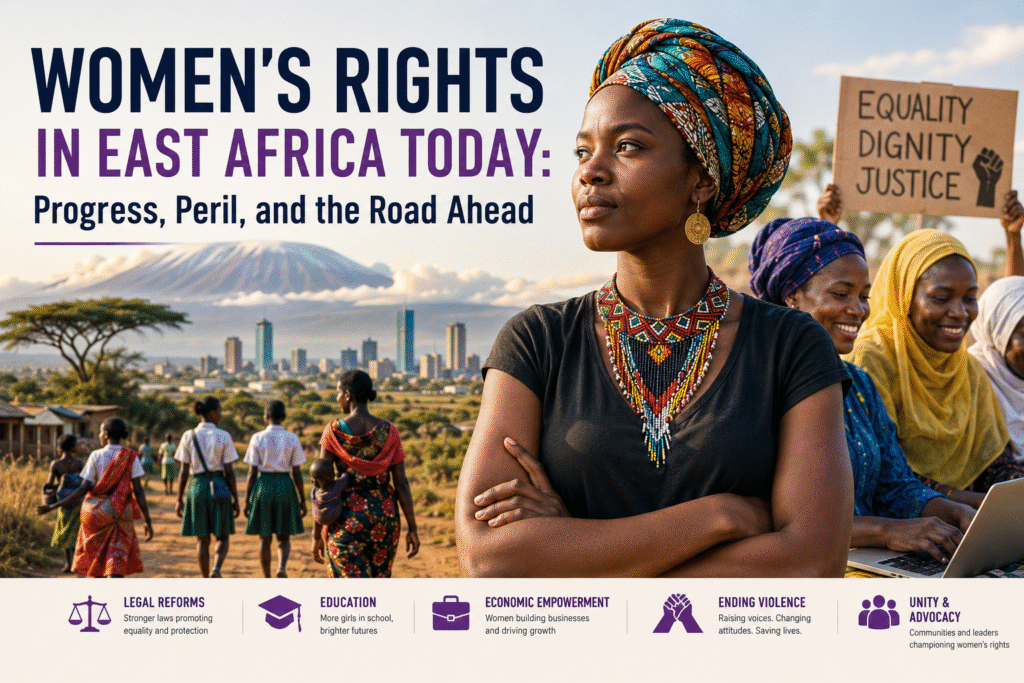
Introduction: A Region at a Turning Point
East Africa today stands at a critical juncture in the long struggle for women’s rights. Across the region—from the shores of Lake Victoria to the highlands of Ethiopia—women are simultaneously recording historic gains in political representation, economic empowerment, and legal protection while continuing to face staggering levels of violence, discrimination, and harmful traditional practices. The past year has seen landmark investments, policy breakthroughs, and grassroots movements gaining momentum. Yet as recent data reveals, approximately 35% of women in Eastern and Southern Africa still experience intimate partner violence, and millions of girls remain at risk of female genital mutilation (FGM) and child marriage . This article examines the state of women’s rights in East Africa today across eight critical dimensions.
Part 1: The Policy Landscape — Turning Pledges into Action
On International Women’s Day 2026, leaders and advocates across East Africa issued a unified call: it is time to translate years of commitments into tangible action. The global theme, “Give to Gain – Rights, Justice, Action,” emphasized precisely this need to move beyond symbolic celebrations toward practical policies and programs that empower women and girls .
According to Fatuma Ndangiza, President of the East African Legislative Assembly (EALA) Women’s Caucus, more than 99 legal reforms were adopted globally between 2019 and 2024 to remove discriminatory laws and strengthen protections for women. Within East Africa, these reforms have contributed to a growing presence of women in decision-making roles, including national parliaments, regional institutions, and local government structures .
Yet Ndangiza was equally clear about the remaining challenges: “Despite these gains, many women and girls across the region continue to face significant barriers. Unequal access to education and economic resources, gender-based violence and limited representation in leadership positions remain persistent challenges” . Women in rural communities and those from marginalized groups are often the most affected, as social norms, economic inequalities, and institutional barriers restrict their ability to fully exercise their rights.
Part 2: The Violence Crisis — 35% and Rising
Perhaps the most alarming statistic shaping East Africa’s women’s rights landscape today comes from the United Nations. Speaking at a Ministerial Meeting on Women, Peace, and Security in Machakos, Kenya, in February 2026, UN Women Deputy Regional Director Adama Moussa revealed that approximately 35% of women in Eastern and Southern Africa experience intimate partner violence .
Conflict-related sexual violence continues to devastate communities across Ethiopia, Somalia, South Sudan, and Sudan. In Sudan alone, an estimated 12.2 million women and girls are at risk of gender-based violence . “These are not abstract statistics,” Moussa emphasized. “They are lives disrupted, rights violated, and futures constrained” .
The situation in Nairobi’s informal settlements provides a stark local illustration of this crisis. In the first quarter of 2026 alone, 3,000 sexual offence cases were handled across the capital’s slums, including 534 sexual offences. Shofco, a non-profit organization working in these communities, secured 18 convictions in defilement cases during the same period, with a further 210 cases pending before the courts .
Part 3: Harmful Practices — FGM and Child Marriage
Beyond violence, millions of East African girls face the lifelong consequences of female genital mutilation and child marriage. Despite measurable progress over the past decade—particularly in areas where sustained, community-led approaches have shifted social norms—significant challenges remain .
The numbers are staggering. In Ethiopia, 65% of women have undergone FGM, and 40% are married off before turning 18. In Kenya, national FGM prevalence has declined to 15%, yet nearly one in four girls still marry before 18. In Somalia, FGM remains nearly universal at 99%, and early marriage continues to affect more than a third of girls .
The impact is profound and lasting. FGM can cause physical and psychological harm that persists throughout a woman’s life, including serious risks during pregnancy and childbirth. Child marriage often leads to early pregnancies, school dropouts, and limited opportunities for economic independence, perpetuating intergenerational inequality . Crisis factors such as poverty, conflict, migration, and climate change further increase the risk that these harmful practices will resurge even where progress has been made.
Part 4: The Future4Binti Initiative — A €50 Million Response
In direct response to these challenges, February 2026 saw the launch of a major new initiative. The Dutch government invested €50 million (approximately USD 59 million) in Future4Binti, a five-year program (2026–2030) implemented across Kenya, Ethiopia, and Somalia by Amref Health Africa, Plan International, and local civil society organizations .
The program builds on years of experience in combating FGM and child marriage. It targets not only girls but also families, communities, healthcare systems, and governments. Because harmful practices stem from deep-rooted gender inequality and power imbalances, the program focuses on lasting change in social norms, improved protection, quality healthcare, and effective legislation .
Nice Leng’ete, Founder of the Nice Place Foundation, framed the initiative as a critical investment: “For too long, harmful practices have limited the potential of our girls. While we have seen meaningful progress in reducing FGM and child marriage across East Africa…those gains remain fragile. The Future4Binti initiative is a critical investment in sustaining and accelerating this momentum. Girls deserve to stay in school, grow up safe, and make informed choices about their own lives” .
Dr. Githinji Gitahi, Group CEO of Amref Health Africa, connected the fight against harmful practices to broader development aspirations: “Africa’s greatest asset is its young population. But we must ask ourselves: what are the chances that a young person reaches 18 with their full human capital potential intact? Harmful practices such as FGM, early marriage, and teenage pregnancy rob girls of that potential before it can be realised” .
Part 5: Economic Empowerment — The PAMOJA Programme in Tanzania
While protecting girls from violence is essential, true women’s rights also require economic independence. In Tanzania, the World Bank-funded PAMOJA programme represents one of the region’s most ambitious efforts to achieve exactly that.
The Project for Advancing Gender Equality in Tanzania (PAMOJA), backed by approximately $104 million from the World Bank, was designed to expand women’s access to economic opportunities while strengthening systems for the prevention of gender-based violence. The program aims to directly benefit at least 319,850 women and indirectly reach nearly 399,000 additional beneficiaries, including families and communities .
In Zanzibar, the program has taken an innovative turn. Through partnership with ZEEA (the Zanzibar Economic Empowerment Agency), PAMOJA is supporting the planting of 30 million clove trees under women-led community initiatives. Cloves remain Zanzibar’s historic economic backbone, but declining productivity, aging trees, climate variability, and limited value addition have constrained the sector for decades. Under the proposed women empowerment framework, thousands of women’s groups could participate in nursery establishment, seedling distribution, organic farming, spice processing, and export-oriented packaging .
The multiplier effect would be substantial. Agricultural experts estimate that a mature clove tree can produce between 2 and 8 kilograms of cloves annually. If even half of the proposed 30 million trees reach productive maturity, Zanzibar could significantly increase foreign exchange earnings while creating tens of thousands of rural jobs for women .
Part 6: Political Participation — Breaking the Leadership Barrier
Women’s rights also mean women’s voices in decision-making. Across East Africa, advocates are pushing for greater female representation in politics and governance—with mixed results.
In Kenya, Independent Electoral and Boundaries Commission (IEBC) Commissioner Dr. Ann Nderitu recently called for gender-responsive electoral processes, noting that although women form a larger share of the population and often record higher voter turnout, they remain underrepresented in the voter register and elective positions .
She identified key barriers to women’s participation, including limited access to timely electoral information, financial constraints, and persistent societal biases. Many women, she observed, receive election information late due to competing family responsibilities, underscoring the need for targeted civic and voter education. She also raised concern over gender-based electoral violence, including cyberbullying and online harassment, which continue to discourage women from seeking leadership .
The Intergovernmental Authority on Development (IGAD) has echoed these concerns. Deputy Executive Secretary Mohamed Ware observed that in nearly every crisis, women and young people shoulder a burden far greater than the influence they are afforded in shaping responses. “They broker local ceasefires at community checkpoints when the formal process has fallen silent. They hold the social fabric together when institutions cannot reach far enough. That work is real, and it warrants far more than our recognition alone,” he said .
Part 7: Economic Control and Financial Independence
Even when women earn income, cultural practices often deny them control over their own resources. A recent sensitization forum in West Pokot County, Kenya—one of 16 counties selected for the pilot phase of Kenya’s National Policy on Women’s Economic Empowerment (NPWEE)—revealed deeply rooted challenges .
Participants highlighted cases where women are forced to surrender their salaries and ATM cards to their husbands, leaving them financially dependent despite being employed. “There are women who must declare all their income or even hand over their earnings entirely. This is economic control and it is still widespread,” Dorcas Aleutum, a location chief in Kapenguria, told the forum .
Other concerns raised included limited access to land and capital resources, with many women unable to own property or engage meaningfully in agriculture and business. In some instances, women are denied access to identification documents, effectively locking them out of financial services and government support programmes .
Local leaders, including members of the Council of Elders, expressed support for reforms. “No woman should be forced to surrender her salary. Everyone has a right to benefit from their own work,” said Thomas Ruto, a representative of the elders .
Part 8: The Way Forward — What East Africa Needs Now
As the region looks toward the remainder of 2026 and beyond, the path forward requires action on multiple fronts.
First, legal protections must be strengthened and enforced. While reforms have been adopted, implementation remains inconsistent. The Future4Binti programme’s focus on strengthening laws, enforcement, and cross-border cooperation is essential, particularly given that stricter enforcement in one country has sometimes led families to cross into neighboring nations to circumvent protections .
Second, economic empowerment must reach the grassroots. Programmes like PAMOJA demonstrate that women-led economic initiatives can simultaneously address poverty, environmental sustainability, and gender equality. Scaling such models across the region could transform rural economies while reducing women’s vulnerability to exploitation .
Third, cultural change requires community engagement. Harmful practices persist because they are embedded in social norms. As Amref’s Dr. Gitahi noted, the solution is not simply service delivery but “shifting social norms from within communities” . This requires engaging elders, religious leaders, parents, and men and boys as allies.
Finally, political will must be sustained. The EALA Women’s Caucus has emphasized that addressing these challenges requires sustained political commitment and stronger collaboration among governments, civil society organisations, and development partners .
Conclusion: Rights, Justice, Action
The state of women’s rights in East Africa today is one of contradictions. Never have there been more legal protections, more international investment, or more grassroots activism dedicated to gender equality. Never have more women held elected office, started businesses, or pursued education. Yet never have the statistics on violence, harmful practices, and economic exclusion been more stark.
The theme of International Women’s Day 2026—“Give to Gain – Rights, Justice, Action”—captures the essential formula. Rights without justice are hollow. Justice without action is meaningless. And action without sustained commitment will fail to create lasting change.
For the millions of women and girls across East Africa—from the clove farmers of Zanzibar to the students of Nairobi, from the peacebuilders of South Sudan to the entrepreneurs of Ethiopia—the question is not whether progress has been made. It has. The question is whether the region’s leaders, institutions, and communities will summon the will to finish what they have started. The evidence is clear: investing in women and girls is not merely a social policy objective. It is one of the most powerful economic and developmental investments any nation can make . The time for action is now.
