

Introduction: More Than an Embassy
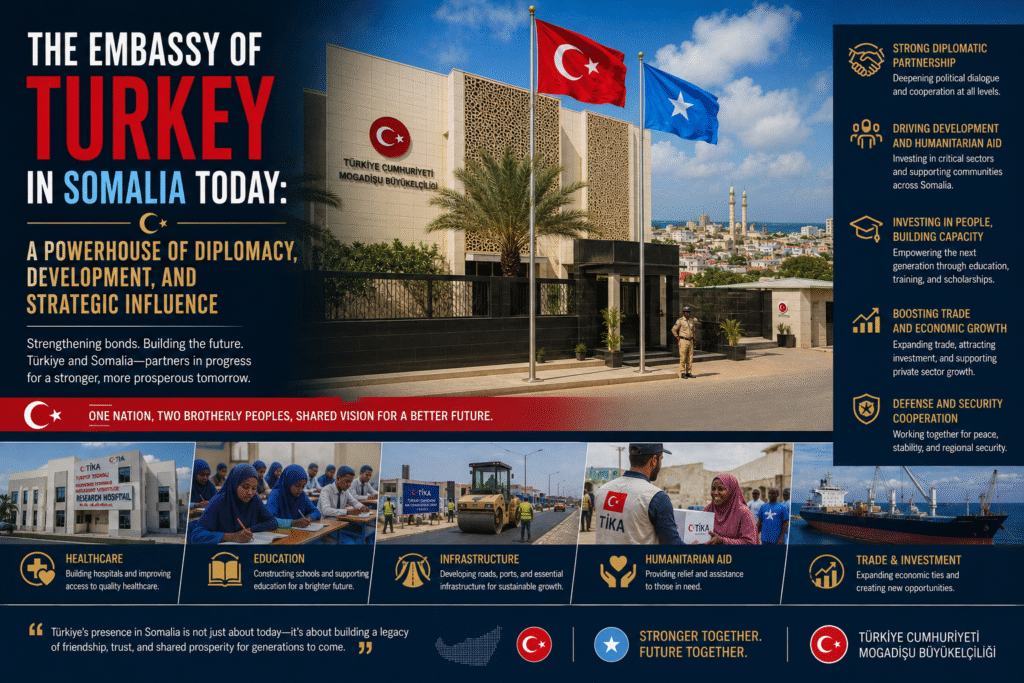
In the heart of Mogadishu, along the bustling Airport Road, stands a diplomatic mission that has transcended the traditional boundaries of embassy work. The Embassy of the Republic of Turkey in Somalia is not merely a venue for political dialogue—it is a nerve center for security coordination, economic investment, humanitarian aid, and increasingly, political mediation. As of May 2026, as Somalia navigates a contested political transition, the Turkish Embassy has emerged as arguably the most influential foreign mission in the country, wielding soft power that rivals its hard security investments. This article examines the multifaceted role of Turkey’s embassy in Somalia today, exploring its diplomatic, security, economic, and cultural dimensions.
Part 1: The Ambassador — Alper Aktaş and His Growing Influence
At the helm of the Turkish Embassy is Ambassador Alper Aktaş, whose tenure has coincided with an unprecedented deepening of Turkey-Somalia relations. Aktaş has become a familiar figure in Mogadishu’s corridors of power, frequently shuttling between Villa Somalia (the presidential palace), the Ministry of Defence, and the port area where Turkish companies are transforming infrastructure .
The ambassador’s role has evolved beyond traditional diplomacy into active political engagement. Just days ago, on May 15, 2026—the day President Hassan Sheikh Mohamud’s original four-year mandate expired under the 2012 constitution—Aktaş met with the president at Villa Somalia in a high-profile meeting widely interpreted as a show of diplomatic backing .
A presidential statement following the meeting said Mohamud thanked Ankara for its continuous support in counter-terrorism and infrastructure, adding that the two discussed “strengthening strategic cooperation” . The timing was not coincidental. Hours earlier, talks aimed at resolving the mandate dispute had collapsed at the UN-protected Halane compound. By meeting with Mohamud on the very day his mandate expired, Ambassador Aktaş signaled Turkey’s continued recognition of the president’s legitimacy .
Part 2: Security and Defence — The Embassy as a Military Coordination Hub
Turkey’s security footprint in Somalia is substantial, and the embassy serves as the coordination hub for this multi-layered engagement. On January 6, 2026, Ambassador Aktaş met with Somali Defence Minister Ahmed Moalim Fiqi at the Turkish Embassy to discuss bilateral cooperation in security and defence .
The meeting covered matters of mutual interest with a particular focus on strengthening security and defence collaboration between the two countries . Turkey is a key partner of Somalia, providing support in areas such as military training, capacity-building, and the development of Somalia’s security institutions . Defence Minister Fiqi posted on X: “I met with the Turkish Ambassador to Somalia, my brother Alper Aktaş, and discussed our cooperation in the defense sector. Turkey is a key partner and ally of Somalia and provides multifaceted support” .
Turkey operates its largest overseas military training facility in Mogadishu—Camp TURKSOM—which has trained thousands of Somali soldiers and officers. This facility has become central to Somalia’s efforts to build a professional national army capable of eventually taking full responsibility for the country’s security as the African Union mission transitions to a smaller footprint .
Part 3: The Political Controversy — Embassy Support for President Mohamud
The embassy’s most controversial role in recent days has been its perceived alignment with President Hassan Sheikh Mohamud during Somalia’s ongoing political crisis. On May 15, the Turkish Embassy issued a statement reaffirming support for the president—a move that drew immediate and sharp criticism from opposition figures .
Somali MP Abdirahman Abdishakur Warsame accused Ankara of undermining neutrality at a time of growing uncertainty over Somalia’s electoral process and constitutional order. In a statement posted on X, the opposition lawmaker said the Turkish Embassy’s message “sends a deeply troubling political signal” by publicly aligning itself with the Somali president immediately after what he described as the expiration of the government’s constitutional mandate .
He warned: “The Turkish government’s decision to publicly reaffirm support for Hassan Sheikh Mohamud at a moment when Somalia faces a contested political transition and no agreed electoral framework sends a deeply troubling political signal” .
Political analysts suggest the embassy’s stance reflects a broader Turkish strategy: maintaining a stable, predictable partner in Mogadishu amid regional turbulence involving Ethiopia, Egypt, and the Gulf states. As one analyst put it: “Villa Somalia is signaling that the chapter on domestic dialogue at Halane is closed. They are looking outward to cement their contested legitimacy through external alliances” . The Turkish Embassy has become a key pillar of that external alliance structure.
Part 4: Economic and Infrastructure Development — The Port and Beyond
Beyond politics and security, the Turkish Embassy plays a central role in coordinating Turkey’s substantial economic investments in Somalia. The most visible of these is the Port of Mogadishu, managed by Turkey’s Albayrak Group since 2014.
In late January 2026, a senior Turkish delegation led by Deputy Minister of Transport and Infrastructure Durmuş Ünüvar arrived in Mogadishu to agree on new infrastructure projects at the port . The agreement aimed to expand trade, raise government revenue, and improve efficiency at Somalia’s most important maritime gateway . Ambassador Aktaş accompanied Ünüvar during a technical inspection of the facility, touring key operational areas including the container terminal and cargo handling zones .
Somalia’s Minister of Ports and Maritime Transport, Abdulkadir Mohamed Nur, described Türkiye as a strategic partner and said Somalia was seeking practical, high-impact projects that would modernize port operations while delivering tangible economic benefits. He emphasized that Mogadishu Port plays a central role in national revenue generation and in facilitating imports critical to the country’s economy .
The economic relationship extends beyond the port. Turkish exports to Somalia have climbed to $273 million, while direct investments by Turkish companies exceed $100 million, according to figures cited during Turkish parliamentary debates on a new grant agreement with Somalia .
Part 5: Energy Cooperation — The Drilling Vessel Cagri Bey
In a landmark development for Somalia’s economic sovereignty, Turkish and Somali presidents agreed in April 2026 on a new phase of energy cooperation. President Erdogan announced that operations by Turkey’s drilling vessel Cagri Bey off Somalia’s coast had commenced, representing a symbol of growing cooperation between the two countries .
The energy partnership was solidified during a high-level summit between President Hassan Sheikh Mohamud and President Erdogan at the Dolmabahçe Palace in Istanbul on April 16, 2026 . The two leaders officially celebrated the historic commencement of Somalia’s deep-sea hydrocarbon extraction, following the successful deployment of the Turkish drilling vessel to Somali waters .
Somalia’s potential oil and gas reserves have long been a source of hope for economic transformation. Turkey’s willingness to invest in exploration—despite the security risks—represents a vote of confidence that resonates through Somalia’s business community and political class.
Part 6: Development and Humanitarian Aid — Beyond Infrastructure
The Turkish Embassy coordinates not only major infrastructure projects but also a steady stream of development and humanitarian assistance. In January 2026, Somali Prime Minister Hamza Abdi Barre held talks with a high-level Turkish delegation led by Ali Onaner, director of the Africa Department at the Turkish Ministry of Foreign Affairs, accompanied by Ambassador Aktaş .
The talks focused on strengthening bilateral ties, security cooperation, counterterrorism, and the stability of the Horn of Africa region . Prime Minister Barre expressed “deep gratitude to the government and people of Türkiye for their unwavering support, describing Türkiye as a strategic partner that has played a vital role in bolstering Somalia’s security, unity, sovereignty, and territorial integrity” .
More recently, on May 7, 2026, the Turkish Parliament approved an in-kind grant support agreement with Somalia . During parliamentary debates, lawmakers highlighted Ankara’s expanding economic, security, and development partnership with the Horn of Africa nation . The approval underscores that Turkey’s commitment to Somalia remains a bipartisan priority in Ankara—a rare point of political consensus.
Part 7: Educational and Cultural Diplomacy — Building Future Generations
The embassy’s work extends into the realm of educational and cultural diplomacy, building people-to-people connections that will sustain the bilateral relationship for decades. A particularly poignant example occurred in February 2026, when the embassy invited a Somali high school student to an iftar program marking the 60th anniversary of diplomatic relations between Turkey and Somalia .
Mohamud Ali Suri, a 10th-grade student at the KM4 Boys Campus of Somali International Maarif Schools (operated by Turkey’s Maarif Foundation), had expressed his dream of becoming a diplomat during a class speech. His ambition was commended by Ambassador Aktaş, who subsequently invited him to the embassy’s iftar event .
At the event, the student had the opportunity to meet Somalia’s Minister of Foreign Affairs and International Cooperation, Abdisalam Abdi Ali. The embassy described the invitation as “a concrete indicator that the friendship between Türkiye and Somalia will be further strengthened through future generations” . This initiative reflects a broader Turkish strategy of investing in Somalia’s human capital through schools, scholarships, and vocational training.
Part 8: Regional Geopolitics — The Ethiopian Dimension
The Turkish Embassy in Mogadishu also serves as a critical node in Ankara’s broader Horn of Africa strategy—one that increasingly involves mediation between Somalia and its neighbor Ethiopia. The two countries have been locked in a bitter dispute since Ethiopia signed a memorandum of understanding with the breakaway region of Somaliland in January 2024, granting Ethiopia naval base access in exchange for potential recognition.
President Erdogan has positioned Turkey as a mediator in this dispute. During the April 2026 summit with President Mohamud, Erdogan reaffirmed Ankara’s support for Somalia’s sovereignty and territorial integrity, saying Turkey will continue to back efforts aimed at fully resolving disputes between Somalia and Ethiopia .
The Turkish Embassy in Mogadishu is the frontline implementer of this mediation strategy. Ambassador Aktaş regularly engages with Somali officials to keep channels of communication open, even as the dispute remains unresolved.
Part 9: The Israel-Somaliland Factor
Turkey’s engagement with Somalia has also been shaped by external geopolitical shocks. In December 2025, Israel announced official recognition of Somaliland as an independent and sovereign state—becoming the only country to do so . The move drew sharp criticism across the region and from Somalia’s federal government.
In response, Somalia reaffirmed its “firm and non-negotiable commitment to its sovereignty, national unity, and territorial integrity, rejecting the Israeli move” . Turkey has stood firmly with Somalia on this issue, with the Turkish government consistently rejecting any recognition of Somaliland’s independence claim.
The Turkish Embassy in Mogadishu has been at the center of coordinating Somalia’s diplomatic response to the Israeli recognition, working with Somali officials to rally international opposition and shore up support for Somalia’s territorial integrity.
Part 10: Criticism and Domestic Opposition
Turkey’s deep involvement in Somalia has not gone uncriticized. Opposition figures increasingly argue that Ankara’s close ties with Villa Somalia risk drawing Turkey into domestic political disputes and prioritizing stability and strategic interests over democratic legitimacy and constitutional accountability .
Critics have previously accused Turkey of interfering in local political disputes, pointing to past military tensions in the Southwest State capital of Baidoa, where media outlets close to President Erdogan’s ruling party openly praised Ankara’s strategic influence .
MP Abdirahman Abdishakur Warsame articulated this concern bluntly: “Somalis have long valued the historic relationship with Türkiye, built on solidarity and mutual respect. That relationship must remain anchored in support for the Somali people, constitutional governance, and inclusive political consensus—not personalised alignment with a single political figure during a fragile and contested transition” .
He added: “Somalia’s stability cannot be sustained through external endorsement of expired mandates or concentration of power. Durable peace and stability require legitimacy, broad political agreement, accountable institutions and public trust” .
Part 11: Turkish Parliamentary Support — Defending the Somalia Policy
Despite domestic criticism in Somalia, Turkey’s Somalia policy enjoys broad political support in Ankara. During the May 7, 2026, parliamentary debate on the in-kind grant agreement, lawmakers from across the political spectrum defended Turkey’s engagement .
Cemalettin Kani Torun, a Bursa deputy from the New Path Party, said Turkish exports to Somalia had climbed to $273 million, while direct investments by Turkish companies exceeded $100 million. “These figures did not come about spontaneously,” Torun said. “These are the fruits of a long-term and multi-actor commitment” .
He rejected accusations that Turkey’s involvement amounted to “guardianship” or colonialism, saying Ankara’s engagement was based on mutual benefit and “win-win” policies. Ruling Justice and Development Party (AK Party) Deputy Group Chair Leyla Şahin Usta defended Turkey’s Africa policy, describing it as rooted in “friendship and brotherhood.” “Türkiye is in Africa to build and repair,” Usta said .
This political consensus in Ankara provides the Turkish Embassy in Mogadishu with a stable mandate and predictable resources—luxuries that many other diplomatic missions in Somalia do not enjoy.
Part 12: Conclusion — An Embassy That Shapes a Nation
The Embassy of Turkey in Somalia today is far more than a diplomatic mission. It is a security coordinator, an economic development agency, an energy partner, a cultural bridge, and increasingly, a political actor in Somalia’s contested transition. Under Ambassador Alper Aktaş, the embassy has become a pillar of President Mohamud’s external legitimacy—a role that has drawn both praise and criticism.
Turkey’s decade-long investment in Somalia—through the airport, the port, the military base, the hospitals, the schools, and now the oil exploration—has created a relationship of extraordinary depth. The embassy in Mogadishu is the operational hub of that relationship, translating Ankara’s strategic vision into tangible outcomes on the ground.
As Somalia navigates the coming weeks and months—with a contested election calendar, a resurgent Al-Shabaab, and an unresolved dispute with Ethiopia—the Turkish Embassy will remain at the center of the storm. Whether that influence stabilizes or complicates Somalia’s fragile political landscape will depend on how Ankara balances its strategic interests with the democratic aspirations of the Somali people. For now, the Turkish Embassy stands as the most powerful foreign mission in Mogadishu, shaping the nation’s trajectory one meeting, one investment, and one diplomatic signal at a time.
