

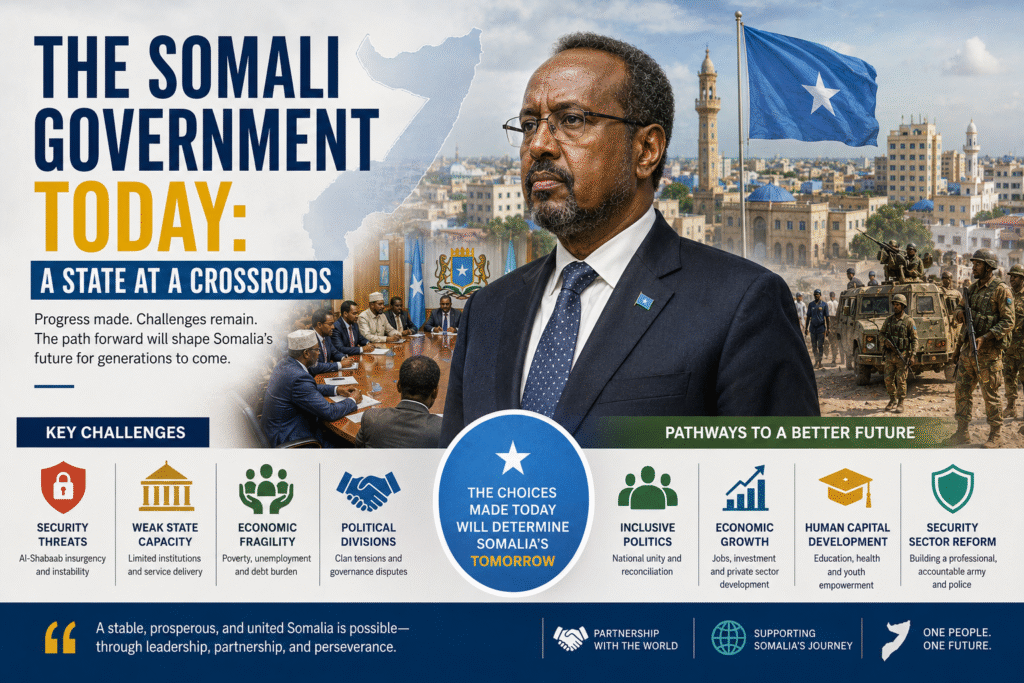
Introduction: A Historic but Perilous Transition
As of May 16, 2026, the Federal Government of Somalia stands at one of the most consequential and precarious junctures in its post-civil war history. President Hassan Sheikh Mohamud has declared the official implementation of a new constitution, shifting the nation toward direct elections and a presidential system . Yet this historic transition coincides with the formal expiration of his original four-year mandate, a collapsing political dialogue with opposition leaders, a grinding military campaign against Al-Shabaab, and a humanitarian crisis now pushing six million people toward famine . This article examines the state of Somalia’s government today across its political, security, economic, and humanitarian dimensions.
Part 1: The Constitutional Revolution — A New System Takes Shape
The most significant development of the past week was President Mohamud’s announcement of the official launch of Somalia’s new constitution. Speaking during National Youth Day celebrations on May 15, the president declared that the separation between parliament and the federal government would soon take effect, with the current government’s term now scheduled to end on May 15, 2027 — not May 15, 2026 .
The constitutional amendments, approved by parliament in March 2024, represent a fundamental restructuring of Somali governance. The system is shifting from a parliamentary to a presidential model, with the president to be elected directly by the public rather than by parliament. The presidential term has been extended from four to five years, and the president now has the authority to appoint and dismiss the prime minister .
Perhaps most radically, the reforms introduce a three-party political system, replacing the clan-based power-sharing model that has governed Somali politics for decades. The number of members of the federal electoral commission will also increase to 18 .
In a formal press release issued on May 15, the Federal Government reaffirmed its “commitment to implement a one-person, one-vote electoral system that grants citizens the opportunity to exercise their constitutional rights,” describing the country as having entered “a historic phase of transition toward a democratic system founded on the principle of universal suffrage and direct elections” .
Part 2: The Mandate Crisis — May 15 and the Opposition Challenge
Yet even as the government celebrates this constitutional milestone, the political opposition and several federal member states refuse to recognize its legitimacy. The opposition argues that under the 2012 Provisional Constitution, President Mohamud’s four-year mandate expired on May 15, 2026 — the date of his original election in 2022 .
Three days of talks convened by foreign diplomats at Mogadishu’s Halane compound ended on May 15 without resolving this fundamental dispute. The government defended its plan for direct, one-person-one-vote elections, while the opposition demanded a broader discussion on the electoral process and a revised version of the traditional indirect voting system .
The United Nations Transitional Assistance Mission in Somalia (UNTMIS) expressed regret that the talks had again ended without resolving major disputes, urging Somali leaders “to find a constructive way forward and unite to address the country’s severe challenges” .
For its part, the Federal Government maintains that “the door to dialogue, consultation, and constructive engagement remains open” — even as it proceeds with its electoral plan . Opposition leaders and some regional states have warned that, without a final agreement, they will cease recognizing the government’s legitimacy .
Part 3: Diplomatic Maneuvering — The Turkish Card
Hours after the talks collapsed and his original mandate expired, President Mohamud met with Turkey’s ambassador to Somalia, Alper Aktaş, at the Villa Somalia presidential palace . The high-profile meeting was widely interpreted as a signal that the government is pivoting away from domestic consensus-building and toward external alliances to cement its contested legitimacy.
A presidential statement said Mohamud thanked Ankara for its continuous support in counter-terrorism and infrastructure, adding that the two discussed “strengthening strategic cooperation” . Turkey has long been a key power broker in the Horn of Africa, providing substantial military training, budgetary support, and humanitarian aid.
However, Ankara’s deep involvement has drawn criticism from Mohamud’s opponents, who have previously accused Turkey of interfering in local political disputes. As one political analyst in Mogadishu put it: “Villa Somalia is signaling that the chapter on domestic dialogue at Halane is closed. They are looking outward to cement their contested legitimacy through external alliances” .
The United States, meanwhile, has denied reports that it is directly mediating the political dispute. Acting U.S. Ambassador to Somalia Justin Davis said Washington is “not hosting or leading mediation talks” and that “Somalia’s political future must be decided by Somalis and their leaders” .
Part 4: The Security Front — Military Gains Against Al-Shabaab
While the political crisis dominates headlines, Somalia’s military campaign against Al-Shabaab continues unabated. On May 14, the Somali National Army (SNA) killed at least 50 Al-Shabaab fighters during a coordinated military operation on the outskirts of Baidoa in Southwest State .
The Ministry of Defense reported that forces destroyed multiple technical battle vehicles, weapons caches, and operational equipment used by the militant group during the assault. The operation was launched in response to an attack carried out by armed fighters targeting security forces .
In a separate intelligence-led operation, Somalia’s National Intelligence and Security Agency (NISA), in cooperation with international partners, conducted an airstrike in the Hiiraan region that wounded at least three senior Al-Shabaab leaders. The agency identified the wounded commanders as Ali Hussein, a militia leader responsible for attacks in central Somalia; Mowliid Jiis, the group’s representative in Bulo Burde district; and Mohamed Hiiraan, the group’s representative in Jalalaqsi district .
The ministry also used the occasion to issue a pointed warning: “The government reaffirms that it will never tolerate any individual or group using weapons or armed militias for political purposes or to undermine national security. Anyone supporting terrorists or providing them cover will face action in accordance with the law” .
Part 5: The Economic Reality — Growth Slows, Shocks Multiply
Behind the political and military headlines, Somalia’s economy is facing significant headwinds. According to the World Bank’s Eleventh Edition of the Somalia Economic Update, released on May 13, economic growth moderated to an estimated 3 percent in 2025, down from about 4 percent in 2023–24. Declining foreign aid, drought conditions, and rising living costs have weighed on demand, leaving real GDP per capita broadly stagnant .
Inflationary pressures have accelerated, with consumer price inflation reaching 3.7 percent in 2025 compared to 3.3 percent in 2024, driven mainly by food, utilities, and transport costs. Looking ahead, real GDP growth is projected at just 2.8 percent in 2026 and 3.1 percent in 2027, constrained by continued aid reductions, climate variability, global price shocks, and limited productive capacity. Inflation is projected to rise to 6 percent in 2026 .
The global shock to oil prices following the closure of the Strait of Hormuz has hit Somalia especially hard. The country relies on imports for 90 percent of its basic goods. Since the closure, fuel prices have gone up from US$0.60 to $1.50 per liter, and the cost of staples including rice, flour, and cooking oil have risen by 50 percent .
The World Bank also highlighted a critical structural vulnerability: with electricity generation nearly entirely diesel-based, increases in global fuel prices transmit quickly to domestic inflation, production costs, and household welfare. While 71 percent of households report access to electricity, only 21 percent receive more than eight hours of supply per day .
Part 6: The Humanitarian Crisis — Six Million at Crisis Hunger Levels
The economic shocks are translating directly into human suffering. New Integrated Food Security Phase Classification (IPC) data released this week shows that 6 million people in Somalia are facing crisis levels of hunger or worse — exceeding earlier predictions and with conditions expected to worsen further without urgent action .
More than 1.9 million people are at IPC Phase 4 (Emergency) — one step below famine. Separately, 1.88 million children under the age of 5 are at risk of malnutrition over the course of the year. Humanitarians have warned that communities in Burhakaba district, Bay Region, will face IPC 5 (famine) levels by June unless there is an immediate scale-up of humanitarian assistance .
The crisis is compounded by displacement. This year, over 550,000 people have been displaced in Somalia, with 91 percent driven by drought-related impacts. This adds to 3.3 million already displaced people in the country .
Yet Somalia’s humanitarian response is critically underfunded, with only 15 percent of requested funds secured. As Mohamed Abdi, Somalia country director for the Norwegian Refugee Council, warned: “Six million people facing crisis level hunger in Somalia is worse than what was predicted, and the figures will keep rising. We are watching this deteriorate in real time while the resources to stop it are not there” .
Part 7: The Way Forward — Challenges and Prospects
The Somali government today faces a daunting array of interconnected challenges. Politically, it must navigate a legitimacy crisis with an opposition that refuses to recognize its mandate beyond May 15. The constitutional transition to direct elections — however historic — cannot succeed without broad political consensus, and the collapse of the Halane talks suggests that consensus remains distant.
Security forces continue to make gains against Al-Shabaab, killing senior commanders and disrupting militant operations. Yet the group remains capable of attacks, and the government’s warning against “armed militias for political purposes” hints at the complex task of demobilizing non-state armed groups beyond the jihadist insurgency .
Economically, the World Bank’s projections point to sluggish growth, rising inflation, and structural vulnerabilities that leave households exposed to global price shocks. The reliance on diesel-generated electricity — and therefore on imported fuel — makes the entire economy vulnerable to disruptions like the Hormuz Strait closure .
Humanitariarily, the situation is dire. Six million people face crisis hunger levels, and the response is only 15 percent funded. Without a dramatic influx of resources, famine in Burhakaba and other districts appears increasingly likely .
Conclusion: A Government Fighting on Multiple Fronts
The Federal Government of Somalia today is simultaneously a revolutionary government, implementing the most fundamental constitutional changes since the civil war began; a contested government, facing an opposition that denies its legitimacy; a wartime government, prosecuting a military campaign against a resilient insurgency; and a crisis government, struggling to respond to a humanitarian emergency of staggering proportions.
President Mohamud has staked his political legacy on the transition to direct, one-person-one-vote elections — a vision that would finally break with Somalia’s decades-long reliance on clan-based indirect voting. But that vision cannot be realized through unilateral action alone. It requires the kind of political consensus that, this week, proved elusive.
As the UN has urged, Somalia’s leaders must “find a constructive way forward and unite to address the country’s severe challenges” . Whether they can do so — and whether the international community will provide the resources needed to avert famine — will determine not just the fate of this government, but the future of the Somali people.
