

Introduction: The Clock Ticks Toward May 15
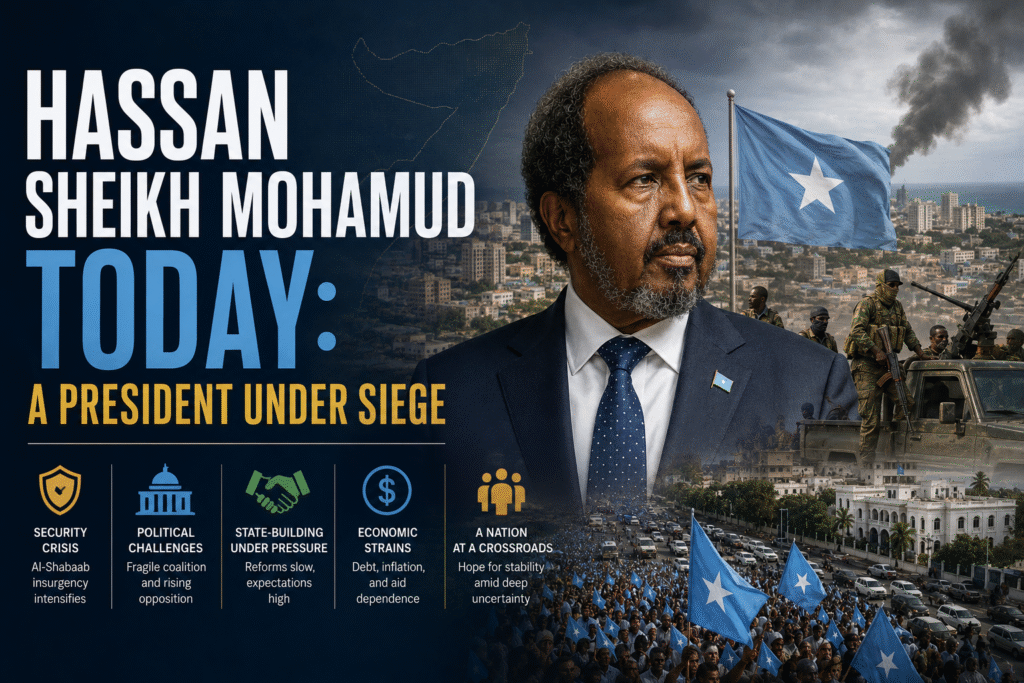
For President Hassan Sheikh Mohamud, the past seven days have been among the most turbulent of his second term. As Somalia’s fragile political order hangs in the balance, the president finds himself simultaneously navigating a domestic legitimacy crisis, an increasingly bold opposition, a high-stakes diplomatic offensive, and the ever-present threat of Al-Shabaab terrorism. With his political opponents declaring that his mandate expires on May 15, 2026—just days away—Mohamud is fighting on multiple fronts to preserve his authority and his vision for Somalia’s democratic future. This article examines the president’s activities, challenges, and strategic calculations during this critical week.
Part 1: The Mandate Crisis – May 15 as a Political Cliff
The central challenge confronting President Mohamud today is not military but constitutional. A deepening dispute over the expiration date of his presidential mandate has brought Somalia to the edge of another political crisis, reviving painful memories of the 2021 standoff that plunged Mogadishu into armed clashes .
The opposition, grouped under the Somali Future Council, argues that Mohamud’s four-year mandate expires on May 15, 2026, as he was elected on May 15, 2022, following a long-delayed indirect election . Their position is unambiguous: after that date, they will regard him as “an ordinary citizen like the rest of the people” .
The president and his allies offer a counter-argument rooted in recent constitutional changes approved by parliament. They maintain that the new provisions allow federal institutions to remain in office for five years, meaning the mandate would end on May 15, 2027 . To the opposition, this is a unilateral power grab. To Mohamud, it is the legitimate implementation of constitutional reforms.
The stakes could hardly be higher. The last time Somalia faced a term-extension crisis in April 2021, the security forces split, rival factions clashed inside Mogadishu, and the country teetered on the brink of open warfare. For Mohamud, preventing a repeat of that scenario is an absolute priority .
Part 2: The May 10 Talks – A Fractured Dialogue
In a direct response to the mounting pressure, President Mohamud extended an invitation to opposition leaders for talks scheduled on May 10, 2026 . The invitation, issued following consultations with politicians, former leaders, traditional elders, and broader Somali society, was framed as an opportunity to discuss “nationally decisive issues”: elections, state-building, national unity, and Somalia’s future political direction .
The European Union, the United Nations, and the United Kingdom all publicly welcomed the invitation, urging the opposition to respond positively and engage constructively. Francesca Di Mauro, the EU ambassador to Somalia, expressed hope for “a constructive way forward…especially on elections” .
Yet the May 10 talks, held inside the heavily guarded Aden Abdulle Osman International Airport compound under the watch of the National Intelligence and Security Agency, ended without agreement . President Mohamud and Deputy Prime Minister Salah Ahmed Jama represented the federal government, facing an opposition delegation led by Puntland President Said Abdullahi Deni and former President Sharif Sheikh Ahmed.
The two sides remained fundamentally divided. The government defended its plan for direct, one-person-one-vote elections, pointing to ongoing voting in districts of Southwest State as evidence of progress . The opposition demanded a broader discussion on the electoral process, including the role of federal member states, arguing that direct elections should not move forward without wider political consensus .
Despite the impasse, both sides reportedly agreed to continue talks, meeting again on May 14—a slender thread of hope that dialogue might yet prevent a unilateral declaration of mandate expiry .
Part 3: Securing Mogadishu – Reinforcing the Capital
With the political temperature rising, President Mohamud’s government has taken decisive action to secure the capital against potential unrest. In the days leading up to the May 10 talks, Somali authorities reinforced checkpoints leading into Mogadishu, deploying additional police units to strategic entry points .
Security sources confirmed that reinforcements were sent to checkpoints outside Mogadishu, with additional forces deployed in Balcad and Afgoye—two strategic towns north and southwest of the capital . The Somali Police Force, under General Asad Osman Abdullahi, ordered station commanders to strengthen security across the Banadir region and ensure that all vehicles entering and leaving Mogadishu undergo thorough security procedures .
Officials familiar with the operation acknowledged that authorities were “not taking any chances” after the traumatic experience of 2021, when rival security factions clashed inside Mogadishu during the previous term-extension crisis . The reinforced checkpoints serve a dual purpose: preventing armed movements toward the capital while demonstrating the government’s determination to maintain order amid political turbulence.
Part 4: Regional Diplomacy – The Kampala Track
Even as the domestic political crisis intensified, President Mohamud continued to project Somalia’s presence on the regional stage. On May 12, he traveled to Kampala, Uganda, to attend the swearing-in ceremony of President Yoweri Museveni for a seventh term in office .
The occasion provided a valuable diplomatic opportunity. On the margins of the ceremony, President Mohamud met with Saudi Deputy Foreign Minister Waleed bin Abdulkarim El-Khereiji, who was representing Saudi Crown Prince Mohammed bin Salman at the inauguration . The discussions focused on bilateral relations, cooperation between Somalia and Saudi Arabia, and ways to strengthen ties—reinforcing the Kingdom’s importance as a diplomatic and economic partner for Somalia .
President Mohamud was also among the regional leaders hosted by Museveni at a state dinner at Speke Resort Munyonyo, alongside South Sudan’s Salva Kiir, representatives from the Democratic Republic of the Congo, and Rwanda’s Prime Minister . These interactions, while ostensibly ceremonial, allow Mohamud to maintain crucial regional relationships and signal that despite domestic turbulence, Somalia remains an engaged member of the East African community.
Part 5: Strengthening International Alliances – The Algerian Letter
Beyond East Africa, President Mohamud has been actively cultivating relationships with North African powers. Earlier this week, Somali Interior Minister Ali Yusuf Hosh delivered a personal letter from President Mohamud to Algerian President Abdelmadjid Tebboune in Algiers .
The letter expressed “profound gratitude and high consideration” for Algeria’s role in supporting just African and Arab causes, according to the Somali minister’s statement to the press . Minister Hosh described Algeria as “a strategic partner” for Somalia and “a support to its sovereignty and stability,” noting that the North African nation has “always carried the voice of Somalia in regional and international forums” .
The timing of this diplomatic outreach is significant. As Somalia faces internal political pressure and continues its long struggle against Al-Shabaab, cultivating relationships with influential African powers like Algeria provides diplomatic backing and potential support for Somalia’s positions in continental and international bodies. The discussions also touched on security cooperation, stability, and the fight against terrorism and extremism—issues at the core of Mohamud’s agenda .
Part 6: Learning from Africa – The Burkina Faso Security Model
President Mohamud’s security strategy extends beyond traditional alliances to innovative models emerging from fellow African nations grappling with similar challenges. In a significant development this month, Somalia formally expressed interest in adopting aspects of the “Burkinabè Model” for its national security overhaul .
Following an official visit to Ouagadougou by Somali Minister of Internal Security General Abdullahi Sheikh Ismail, the Somali delegation indicated that Burkina Faso’s recent security reforms—which integrate security, governance, and national development—could serve as a blueprint for Somalia’s own institutional restructuring .
The delegation toured key strategic sites, including the National Police Academy, the Video Surveillance Command Center, and the Faso Mêbo Agency, before meeting with President Ibrahim Traoré. During that meeting, General Ismail delivered a message from President Mohamud underscoring that “African solidarity is the essential prerequisite for overcoming the continent’s intertwined security and development obstacles” .
This initiative reflects Mohamud’s pragmatic approach to counter-terrorism. Rather than relying solely on external partners, he is seeking to learn from African peers who have developed innovative solutions to jihadist insurgencies. Burkina Faso’s experience in integrating security with governance and development offers lessons that could prove valuable in Somalia’s own fight against Al-Shabaab.
Part 7: The Vision – One Person, One Vote
Amid the crisis management and diplomatic maneuvering, President Mohamud has not lost sight of his core political vision: transitioning Somalia from indirect elections to universal suffrage. Just weeks ago, in late March, he inaugurated a newly reconstructed road in Mogadishu—a tangible symbol of recovery and progress—and used the occasion to reaffirm his commitment to electoral reform .
“Our goal is to regulate politics and return power to the people,” Mohamud declared at the ceremony. “It is not possible for an individual or a few individuals to decide the fate of millions of Somalis. An election is one person and one vote, so be prepared” .
This vision remains deeply contentious. Puntland, Jubbaland, Southwest state, and major opposition groups all reject the federal government’s direct election plans, citing security challenges, lack of political consensus, and the incomplete readiness of political parties . The opposition accuses Mohamud of pushing through electoral reforms without consensus, while the president argues that direct elections are the only way to end Somalia’s decades-long reliance on elite bargaining and indirect voting.
The May 15 mandate crisis is, in many ways, a battle over this vision. If Mohamud is forced from office—or his legitimacy fatally undermined—his dream of one-person, one-vote elections may die with his presidency. If he survives the political storm, he may yet have the opportunity to lead Somalia toward that democratic horizon.
Part 8: The Road Ahead – What Comes After May 15?
As the clock ticks toward May 15, the immediate question is not electoral reform but political survival. The opposition has vowed peaceful resistance and mass mobilization if Mohamud remains in office beyond what they consider his constitutional term . The government has reinforced Mogadishu’s security cordon and insists that the constitutional changes justify a five-year mandate .
International partners—the EU, UN, UK, and others—have consistently urged dialogue, welcoming Mohamud’s invitation to talks while stopping short of endorsing either side’s position on the mandate dispute . Their hope is that continued negotiations can produce a compromise that avoids the violence of 2021.
Whether that hope is realized depends on the willingness of both sides to find common ground. The talks resumed on May 14, according to sources familiar with the discussions . If they fail, Somalia could face its most severe political crisis since the civil war—a crisis that would test not only President Mohamud’s leadership but the very fabric of the Somali state.
Conclusion: A President Fighting for His Political Life
Today, Hassan Sheikh Mohamud stands at the most precarious moment of his political career. A former president who returned to power in 2022 promising stability, reform, and democratic transformation, he now finds himself fighting for his political survival against an opposition that refuses to recognize his legitimacy beyond the coming days.
Yet even as the domestic crisis intensifies, Mohamud continues to project strength internationally—cultivating relationships with Algeria, engaging Saudi Arabia, learning from Burkina Faso, and maintaining regional alliances. His vision of a democratic Somalia with one-person, one-vote elections remains alive, even if its path forward is anything but certain.
The coming days will determine whether President Mohamud’s second term continues or collapses. For now, he governs from a capital ringed by reinforced checkpoints, negotiating with opponents who would see him leave office, while keeping one eye on the clock and the other on a democratic dream that remains tantalizingly out of reach.