

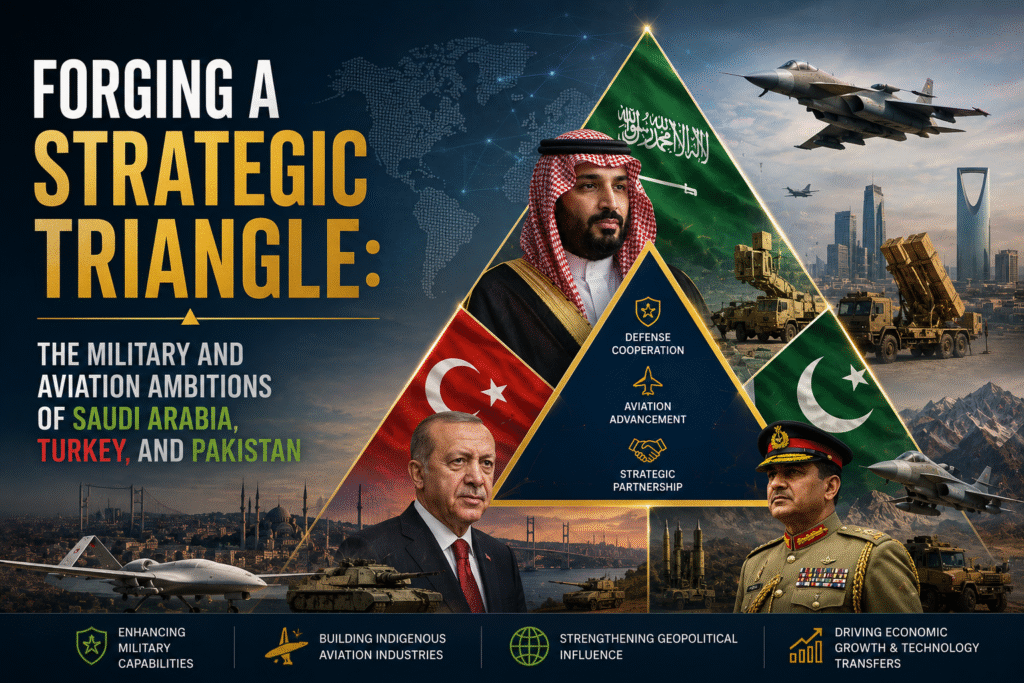
Introduction: A New Axis Takes Shape
As global power dynamics shift and traditional alliances show signs of strain, three nations stretching from the Mediterranean to the Indus River are quietly building what analysts describe as a potentially transformative strategic alignment. Saudi Arabia, Turkey, and Pakistan—bound by shared Islamic identity and converging security concerns—are deepening military cooperation while simultaneously modernizing their aviation sectors. This comprehensive analysis examines the defense and airline developments across these three pivotal states, revealing how they are positioning themselves for a multipolar future.
Part 1: The Strategic Mutual Defence Agreement – A New Security Architecture
At the heart of this emerging alignment lies the Strategic Mutual Defence Agreement (SMDA) signed between Pakistan and Saudi Arabia in September 2025. This landmark pact, inked during Prime Minister Shehbaz Sharif’s visit to Riyadh, formalized what had long been an informal security relationship . The agreement’s core provision is significant: it treats aggression against either nation as an act of aggression against both .
What makes this development remarkable is its timing. The pact came just months after Pakistan’s decisive military victory over India in May 2025, during which Pakistan downed multiple Indian fighter jets, including three Rafale aircraft . This demonstration of military capability appears to have accelerated strategic discussions across the region.
Part 2: Turkey’s Bid to Join – From Bilateral to Trilateral
The SMDA’s significance grew exponentially when Turkey entered advanced talks to join the framework. According to Bloomberg reporting from January 2026, Turkey’s potential accession would create a new security alignment that “could shift the balance of power in the Middle East and beyond” .
Pakistan’s Defence Production Minister, Raza Hayat Harraj, confirmed in January 2026 that a draft trilateral defence cooperation agreement had been prepared after nearly a year of negotiations . While the framework awaits final approval, its existence signals a fundamental rethinking of regional security architecture. Turkish Foreign Minister Hakan Fidan acknowledged the talks, though he emphasized that no final agreement had been signed, reflecting the careful diplomatic calibration underway .
Part 3: Why Now? The Erosion of Trust in Western Guarantees
The driving force behind this alignment is not ideological but practical: a growing perception that Western security guarantees are no longer reliable. The Trump administration’s 2025 National Security Strategy explicitly identified the Middle East as a region of diminished strategic importance, citing America’s emergence as a net energy exporter .
This shift has profound implications. “The US prioritized protecting Israel during the [Israel-US-Iran] war, and that will change the Gulf countries’ strategic outlook,” explained Barin Kayaoglu, Assistant Professor at the Social Sciences University of Ankara . For Saudi Arabia, which has relied on American security umbrellas for decades, this realization has prompted urgent diversification of security partnerships.
Part 4: The Iran War as a Catalyst
The ongoing conflict between the US-Israel alliance and Iran has served as a dramatic accelerator. During the war’s second month, foreign ministers from Pakistan, Saudi Arabia, Turkey, and Egypt convened in Islamabad for two days of talks focused on regional stability . This followed a similar gathering in Riyadh, signaling an emerging pattern of coordinated diplomacy.
Pakistan has positioned itself as a potential mediator, confirming that it transmitted a 15-point US proposal to Iran and relayed Iranian responses back to Washington . This diplomatic role leverages Pakistan’s unique position—maintaining working relations with both sides while hosting no direct talks—to serve as an honest broker.
Part 5: The Division of Labor – What Each Nation Brings
The proposed trilateral arrangement is built on complementary strengths. Saudi Arabia provides the financial muscle, capable of funding joint ventures and co-production arrangements. Turkey offers advanced defense technology—particularly its battle-proven drone systems like the Bayraktar—alongside the second-largest army in NATO and operational experience . Pakistan contributes the Muslim world’s only nuclear deterrent, a large combat-experienced military, and decades of maintenance expertise .
Analysts describe this as a “Sunni Super-Bloc” designed to create inter-regional collective security independent of Western or Chinese orbits . Rather than a NATO-style mutual defense clause, however, the framework emphasizes incremental, flexible collaboration—a pragmatic approach suited to a volatile regional environment .
Part 6: Defense Industrial Cooperation – Beyond Traditional Alliances
The proposed agreement places strong emphasis on defense-industrial cooperation rather than merely military coordination. Likely areas include drones, air and missile defense systems, naval platforms, and electronic warfare . This approach reduces costs, enhances indigenous capabilities, and mitigates vulnerabilities arising from sanctions or export restrictions.
For Saudi Arabia, which under Vision 2030 aims to localize 50% of military spending by 2030, access to Turkish technology and Pakistani operational capacity offers tangible benefits without the political constraints of formal alliance structures .
Part 7: The Kaan Fighter Program – A Fifth-Generation Game Changer
One of the most visible manifestations of this deepening cooperation is Turkey’s Kaan fifth-generation fighter program. At the World Defense Exhibition (WDS) 2026 in Riyadh, Turkish Aerospace Industries confirmed that talks with Saudi Arabia regarding participation in the KAAN fighter program had reached their final stages, with a potential decision expected during 2026 .
This development has generated unease in Washington. US officials reportedly expressed frustration over Riyadh’s exploration of alternative advanced aerial capabilities, particularly following the 2025 agreement to supply the Kingdom with Lockheed Martin’s F-35 Lightning II . Turkey itself has been suspended from the F-35 program since acquiring Russian S-400 missile systems.
However, the prospective F-35 sale to Saudi Arabia faces complications. Any transfer would likely involve aircraft with limited capabilities and significant restrictions on modifications to preserve Israel’s Qualitative Military Edge. Given these limitations, Riyadh finds appeal in partners offering advanced capabilities with fewer restrictions .
Part 8: The Gökbey Helicopter – Joint Production Takes Flight
Another concrete achievement emerged from the WDS 2026 exhibition. Türkiye and Saudi Arabia agreed to the joint production of the Gökbey helicopter, a multi-role utility aircraft developed by Turkish Aerospace Industries. The agreement, signed between TAI, the Saudi Ministry of Investment, and the General Authority for Military Industries, paves the way for local manufacturing of the helicopter in Saudi Arabia, with production scale depending on order size .
This represents precisely the kind of technology transfer and industrial cooperation that Saudi Arabia seeks—moving beyond simple arms purchases toward genuine domestic manufacturing capability.
Part 9: Pakistan’s YALGHAR-200 – A Suicide Drone with Strategic Range
Pakistan also showcased its growing indigenous defense capabilities at WDS 2026. The YALGHAR-200 suicide drone, unveiled during the exhibition, combines reconnaissance and precision strike capabilities within a single platform. With a range of up to 200 kilometers, it offers an efficient alternative to conventional cruise missiles .
Such systems are increasingly valuable in modern warfare, as demonstrated by the effectiveness of drone warfare in Ukraine, Nagorno-Karabakh, and ongoing Middle Eastern conflicts. Pakistan’s ability to produce such systems cost-effectively positions it as a valuable partner for both Saudi Arabia and Turkey.
Part 10: Saudi Arabia’s F-15 Fleet – The American Option Remains
Despite the pivot toward Turkish and Pakistani partnerships, Saudi Arabia continues to engage with traditional Western suppliers. At WDS 2026, Boeing executives confirmed talks with the Royal Saudi Air Force regarding potential upgrades to its substantial F-15 fleet—the second-largest in the world after the US Air Force, comprising approximately 232 aircraft .
The discussion involves two tracks: upgrading existing aircraft to the advanced F-15EX standard, which would include Raytheon APG-82 active electronic scanning radar, large cockpit displays, and improved electronic warfare systems; or potentially purchasing new aircraft. The US Defense Security Cooperation Agency has already outlined a potential $3 billion support package for the existing F-15 fleet .
This dual-track approach—pursuing both Western and alternative partnerships—represents Saudi Arabia’s sophisticated hedging strategy, maintaining traditional relationships while building new ones.
Part 11: Riyadh Air – A New Aviation Powerhouse
Beyond military aviation, Saudi Arabia is transforming its civilian aviation landscape. Riyadh Air, the Kingdom’s new national carrier backed by the Public Investment Fund, has filed slot requests targeting 15 international destinations for its opening commercial network .
The destinations include Amman, Bangkok, Cairo, Dubai, Islamabad, Jakarta, Jeddah, Kuala Lumpur, Lahore, London Heathrow, Madrid, Manchester, Manila, Mumbai, and Paris. Notably, multiple Pakistani cities appear on this list—Islamabad and Lahore—reflecting the deep people-to-people and economic ties between the two nations .
Riyadh Air has built its fleet around three aircraft types: 60 Airbus A321neo aircraft for regional routes, 39 Boeing 787-9 Dreamliners for medium and long-haul services, and 25 Airbus A350-1000 aircraft for high-capacity markets. The airline aims to position King Khalid International Airport as a major East-West transit hub, offering alternatives to established Gulf carriers .
Part 12: Turkish Airlines and Pakistan International Airlines – Regional Connectivity
While Riyadh Air represents Saudi Arabia’s future-focused expansion, existing carriers continue to play vital roles. Turkish Airlines has long served as a bridge between East and West, leveraging Istanbul’s geographic position to offer connections to more countries than any other airline.
The aviation relationship between Turkey and Pakistan has strengthened alongside defense cooperation. Turkish companies have provided maintenance and upgrade services for Pakistan International Airlines’ fleet, and codesharing arrangements facilitate passenger movement between the two countries. Similarly, Saudi carriers maintain substantial operations to Pakistan, serving the large Pakistani expatriate workforce in the Kingdom.
Part 13: Challenges and Constraints – The Limits of Cooperation
Despite the optimistic trajectory, significant challenges remain. Turkey’s Kaan fighter program, while progressing well, likely needs five to ten years to match American capabilities in areas such as missile defense . The program remains developmental rather than operational, limiting its near-term utility.
Furthermore, the trilateral framework lacks a single binding treaty. Instead, it operates through overlapping bilateral agreements, repeated high-level meetings, and ongoing discussions about formalizing cooperation . This structure provides flexibility but also lacks the institutional weight of NATO-style alliances.
There are also geopolitical complications. Pakistan must balance its deepening ties with Saudi Arabia and Turkey against its relationships with China—which supplies much of its advanced military equipment—and the United States. Similarly, Turkey remains a NATO member, and its pivot toward alternative alignments cannot come at the cost of its Western relationships.
Part 14: Looking Ahead – What the Strategic Trio Means for Regional Security
As 2026 progresses, several developments bear watching. The potential formalization of the trilateral defence agreement would represent a significant milestone, creating structured consultation mechanisms for coordinated crisis response . Even without a mutual defence clause, such coordination complicates adversaries’ calculations by implying that pressure on one partner could entail broader consequences .
The aviation relationship will likely deepen alongside defense cooperation. Riyadh Air’s launch, expected in early 2026, could include expanded codeshares with Turkish Airlines and Pakistan International Airlines. Military-to-military ties may extend to civilian aviation training and maintenance.
Ultimately, the emerging strategic trio reflects a broader realignment—one where regional powers increasingly seek self-reliance and diversified partnerships rather than dependence on any single external guarantor. As the writer in Pakistan Observer concluded, this alliance “could also strengthen non-Western global governance initiatives and challenge existing power structures in the Middle East and beyond” .
Whether this potential translates into enduring strategic reality will depend on the three nations’ ability to navigate competing interests, maintain momentum, and deliver tangible benefits to all parties. But the direction of travel is clear: from the Mediterranean to the Indus, a new alignment is taking shape, one flight and one defense agreement at a time.
