

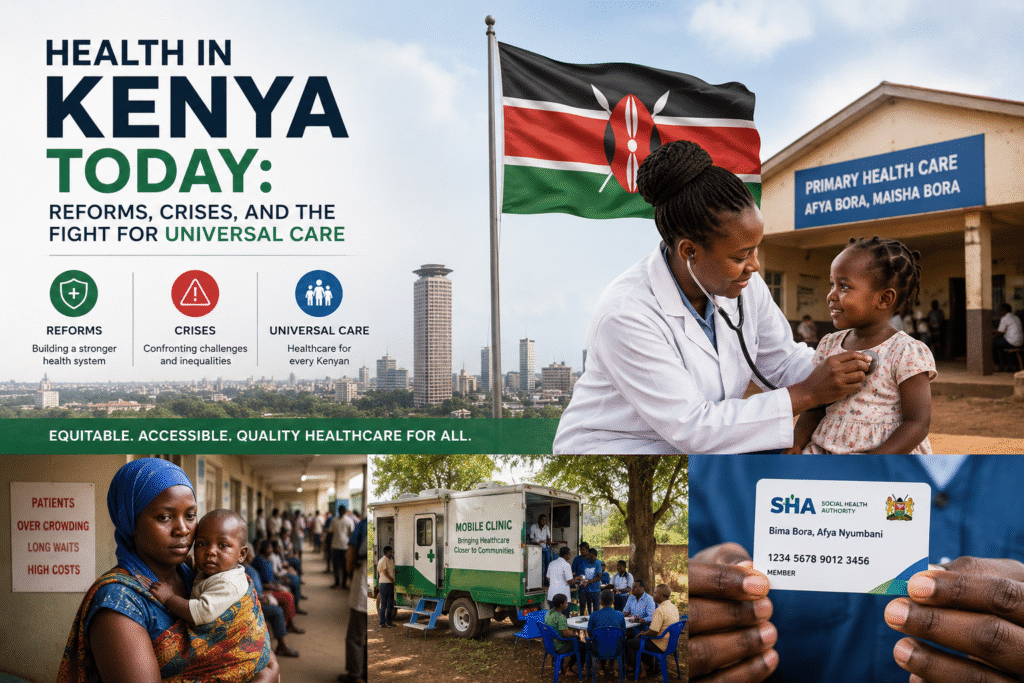
Nairobi, Kenya — On a sweltering morning at Nakuru County Referral Hospital, long queues snake through crowded corridors. Two doctors are meant to attend to the torrent of patients, but today neither has shown up. Only four clinicians are available to serve hundreds. Broken toilets go unrepaired. The maternity ward, which handles over 1,000 deliveries monthly, operates under constant strain .
This scene, witnessed recently by the Senate Committee on Health, captures the paradox of healthcare in Kenya today . On one side stand ambitious reforms: over 30 million Kenyans registered for health coverage, digital systems being deployed nationwide, and partnerships with global health giants. On the other side lie crumbling county hospitals, striking doctors, and an AI-driven insurance algorithm that critics say is systematically overcharging the poor .
As 2026 unfolds, Kenya finds itself at a critical juncture in its decades-long quest for Universal Health Coverage (UHC). The path forward is paved with both unprecedented innovation and deep, structural crises.
Part 1: The Promise of Universal Coverage
Kenya’s flagship health policy remains the Social Health Authority (SHA), launched in October 2024 to replace the decades-old National Hospital Insurance Fund . The ambition is audacious: to bring healthcare to Kenya’s massive informal economy—the 83% of workers who are day labourers, hawkers, farmers, and non-salaried employees .
As of April 2026, Health Cabinet Secretary Aden Duale reported that over 30.5 million Kenyans have been onboarded to the SHA, with KES 93.4 billion disbursed to facilities . The government has connected 10,277 health facilities to national digital systems and deployed over 30,000 digital devices to support the new “Taifa Care Model” . Community health promoters—107,000 strong—have been deployed to bring services closer to households .
“We are firmly committed to ensuring that no Kenyan is left behind,” President William Ruto promised during his campaign . Yet on the ground, the reality has proven far more complicated.
Part 2: The Algorithm That Failed the Poor
At the heart of the SHA is an artificial intelligence system that was supposed to revolutionize healthcare financing. Instead, it has sparked protests, anger, and fears that the poorest Kenyans are being priced out of survival .
The system uses a predictive machine learning algorithm to determine how much each household must pay for public health insurance . Government volunteers visit homes and ask intrusive questions: What type of toilet do you use? What is your roof made of? Do you own a radio? The answers feed into an opaque formula that calculates a household’s deemed income and, consequently, its monthly premium .
An investigative audit by Africa Uncensored, Lighthouse Reports, and the Guardian has revealed systemic failures . The algorithm systematically overcharges the poorest Kenyans—overestimating their incomes—while undercharging the wealthiest by underestimating theirs . Families already struggling to feed themselves are being charged sums equal to 10% to 20% of their meager earnings .
David Khaoya, a health economist who advised Kenya’s health ministry, said a choice was made: the system could either correctly assess poor households or correctly assess rich ones. The government chose to prioritize accurately evaluating the wealthy .
The human cost is devastating. Grace Amani, a government volunteer who registers households in Nairobi’s poorest communities, has watched families choose between paying SHA premiums, buying food, or paying rent. “People are dying, people are suffering,” she said. “People are dying at home” .
Part 3: One Health System, Two Realities
The gap between national ambition and county reality yawns wide. While the Ministry of Health celebrates digital transformation and enrollment numbers, county referral hospitals are struggling to provide basic services .
At Nakuru County Referral Hospital, a facility that once served the entire Rift Valley Province, the Senate Committee on Health found an acute shortage of doctors, broken-down toilets, poor maternity services, and a lack of pharmaceutical supplies . The facility receives Sh83 million monthly, collects Sh23 million from patients, and receives just Sh60 million in reimbursements from SHA—a shortfall that makes consistent service delivery impossible .
In Embu County, the situation has grown so dire that the Kenya Medical Practitioners, Pharmacists and Dentists’ Union (KMPDU) has threatened to withdraw doctors from health facilities entirely . At Ishiara Level IV Hospital, only seven doctors serve the entire facility. Key services—including maternity, paediatric, and surgical clinics—have been forced to close . Community protests over the healthcare collapse led to clashes with police that left two dead .
Dr Dennis Miskellah, KMPDU National Deputy Secretary, placed the blame squarely on county financial management: “We are tired of healthcare workers being used as scapegoats over failure by the County Government to address the underlying issues, including chronic underfunding of facilities and poor staffing” .
Part 4: The Silent Epidemic of Antimicrobial Resistance
Beyond the headline crises of insurance and infrastructure, a quieter but deadlier threat is emerging. Antimicrobial resistance (AMR) is now killing more Kenyans than tuberculosis, malaria, and HIV combined, health experts warn .
Professor Sam Kariuki, a senior researcher at the Kenya Medical Research Institute (KEMRI), revealed that approximately 27.5 out of every 1,000 deaths in Africa are now linked to infections that no longer respond to antibiotics . During the same period that COVID-19 claimed 3.6 million lives globally, AMR-related illnesses killed nearly five million people .
Common diseases—typhoid, cholera, bacterial bloodstream infections—are becoming harder to treat . The drivers are familiar but deeply embedded: over-the-counter antibiotic sales, poor prescription adherence, inappropriate veterinary practices, and the contamination of the food chain .
Dr Irungu Kamau, head of AMR at the Kenya National Public Health Institute, called for a “One Health” approach linking human, animal, and environmental health . Yet simple measures remain underused: proper handwashing, sanitation, and hygiene could reduce infections by nearly 50 percent .
“We are exposing our bacteria and viruses to traces of antimicrobials, causing them to develop resistance that transmits between humans, animals and through the environment,” Dr Kamau warned .
Part 5: Staffing Crisis and the 114,000-Worker Gap
Every reform—every algorithm, every digital device, every insurance card—depends on one irreplaceable resource: human beings. And Kenya is running dangerously short.
A Health Labour Market Analysis projects that to meet the population’s health needs, more than 114,000 additional health professionals across 31 different roles must be trained, employed, and retained within the health system by 2031 . While Kenya has doubled its production of nurses, doctors, and other health professionals over the past decade, the gap remains immense .
On the ground, this shortage translates into overworked staff, closed wards, and preventable deaths. At Nakuru, two doctors are expected to serve a patient population that requires dozens . At Ishiara, seven doctors cover a facility that once ran multiple specialized clinics—all now shuttered .
The World Health Organization has stepped in with a new partnership with the Novo Nordisk Foundation to strengthen Kenya’s health workforce education . The focus is on competency-based curricula for critical care nursing, general surgery, and community health workers . But training takes time, and Kenya’s needs are immediate.
Meanwhile, unions and county governments remain locked in disputes over hiring. Senator Jackson Mandago, chair of the Senate Committee on Health, has called for creative solutions: recruiting health workers as interns or on contract with a framework to transition them to permanent roles . But such proposals require political will that has often been lacking.
Part 6: Partnerships and the Road Ahead
Despite the crises, there are glimmers of progress—and a recognition that Kenya cannot go it alone.
The government has formalized public-private partnerships with leading institutions. An agreement with Roche has significantly reduced the cost of Herceptin, a critical cancer drug, to SHA rates . SHA beneficiaries can now access specialized services at Aga Khan University Hospital and The Nairobi Hospital—services that were previously out of reach for most Kenyans .
The “Lipa SHA Pole Pole” initiative—a pay-as-you-go financing model—has enrolled 411,011 Kenyans and mobilized Sh1.4 billion in contributions, offering flexible premiums for informal workers . The national government is also sponsoring 558,000 indigent households under the Social Health Insurance Fund, with an additional 62,461 households supported through constituency development funds .
At the Africa Health Business Symposium 2026 in Nairobi, CS Duale called for renewed focus on domestic health financing, enhanced accountability, and reduced reliance on external support amid tightening global aid budgets . The message was clear: Kenya must build a health system that stands on its own feet.
Conclusion
Kenya’s healthcare system in 2026 is a study in contradictions. The same government that has enrolled 30 million citizens in health coverage is struggling to pay its bills to county hospitals. The same digital infrastructure that promised efficiency has delivered an algorithm that punishes the poor. The same clinics that save lives daily are losing staff to burnout and emigration.
Perhaps the most telling testimony comes from Dr Brian Lishenga, chair of Kenya’s Rural and Urban Private Hospitals Association. Having watched the SHA’s AI system fail its most vulnerable citizens, he offered a grim assessment: “This is an experiment that has failed. It’s a really poor tool for identifying poor households. It’s a great tool for helping the government run away from responsibility” .
As Kenya approaches the midpoint of 2026, the path to Universal Health Coverage remains long and uncertain. The ambition is noble. The need is urgent. But between the promise and the reality lie broken toilets, empty clinics, grieving families, and an algorithm that cannot tell the difference between a poor farmer and a wealthy one .
Until those gaps are closed, “health for all” will remain a slogan—not a reality.
