

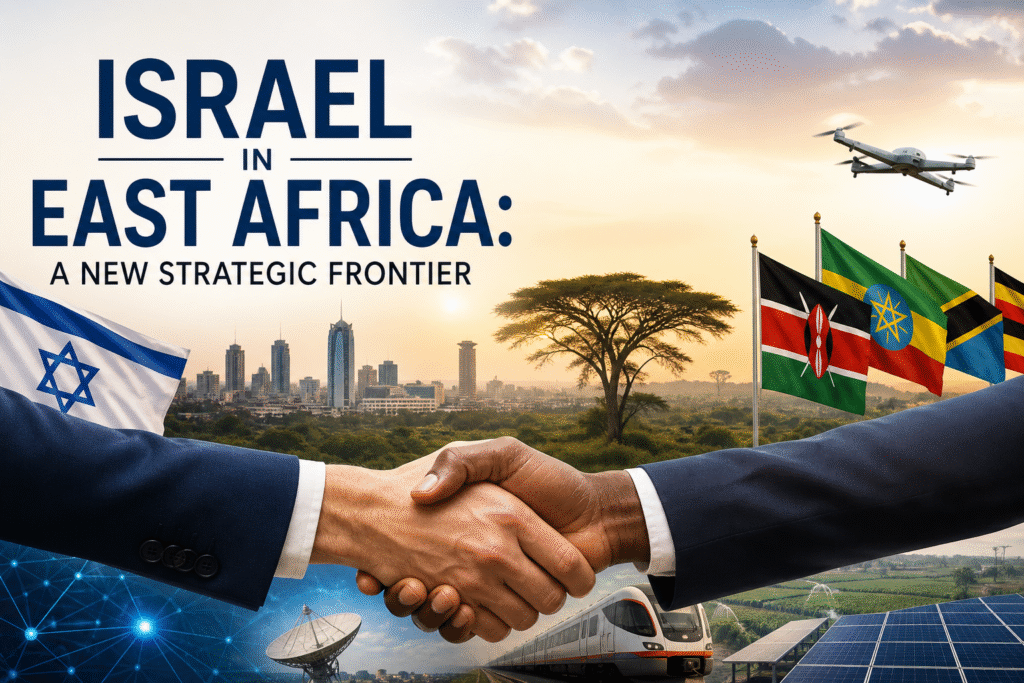
Part 1: The Recognition That Shook the Horn
On December 26, 2025, Israel made a diplomatic move that sent shockwaves across the Horn of Africa and beyond. It became the first—and to date, the only—nation in the world to officially recognize the Republic of Somaliland, a breakaway region of Somalia that has claimed independence for over three decades . For Somaliland, which has operated its own passport system, currency, army, and police since declaring autonomy from Somalia in 1991, the recognition was a long-sought diplomatic breakthrough. For Israel, it represented something far more strategic: a foothold on the Gulf of Aden, at the southern mouth of the Red Sea, within striking distance of the Bab el-Mandeb strait—one of the world’s most critical maritime chokepoints . The move was immediately condemned by Somalia, China, Turkey, Egypt, and the African Union. But for Israeli Prime Minister Benjamin Netanyahu, it was a calculated gamble in a high-stakes geopolitical chess game .
Part 2: A Strategic Alliance Forged in the Red Sea
Why Somaliland? The answer lies in the map. Somaliland’s coastline, anchored by the port city of Berbera, sits directly across the Gulf of Aden from Yemen. This places it at the epicenter of the Red Sea crisis, where Houthi attacks on Israel-linked vessels have disrupted roughly 12 percent of global maritime trade . For Israel, whose economy depends heavily on unfettered access to shipping lanes, establishing a friendly presence on this coast is a matter of national security. Israeli leaders have framed the relationship not merely as diplomatic but as mutually beneficial security cooperation. While Somaliland’s president has denied that establishing an Israeli military base has been formally discussed, Israeli analysts view the partnership as a strategic counterweight to Iranian influence in the region . Within Israel’s intelligence community, the Somaliland relationship is seen as a model—similar to Israel’s strategic partnership with Azerbaijan—for projecting power in a dangerous neighborhood .
Part 3: Minerals, Trade, and “The Sky is the Limit”
Beyond geopolitics, there is the matter of resources. Somaliland’s President Abdirahman Mohamed Abdullahi has been blunt about what his country offers: vast reserves of lithium, critical for electric vehicle batteries; oil and gas deposits; marine resources; arable land; and a substantial livestock population . In return, Somaliland seeks Israeli technology, investment, and trade. “The sky is the limit,” Abdullahi told Reuters . While no formal economic deal has yet been signed, negotiations are underway for a “partnership agreement” that could grant Israeli companies access to Somaliland’s ports, agriculture, and mining sectors—including, potentially, the strategic Berbera port, where the UAE’s DP World is already a major investor . For a nation facing an energy transition and seeking to secure critical mineral supply chains, Somaliland’s untapped geology offers a tempting prize.
Part 4: Accepting an Ambassador—Deepening Ties
The recognition was not merely symbolic. By February 2026, Israel had formalized relations further by accepting the appointment of Somaliland’s first ambassador to Israel, Mohamed Hagi, a close advisor to President Abdullahi . In return, Israel announced it would soon appoint its own ambassador to Somaliland. The Israeli development agency MASHAV has already begun cooperation, holding a course for officials from Somaliland’s Water Authority in Israel . These steps—exchanging envoys, launching technical cooperation, and planning a presidential visit—signal that Israel views its commitment to Somaliland as durable. For Somaliland’s leadership, each step deepens the legitimacy they have sought for decades. For Israel, it locks in a strategic partner at a time when its traditional alliances in the Middle East are being tested.
Part 5: Ethiopia—Israel’s Other Strategic Priority
While Somaliland captured headlines, Israel quietly intensified its relationship with the region’s other major power: Ethiopia. In late February 2026, Israeli President Isaac Herzog arrived in Addis Ababa for a two-day official visit, the most senior Israeli diplomatic foray into East Africa since the recognition of Somaliland . Herzog met with Prime Minister Abiy Ahmed and President Taye Atske Selassie, focusing on trade, agriculture, technology, and regional security . “Our bond is strong, and our shared interests are stronger than any attempt to undermine them,” Herzog said, an apparent reference to rivals seeking to limit Israeli influence in Africa . The visit underscored Ethiopia’s status as a “pivotal country” in Israeli strategy—a nation of 120 million people, a growing economy, and significant diplomatic weight in the African Union.
Part 6: Jerusalem and Addis Ababa—A Historic Friendship
Israel’s relationship with Ethiopia is not new; it is rooted in history and demography. Israel is home to some 170,000 Ethiopian Jews, the majority of whom arrived during operations Moses (1984) and Solomon (1991) . That community provides a human and cultural bridge between the two nations. During his visit, Herzog paid tribute to this heritage, and he also visited the Adwa Victory Memorial Museum, a symbol of Ethiopian resistance to colonialism . For Abiy Ahmed’s government, ties with Israel offer access to advanced agricultural technology, water management expertise, and security cooperation. For Israel, Ethiopia is a gateway to the African Union headquarters in Addis Ababa and a counterbalance to Turkish and Gulf influence in the region . Notably, analysts have linked Israel’s recognition of Somaliland to Ethiopia’s own longstanding quest for guaranteed access to the sea .
Part 7: Agricultural Diplomacy—The Quiet Revolution
While diplomats spar over recognition and military bases, a quieter—but perhaps more enduring—form of Israeli engagement is taking root across East Africa’s farms and villages. Israeli agricultural expertise has long been a cornerstone of its soft power. Nowhere is this more evident than in the work of CultivAid, an Israeli-American nonprofit that has spent over a decade training farmers in East Africa to grow more sustainable and marketable produce . The organization, recently honored with the Charles Bronfman Prize, operates four locations in Tanzania and is expanding in Kenya, with plans to enter Zambia. Its approach is methodical: establish a research farm, bring local farmers together to benefit from economies of scale, research market needs, and train farmers in quality production. The results: a few thousand trained farmers have altered the economic prospects of hundreds of thousands of Africans .
Part 8: The Agricultural Helix in Tanzania and Kenya
CultivAid’s hub sits in Dodoma, Tanzania’s capital, where the organization works in a dozen villages, each home to roughly 5,000 residents. By training 100 farmers per village, the impact ripples outward, funding education and improving food security . In Tanzania’s south, CultivAid is building agricultural training capacity at Mbeya University of Science and Technology, in partnership with the University of Maryland, Nepal’s Kathmandu University, and Israel’s Arava Institute. The organization, which employs 100 people and operates on a $3.5 million annual budget, receives no Israeli government funding—making it a purely civil society bridge between the two countries . Yet its work embodies what Israeli Ambassador to Kenya Gideon Behar calls “agricultural, water, and climate diplomacy”—the idea that scientific cooperation can transcend political differences .
Part 9: The Iran Rivalry Shifts to Africa
Israel’s moves in East Africa cannot be understood in isolation from its broader regional rivalry with Iran. For years, Iran has also been courting East Africa. In July 2023, then-President Ebrahim Raisi visited Kenya, Uganda, and Zimbabwe—the first visit by an Iranian president to Africa in 11 years . The competition is increasingly zero-sum: where Israel builds a port, Iran seeks a proxy. There are concerns that Iran could leverage Shiite communities—such as the Islamic Movement of Nigeria—to create spheres of influence that threaten Israeli interests . As the Israel-Iran rivalry intensifies following direct exchanges of fire in early 2026, Africa has become a new theater of competition. For East African nations, this rivalry presents both risks—of being drawn into proxy conflicts—and opportunities to play competing powers off against each other for maximum benefit .
Part 10: Regional Reactions and the Geopolitical Chessboard
Not everyone has welcomed Israel’s growing footprint. Turkey, which has mediated between Ethiopia and Somalia via the Ankara Declaration, views Israel’s recognition of Somaliland as an unwelcome intervention that escalates tensions . Egypt has also criticized the move, wary of any redrawing of the Horn’s political map that might affect Nile Basin politics or Red Sea security. China, which has growing economic interests in the region, has likewise condemned recognition of Somaliland, as has the African Union . Yet the UAE—a key Israeli partner since the Abraham Accords—has remained notably ambiguous, continuing to invest in Berbera port while not yet recognizing Somaliland’s independence . This patchwork of alliances and rivalries means that Israel is navigating a crowded field that includes Turkey, the UAE, Saudi Arabia, India, and Russia, all of whom have designs on the Red Sea corridor .
Part 11: The Risks of a Militarized Presence
Analysts have raised a cautionary note: Africa, and East Africa in particular, is a region of fragile states, deep-seated clan conflicts, and growing food insecurity . Introducing an overt Israeli military presence—whether through a base in Somaliland or expanded intelligence cooperation—could inflame local tensions. Already, Somalia’s government has reacted furiously to recognition of Somaliland, viewing it as a violation of its territorial integrity. There are also domestic political risks: in African countries with large Muslim populations, overt alignment with Israel could provoke public backlash, especially given the ongoing war in Gaza . Iran could exploit such sentiment, positioning itself as a defender of Palestinian rights while Israel is cast as a neocolonial power. How Israel manages these perceptions will determine whether its East Africa gambit succeeds or backfires.
Part 12: What Comes Next—The Future of Israeli Engagement
Looking ahead through 2026 and beyond, several trajectories are clear. First, Israel will likely continue to deepen its relationship with Somaliland, including a likely presidential visit, further economic agreements, and possibly, eventually, security cooperation . Second, Ethiopia will remain Israel’s most important traditional partner in the region, with agricultural, technological, and security ties expanding. Third, Israel’s competition with Iran in Africa will intensify, with each side seeking to court governments, build local alliances, and secure strategic positions. Fourth, Israeli civil society and agricultural NGOs will continue to build people-to-people ties, providing a foundation of goodwill that can survive diplomatic storms. And finally, the question of broader recognition for Somaliland remains open—if the United States were to follow Israel’s lead, it would fundamentally reshape the Horn’s political map. For now, Israel’s bet on East Africa represents one of the most ambitious and high-stakes foreign policy gambles of the decade. Whether it pays off will depend on managing risks as skillfully as it has seized opportunities.
