

Geneva, Switzerland — In the crowded corridors of the Munich Security Conference in February 2026, International Organization for Migration Director General Amy Pope delivered a warning that resonated far beyond the conference halls. “Broken migration systems increase security risks and exploitation,” she told global political and military leaders. “When countries work together to create ways for people to move legally for work, fewer people feel forced to take dangerous, irregular routes” .
The message was simple but stark: migration is not going away, and the current systems are failing . As 2026 unfolds, IOM finds itself at the center of the world’s most pressing humanitarian crises. From the war in Sudan to climate-driven displacement in the Pacific, from South Sudan’s overflowing camps to the Mediterranean’s deadly routes, the Organization is racing against time and funding shortages to save lives while building long-term solutions .
The Scale of the Challenge: 22 Million Lives at Stake
The numbers that define IOM’s 2026 operations are staggering. In January, the Organization released its Crisis Response Plans for the year, a set of 32 prioritized country and regional strategies designed to reach 22.7 million people — migrants, internally displaced persons, and host communities — with life-saving assistance .
The price tag for this operation is $2.5 billion. Crucially, this actually represents a reduction from previous years — but as IOM is quick to emphasize, this does not reflect diminishing needs . Rather, it represents a painful prioritization, directing limited resources to the most severe crises, the most vulnerable populations, and the interventions most likely to save lives .
The reality on the ground explains why this prioritization is necessary. In Sudan alone, nearly one in three people has been displaced since the conflict began, either internally or across borders . IOM’s 2026 Sudan Crisis Response Plan seeks $170 million to assist 1.3 million people affected by this war, with a focus on strengthening resilience among displaced and returning populations .
Yet even these targeted plans may prove insufficient. IOM Deputy Director General Sung Ah Lee reported in April that nearly four million people have voluntarily returned to their places of origin in Sudan, particularly to Aj Jazirah and Khartoum. But their returns have not brought the hoped-for recovery .
“Returning home should mark the beginning of recovery,” Lee told a press briefing in Geneva. “But in Sudan today, it is often the beginning of another struggle for survival” .
Squeezed at Every Turn: The Funding Crises of 2026
If there is a single theme that dominates IOM’s work in 2026, it is the widening gap between needs and resources. Nowhere is this more evident than in South Sudan.
The country remains one of the world’s most displacement-affected nations, with nearly two million people displaced internally and 10 million people requiring humanitarian assistance . In late February, IOM warned that funding shortfalls were putting the lives of over 1.9 million displaced people at risk .
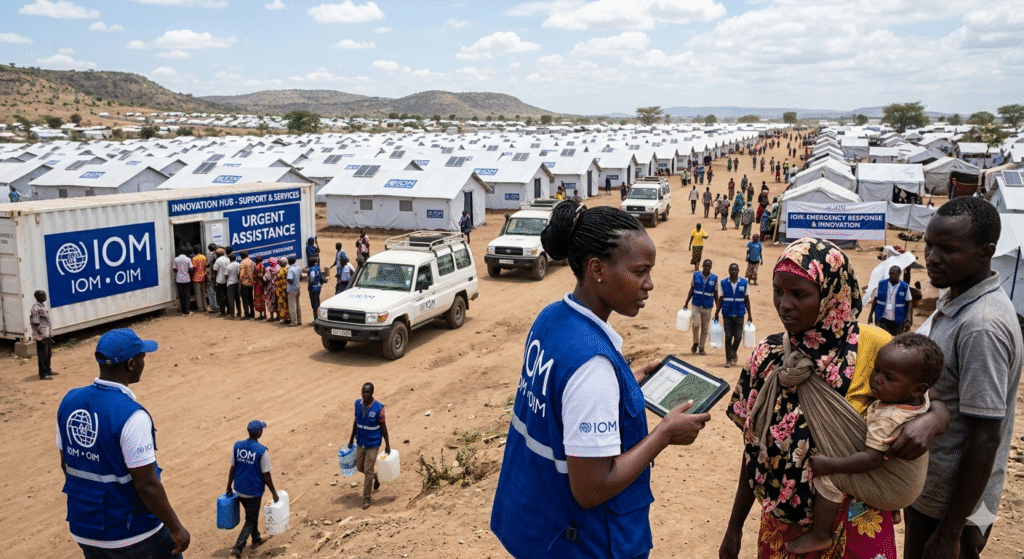
The situation has only worsened since then. In March, IOM issued another urgent appeal, this time warning that life-saving services for nearly 187,000 displaced people in Bentiu and Malakal could collapse within weeks due to a $6 million funding gap .
The consequences of such a collapse are not abstract. “Taps will run dry, latrines will overflow, and sections of Bentiu camp could flood during the coming rains,” warned Vijaya Souri, IOM Chief of Mission in South Sudan . “The risk to people’s health and safety would be immediate” .
Beyond the immediate humanitarian catastrophe, the warning carries an epidemiological dimension. Rubkona County is projected to reach IPC Acute Malnutrition Phase 5 — “Extremely Critical” — during the April to June lean season. A cholera outbreak is already spreading across the country. Flooding in the camps could contaminate water sources and accelerate disease transmission, triggering further displacement .
The dry season offers a critical window to maintain flood protection infrastructure ahead of the rains. Without drainage and dyke maintenance, Bentiu IDP Camp faces a high risk of flooding. IOM is urgently appealing for $6 million to sustain critical services through the end of 2026 .
The Human Face of Return: 145 Nigerians from Libya
Amid the sprawling numbers and geopolitical strategies, individual stories of return offer a more intimate window into IOM’s work. On April 28, 2026, the National Emergency Management Agency of Nigeria, in collaboration with IOM, received 145 Nigerian returnees from Benghazi at the Murtala Muhammed International Airport in Ikeja .
The returnees arrived aboard an Al Buraq Airlines flight under IOM’s Assisted Voluntary Return programme, which facilitates the safe return and reintegration of Nigerians stranded abroad . The breakdown of the group told its own story: 122 adults (46 males, 76 females), alongside 29 children and 27 infants .
Upon arrival, officials from the Nigeria Immigration Service carried out biometric registration and documentation. NEMA provided immediate assistance, including food, potable water, medical care, counselling, and logistics support .
This single operation represents a fraction of IOM’s global assisted returns, but it symbolizes the Organization’s dual mandate: not only responding to crisis-driven displacement but also facilitating safe, orderly migration for those who choose to return home .
Innovation for a New Era: AI and Climate Solutions
While much of IOM’s work focuses on immediate life-saving assistance, the Organization is also investing heavily in the future. Two major initiatives launched in 2026 highlight this forward-looking approach.
The first is LOCALISE, an AI-powered planning system developed in collaboration with Google Cloud and mapping specialists NGIS. The tool reimagines how humanitarian responses are planned, reducing analysis that used to take weeks to just days .
“The sooner teams on the ground can understand what a community needs, the sooner people can start rebuilding their lives,” IOM explained. The upgraded LOCALISE Toolkit incorporates community voices and local expertise directly into the planning process — ensuring that affected populations have a genuine voice in shaping the response .
The tool will first be piloted in two locations. It uses AI to automate IOM’s Displacement Tracking Matrix and gather up-to-date images and maps of basic services like electricity, schools, hospitals, and water. Once available worldwide, it will allow IOM missions, governments, and partners to plan assistance more efficiently wherever needed .
The second major innovation addresses the growing challenge of climate mobility. In April, IOM’s Climate Mobility Innovation Lab, in partnership with the Pacific Community, launched a study examining how Nature-based Solutions can help communities stay, adapt, or plan movement as climate impacts intensify .
The research, presented to over 130 participants in a regional webinar, reframes how mobility is understood in climate policy. “Climate mobility is not driven by single events, but by the gradual erosion of the systems that sustain life — food, water and livelihoods,” said lead author Lorenzo Guadagno .
Nature-based Solutions work at that level. Restoring mangroves, implementing agroforestry, protecting groundwater — these interventions can rebuild the ecosystems that underpin food and water systems, reducing the pressures that force people to move, extending the time communities can remain in place, and better informing decisions where movement becomes unavoidable .
For Solomon Islands Kantha, IOM’s Chief of Mission in the South Pacific, the message is clear: “Climate mobility is already a reality across the region. It requires approaches that reduce risk, strengthen resilience, and support people to adapt in place where possible, while enabling safe and dignified movement where necessary” .
Strategic Partnerships: Australia’s Renewed Commitment
IOM’s work is impossible without its partners, and March 2026 brought a significant vote of confidence. The Organization and the Government of Australia signed a Strategic Partnership Framework for 2026–2030, renewing a collaboration that dates back to Australia’s role as a founding member state of IOM .
“Australia has long been a trusted partner to IOM and to migrants and communities across the region,” Pope said at the signing ceremony in Geneva. “As displacement rises and migration grows more complex, partnerships like this matter more than ever” .
The Framework outlines six shared priorities: supporting effective responses to humanitarian crises, driving solutions to displacement and increasing resilience, facilitating safe and regular migration, delivering evidence-based programmes, advancing gender equality and social inclusion, and strengthening multilateral cooperation .
The Road Ahead
As IOM moves through 2026, the equation remains simple but unforgiving. Millions of lives depend on timely, predictable funding. The 32 Crisis Response Plans demonstrate how every dollar invested contributes directly to reaching people in crisis, providing safety, dignity, and pathways to recovery .
But the funding is not keeping pace. In South Sudan, a $6 million gap threatens 187,000 people. In Sudan, returns are creating new crises rather than solving old ones. Across the globe, broken migration systems continue to channel people into the hands of smugglers and traffickers .
IOM’s call to the international community is urgent and clear. “Millions of lives depend on timely, predictable funding,” the Organization states . The tools exist. The plans are drawn. The needs are documented. What remains uncertain is whether the world will answer the call before the taps run dry, the latrines overflow, and another generation of displaced people loses the chance to rebuild .
