

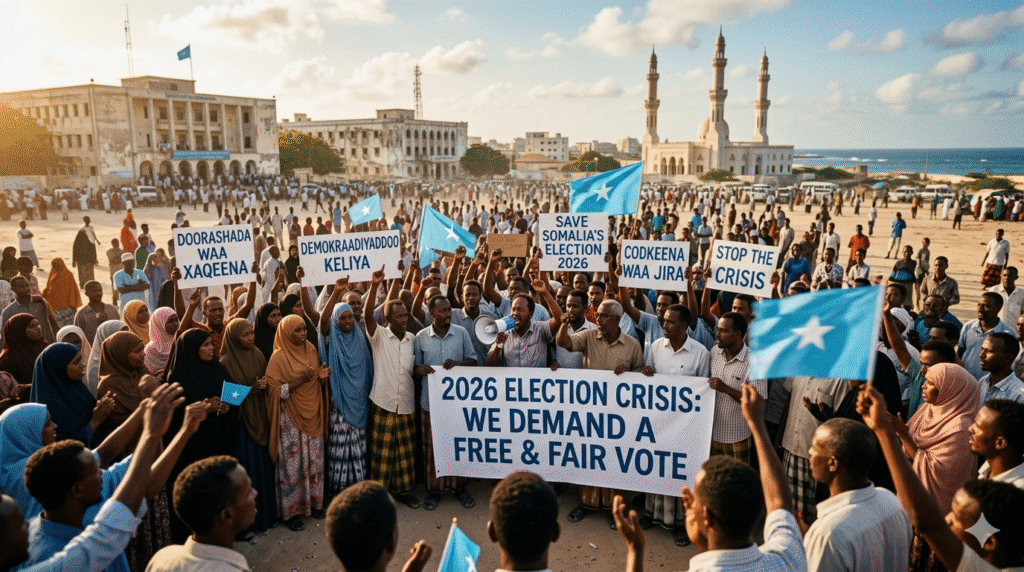
As the sun sets over Mogadishu on an April evening in 2026, Somalia finds itself at one of the most dangerous crossroads in its tumultuous post-civil war history. The federal parliament’s term expired on April 14. President Hassan Sheikh Mohamud’s mandate is scheduled to end on May 15 . Yet instead of preparing for a transition of power, the nation is locked in a fierce political battle over constitutional amendments, extended mandates, and the very soul of its democratic experiment. What is unfolding is not merely an election dispute—it is a struggle that threatens to unravel the fragile gains made against two decades of extremist insurgency and clan warfare .
The Constitutional Earthquake
The crisis began in early March 2026, when Somalia’s parliament voted to approve sweeping amendments to the nation’s long-awaited new constitution . After years of debate and delay, lawmakers—222 of them—passed a document that replaces the provisional 2012 constitution and fundamentally restructures Somali governance . Among the most contentious changes: the extension of presidential and parliamentary terms from four years to five .
What the government presents as a necessary step toward stability, the opposition has condemned as a “constitutional coup.” The Somali Future Council (SFC), a powerful alliance that includes two former presidents, three former prime ministers, and the presidents of Puntland and Jubaland states, has rejected the extension outright . Their argument rests on a principle of non-retroactivity: the amendments cannot apply to the current administration’s term, which was elected under the old four-year framework. President Hassan Sheikh, they insist, must leave office on May 15, 2026 .
Former President Sharif Sheikh Ahmed did not mince words. “There can be no one person saying alone that I will stay until 2027,” he told reporters. “That is shameful and unacceptable” .
Two Governments, One Nation
The clock is now ticking toward a moment of potential dual authority. The SFC is actively preparing a National Salvation Conference to establish a transitional authority, to be operational by May 15 . This means that if the federal government continues to claim a mandate that a significant portion of the federation considers expired, Somalia will effectively have two heads—each claiming the sovereign right to rule, to tax, and to deploy military force .
This is not abstract political theater. In late March, the Somali National Army moved to dismantle the regional administration of South West State after President Abdiaziz Laftagareen signaled his intent to join the opposition . Turkish-trained units and armored assets—hardware intended for counterterrorism operations—were deployed to settle a domestic political score. Laftagareen was forcibly replaced by a federal appointee . The message from Mogadishu was clear: dissent will be met with force.
The Great Electoral Experiment
Amid this high-stakes political warfare, Somalia is attempting something it has not done in five decades: direct, one-person, one-vote elections. On April 28, 2026, the South West State is scheduled to hold elections for its House of Representatives and 11 district local councils . If completed as planned, these would be the first direct elections at the regional level since the 1960s.
President Hassan Sheikh has championed this shift passionately. “We remain firmly committed to ensuring that the Somali people regain their constitutional right to elect leaders of their choice after 57 years,” he told traditional elders at a state dinner in Mogadishu on April 27 . He argued that the country’s long reliance on an indirect, clan-based electoral model—where traditional elders select regional lawmakers, who then select the president—has left Somalia with “many challenges, foremost among them insecurity” .
Yet the timing is fraught. The South West elections are being conducted under an interim administration appointed by the federal government after the forceful removal of Laftagareen . The arrival of Speaker Aden Madobe—a Villa Somalia-backed candidate—in Baidoa on April 25 signaled clearly that Mogadishu intends to control the outcome . Critics argue that direct elections lose their meaning when the political playing field is leveled by force and federal patronage.
A Nation Divided: The Federal-State Schism
The deeper structural problem is that Somalia’s federal project is coming apart. The new constitution centralizes foreign relations, giving the federal government exclusive authority over bilateral agreements and barring individual states from negotiating with other countries . It also centralizes security in ways that Puntland and Jubaland—long accustomed to substantial autonomy—find deeply threatening.
The SFC is not merely an opposition political coalition; it represents the interests of powerful regional states that control significant territory and armed forces. Puntland President Said Abdullahi Deni and Jubaland’s Ahmed Madobe have explicitly rejected the 2027 election delay as illegitimate . They command loyal security forces and have the capacity to govern independently of Mogadishu. The risk is not just political gridlock but actual territorial fragmentation.
The Security Vacuum
While political elites fight over mandates and constitutional clauses, al-Shabaab is watching—and advancing. The militant group, still controlling large rural areas and capable of devastating attacks on population centers, thrives on state fragmentation . Every Turkish rifle diverted to a clan feud, every drone strike perceived as politically motivated rather than counterterrorism, serves as a recruitment victory for the insurgency .
In the Hiraan and Middle Shabelle regions, the state presence has diminished noticeably as Mogadishu’s attention turns inward. Al-Shabaab has moved quickly to fill the void, reasserting its predictable shadow governance of courts, taxation, and dispute resolution . The group does not need to defeat the state militarily; it only needs the state to fragment until it becomes irrelevant.
External Entanglements
Compounding the domestic crisis is Somalia’s growing role in a wider regional power struggle. The Turkish drilling vessel Cagri Bey docked at the Port of Mogadishu on April 10, just 72 hours before the parliamentary mandate expired . While celebrated by the federal government as a milestone for energy independence, the timing has raised eyebrows. Critics worry that in a politically fragile system, signing long-term resource concessions without federal consensus is an act of desperation that will haunt Somalia for generations.
The Egypt-Somalia Defense Pact and escalating tensions with Ethiopia over a maritime memorandum with Somaliland have also dragged Somalia into the center of a Red Sea geopolitical contest . The federal government is increasingly reliant on external military alliances, including Turkish-supplied Bayraktar TB2 drones and Egyptian security cooperation. This external dependency raises uncomfortable questions: Is Somalia’s sovereignty being traded for short-term political survival?
Signs of Strain
Even within the president’s inner circle, the pressure is showing. On April 26, Senior Presidential Advisor on Countering Violent Extremism Abdullahi Mohamed Nor resigned, citing “political disagreements” with President Hassan Sheikh . He warned that unresolved political disputes “could lead to political and security instability” and called urgently for an inclusive solution . He joins a growing list of defections, including a former intelligence chief and a senior ruling party secretary who have distanced themselves from the administration .
Meanwhile, efforts to build consensus continue. Interim leaders and presidential candidates in South West State have met to discuss “transparent, fair, and lawful” elections . Traditional elders have been courted to support the one-person, one-vote transition . The Independent National Electoral and Boundaries Commission insists preparations are underway for state-level elections in April, with voter registration expanding to 35 districts .
But these efforts feel increasingly like rear-guard actions. The fundamental question remains unanswered: Who governs Somalia after May 15?
The Road Ahead
The international response has been notably muted. African Union and United Nations officials have offered cautious statements about dialogue, but there is a palpable sense of “Somalia fatigue” in Western capitals . After decades of crisis, few appetite exists for another major intervention. Yet as one analyst put it, “silence is not neutrality—it is complicity” .
Somalia now faces several possible futures. The best-case scenario involves a last-minute political compromise that postpones the mandate crisis while establishing a clear roadmap to 2027 elections. A more likely scenario is parallel governance, with the federal government controlling Mogadishu and major cities while the SFC administers large portions of the federal member states. The worst-case scenario—and it is increasingly plausible—is violent fragmentation, with al-Shabaab seizing strategic territory amid the chaos.
The constitutional clock has run out. Al-Shabaab is advancing. Federal cohesion is snapping. The choice to return to consensus still exists, as one analyst notes, but “the window is nearly shut” . The question is no longer whether Somalia faces risk—it is whether the nation still has the time to reverse its trajectory before May 15 triggers a definitive and potentially irreversible fragmentation of the Somali state.
For a country that has known little peace since 1991, the 2026 election crisis represents perhaps the most dangerous test yet of whether Somalia can build a democratic future—or whether it will remain trapped in a cycle of political collapse and violent recovery. The world watches. The clock ticks. And Somalis wait, once again, to see if their leaders can put nation above faction, constitution above ambition, and peace above power.
