

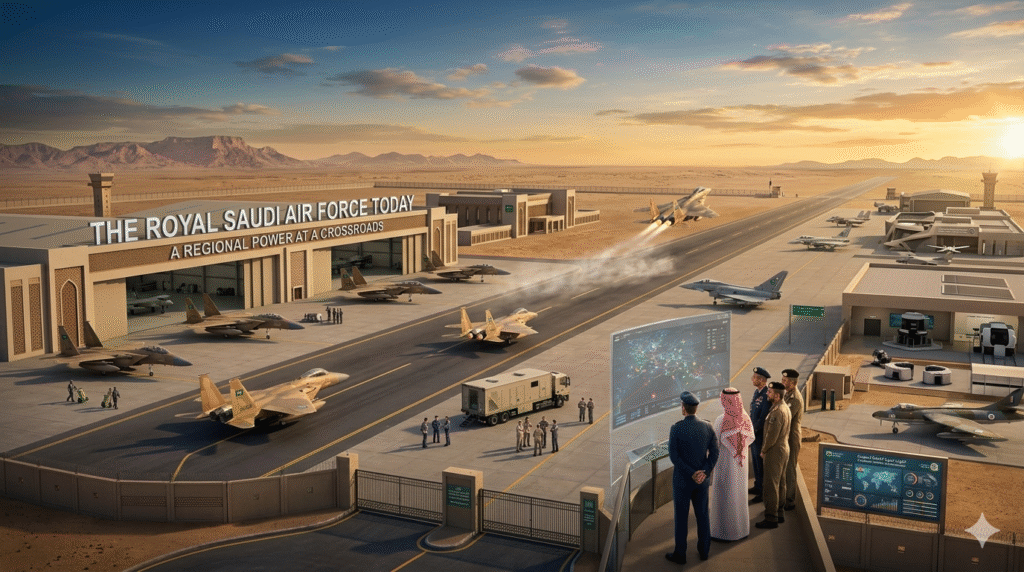
As tensions continue to simmer across the Middle East in the spring of 2026, the Royal Saudi Air Force (RSAF) finds itself at a pivotal moment in its history. Ranked as the sixth most powerful air force globally, possessing a fleet of 914 active aircraft, and armed with some of the most advanced fourth-generation fighters in the world, the RSAF is a formidable force .
However, the shifting sands of geopolitics and the recent US-Israel-Iran war have forced Riyadh to rethink its strategy. While the Kingdom is on the verge of acquiring the fifth-generation F-35 stealth fighter, it is simultaneously looking east—towards China and Turkey—to secure its future. From intercepting swarms of hostile drones to modernizing its training infrastructure, the RSAF is proving that it is no longer just a client state of the West, but an emerging architect of its own air power destiny.
Guardians of the Skies: Air Defense in a Time of War
The most immediate test for the RSAF in 2026 has been the defense of the Kingdom’s airspace amid the ongoing regional war. In a stunning display of situational awareness and firepower, the Saudi Defense Ministry announced in March that its air defenses had intercepted and destroyed 56 hostile drones within a 24-hour period .
These incursions, attributed to the ongoing conflict involving Iran, targeted sensitive areas, including the Eastern Province and even an attempted breach of the Diplomatic Quarter in the capital, Riyadh . The sheer volume of these interceptions highlights the shifting nature of aerial warfare. The RSAF is no longer just preparing for dogfights against enemy fighter jets; it is on the front lines of a new era defined by drone swarms and ballistic missiles. Operating alongside advanced US-supplied Patriot and THAAD systems, the RSAF’s ability to track and eliminate low-flying, slow-moving UAVs demonstrates a high level of operational readiness.
The Crown Jewel: Pursuing the F-35 Lightning II
For years, the prize that eluded Saudi Arabia was the Lockheed Martin F-35 Lightning II. Due to political concerns over Israel’s Qualitative Military Edge (QME) and human rights issues, Washington previously blocked sales. However, 2026 marks a historic shift.
At the World Defense Show in Riyadh earlier this year, a full-scale mock-up of an F-35 bearing the Saudi flag and RSAF insignia was displayed, signaling a dramatic policy change . This followed a declaration by former US President Donald Trump in late 2025 that the US would “give you the best F-35,” paving the way for a deal estimated to be worth a staggering $148 billion, covering up to 48 F-35A conventional takeoff and landing variants .
This acquisition is a game-changer. The stealth capabilities of the F-35 would allow the RSAF to penetrate the dense air defense networks of regional adversaries, a mission currently impossible for their non-stealth F-15s and Typhoons. However, the deal is complex. US officials have expressed frustration over Riyadh’s simultaneous negotiations with other powers, and analysts suggest that the specific F-35 variant provided to Saudi Arabia may come with “significant restrictions on future modifications” to maintain US technological control .
The “High-Low Mix”: F-15 Eagles, Eurofighters, and Chinese JF-17s
While waiting for stealth, the RSAF is aggressively modernizing its current fleet and diversifying its supply chain. The backbone remains the F-15SA (Saudi Advanced), a twin-engine heavyweight that experts consider superior to nearly any other fourth-generation fighter in the region . Alongside the 84 F-15SAs and 68 upgraded F-15 Strike Eagles, the RSAF operates over 70 Eurofighter Typhoons, with an additional 48 on order .
Yet, the most intriguing development is the reported negotiation to purchase the JF-17 Thunder Block-III, a light-weight fighter co-produced by China and Pakistan. Valued at approximately $6 billion, this deal is not just about hardware; it is about strategy.
The RSAF currently lacks a single-engine, light combat aircraft . The JF-17, which is significantly cheaper to operate than the massive F-15, would allow the RSAF to implement a “high-low mix” strategy. The heavy F-15SAs would handle long-range strike and air superiority, while the JF-17s would handle interception, border patrol, and air defense duties, preserving the flight hours of the more expensive jets .
Furthermore, the JF-17 offers a hedge against Western political pressure. Because the aircraft relies on Chinese electronics and Russian RD-93 engines, it is not subject to US ITAR (International Traffic in Arms Regulations) restrictions. In a crisis, Saudi Arabia could deploy these jets without fear of Washington disabling their software .
Operational Capabilities and Combat Experience
Having the equipment is one thing; using it effectively is another. The RSAF has a checkered combat record. During the 1991 Gulf War, Saudi pilots flew over 6,800 sorties and scored air-to-air kills, proving their mettle . However, the intervention in Yemen (2015-2022) was a difficult lesson. The RSAF struggled with dynamic targeting against mobile Houthi forces hiding in mountainous civilian areas, leading to international criticism over collateral damage .
Today, the RSAF is working hard to shed those inconsistencies. In early 2026, the Kingdom launched the “Spears of Victory” multinational exercise. Hosted at the Air Warfare Center, the drill involved air forces from Pakistan, France, the UK, and the US, focusing specifically on joint operations in “advanced electronic warfare conditions” . This focus on EW is critical, as any conflict with a near-peer would begin with the blinding of radar and communication systems.
Furthermore, the RSAF is enhancing its human capital through technology transfer. In February 2026, US firm Quantum3D completed a training program with RSAF personnel, teaching them to build and maintain high-fidelity 3D terrain databases for simulators . This allows Saudi pilots to train against specific local terrain—like the valleys of the Empty Quarter—without leaving the ground, dramatically improving readiness.
Strategic Autonomy: The Turkish Kaan and Vision 2030
The diversification of Saudi air power now includes a glance toward Ankara. Reports indicate that Riyadh is interested in supporting the development of Turkey’s fifth-generation fighter, the Kaan . While the F-35 is likely the primary choice for the future, engaging with the Kaan project serves two purposes.
First, it gives Riyadh leverage in negotiations with Washington, reminding the US that alternatives exist. Second, it aligns with Crown Prince Mohammed bin Salman’s Vision 2030 plan, which mandates that 50% of military spending be localized within the Kingdom . The Kaan project offers a higher chance of industrial participation and technology transfer than the tightly controlled US supply chain.
Aircraft by Type (2026)
| Aircraft Type | Active |
|---|---|
| Combat | 384 |
| Helicopter | 262 |
| Training | 156 |
| Special Missions | 66 |
| Transport | 46 |
| Total | 914 |
*Source: GlobalMilitary.net *
Conclusion
Today, the Royal Saudi Air Force stands as a paradoxical titan. It boasts 914 aircraft and is ranked 6th in the world, yet it is actively seeking to expand its fleet with Chinese light fighters and Turkish stealth jets . It is a close US ally about to receive the F-35, yet it is building a logistics chain to bypass Western parts suppliers .
The war with Iran has proven that the RSAF can defend the homeland, but the strategic choice looming over Riyadh is whether to move from defense to offense . As the Kingdom continues to assert its independence on the world stage, the RSAF is no longer just a buyer of security—it is striving to become the indispensable pillar of Arab military power.
