

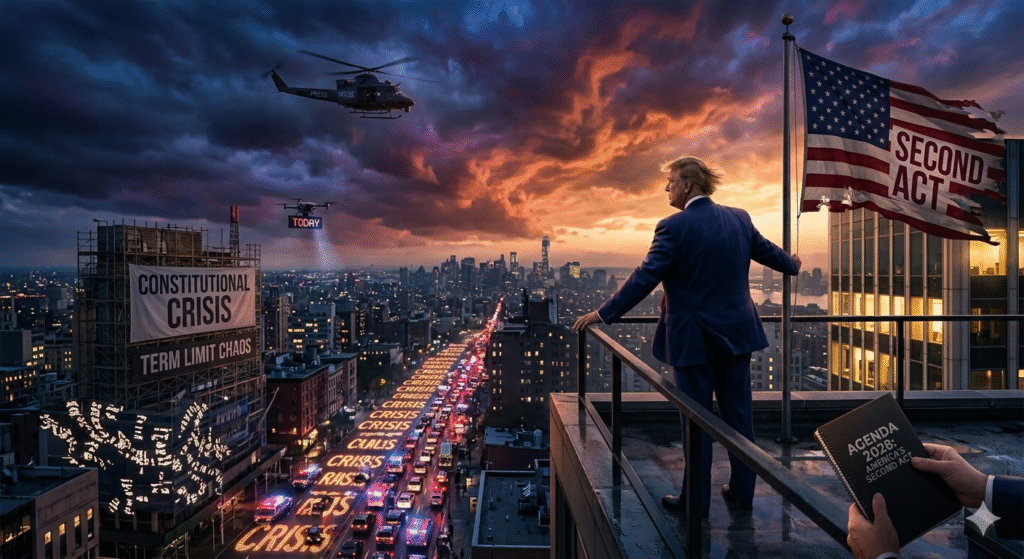
April 27, 2026 — If the first year of Donald Trump’s second term was defined by triumphalism and legislative blitz, the spring of his second year is shaping up as a season of peril. The 79-year-old president finds himself at a critical juncture, grappling with a stalled overseas war, a hostile judiciary, sagging approval ratings, and a shocking assassination attempt that has laid bare the fractures in American political life. As the nation digests the images of Washington’s elite ducking under tables at the White House Correspondents’ Dinner, the question looming over the capital is stark: can the 45th and 47th president regain his footing before November’s midterm elections?
From the battlefields of the Persian Gulf to the federal courthouse, and from the Las Vegas rally stage to the crime scene at the Washington Hilton, the last week of April has offered a panoramic view of a president under siege—and fighting back with characteristic defiance .
The Gunfire at the Gala: A Nation on Edge
The most jarring image of the week came not from the White House briefing room, but from a black-tie ballroom. On Saturday night, during the annual White House Correspondents’ Association Dinner—an event Trump had historically boycotted—gunfire erupted. The president, First Lady Melania Trump, Vice President JD Vance, and a room of 2,600 journalists and officials were rushed to safety after a 31-year-old California man, identified as Cole Allen, allegedly stormed a floor above the dinner, exchanging gunfire with Secret Service agents .
The scene was one of pandemonium. Attendees dove under tables as waitstaff hurried toward the exits . Within minutes, Trump took to Truth Social, the social media platform that is the cornerstone of his $12 billion media empire, reassuring the nation: “The First Lady, plus the Vice President, and all Cabinet members, are in perfect condition” . The suspect was apprehended, but the incident marked the third known attempt on Trump’s life in two years—a sobering statistic for any chief executive .
In the immediate aftermath, Trump pivoted from victim to narrator. He posted surveillance footage of the suspect on Truth Social and used the attack to renew a long-standing political demand: the construction of a “top secret” gala hall on the White House grounds. “An incident like Saturday night’s would not have happened if the new hall… had already been operational,” he wrote, arguing that the current venues are insufficiently secure . For a president who built his brand on strength, the necessity of being rushed from a room by armed guards is an uncomfortable reality, yet one he is trying to turn into a policy talking point about infrastructure and security.
The Legal Tangle: Suing Himself?
Even before the echoes of gunfire faded, Trump faced a different kind of confrontation—this time in a Miami courtroom. On Friday, a federal judge signaled deep skepticism regarding Trump’s $10 billion lawsuit against the Treasury Department and the IRS .
The lawsuit stems from the 2022 leak of Trump’s tax returns by a former IRS contractor, who is now serving a five-year prison sentence. Trump is seeking massive damages for the violation of his privacy. However, Judge Kathleen Williams pointed out a glaring logical paradox: Under the Constitution’s “case or controversy” requirement, courts only hear disputes between opposing parties. But as the sitting president, Trump oversees the very executive branch agencies he is suing .
“It is unclear to this Court whether the Parties are sufficiently adverse to each other,” Williams wrote, noting that Trump has personally admitted it is “unusual” to be on both sides of a lawsuit. The judge has ordered both sides to explain by May 20 how the court even has jurisdiction to hear the case . For a president who has centralized power through expansive theories of “unitary executive” control, this lawsuit represents the collision of his political power with the structural limits of the law: he cannot command the judiciary to set aside logic, even if he commands the IRS .
The War and the Economy: The Anchor Weighing Him Down
While the shooting dominated cable news, it is the twin crises of inflation and the Iran war that are eroding Trump’s standing with the voters who sent him back to the White House. A recent Reuters/Ipsos poll shows Trump’s approval rating has sunk to 36%, the lowest of his second term .
The “America First” peace president is now overseeing the largest US military operation since the 2003 invasion of Iraq. The Strait of Hormuz remains effectively closed, choked by Iranian mines and US counter-blockades. Despite a two-week ceasefire that Trump recently extended indefinitely, Tehran maintains its grip on the vital waterway . Gas prices, which Trump promised to slash, are nearing a national average of $4 per gallon, driving a spike in “inflation” that the administration’s own Labor Department confirmed last month .
Trump’s response has been vintage Trump. Speaking at a rally in Nevada—a critical swing state with a high concentration of service workers—he dismissed the official inflation figures as “fake inflation” caused by “fuel and energy prices” . He pivoted aggressively to his signature legislative win, the “One Big Beautiful Bill Act,” which eliminated taxes on tips for service industry workers. “Every single American at every income level has more money in their pockets this week because of the Republican tax policies,” he told the crowd, urging them to vote Republican in the midterms to protect the cuts .
Yet, inside the Republican establishment, panic is setting in. In a closed-door meeting at the Waldorf Astoria (formerly Trump’s Washington hotel), top campaign officials reportedly told operatives to stop nationalizing the election around Trump . The strategy, according to leaks, is to keep Trump’s base energized while focusing swing voters on “local issues” rather than the president’s sinking popularity.
“I think the key is to project where it could be over the summer, and it’s still very fluid,” said David McIntosh of the Trump-aligned Club for Growth, trying to put a brave face on the data . But the numbers are brutal: only 36% approval, a war without an exit, and a Democratic opposition eager to tie every Republican candidate to the President’s “chaos.”
The Business of the Presidency: A $65 Billion Empire
Amid the political chaos, the Trump business empire continues to expand at a rate unprecedented for a sitting president. According to financial disclosures, the Trump family’s net worth has soared to approximately $65 billion, a 60% increase since Trump returned to the White House .
The growth is fueled by two engines: cryptocurrency and overseas licensing. The Trump family’s venture into “DeFi” (decentralized finance) has been extraordinarily lucrative, generating billions through the sale of “Trump”-branded meme coins and the World Liberty Financial platform. Simultaneously, the Trump Organization has launched eight new overseas projects in the second term—ranging from a golf course in Qatar to a tower in Vietnam—compared to zero during his first term .
Ethics watchdogs are howling. They point out that these financial windfalls often coincide with favorable policy decisions by the administration. For instance, following large investments from Middle Eastern entities into Trump crypto ventures, the administration approved sensitive advanced chip exports to the UAE . While the White House denies any quid pro quo, the sheer scale of the wealth accumulation—and the timing of the deals—presents a complicated backdrop for a president already struggling with his public image.
Conclusion: The Art of the Comeback?
As the sun rises on April 27, Donald Trump faces a confluence of threats: a bullet dodged (literally), a court skeptical of his power, a party unsure of his coattails, and a world seemingly on fire.
But to count Trump out is to ignore the last decade of political history. On Sunday night, in a “60 Minutes” interview recorded after the shooting, Trump was asked if he feared for his life when the bullets flew. “I wasn’t worried,” he replied. “I understand life. We live in a crazy world” .
He is now betting that the American people will agree with his diagnosis of the “crazy world”—and that they will trust him, the survivor, to navigate it.
For the next six months, the battle lines are drawn. Trump will attempt to project strength through the Iran crisis, leverage the sympathy from the assassination attempt, and drown out the bad economic news with the sheer volume of his rallies. The Republicans, however, may try to run away from him. Whether Donald Trump is the party’s anchor or its lifeboat will be decided by the price of a gallon of gas and the trajectory of a missile in the Strait of Hormuz .
