

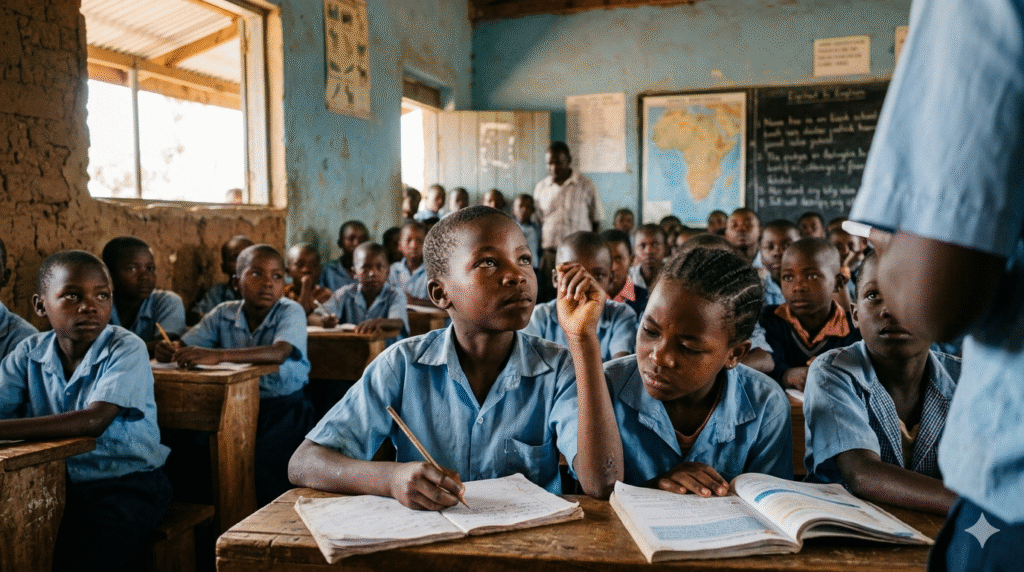
In a modest classroom in the Dzita Traditional Area of Ghana’s Anloga District, 78 pupils share a single teacher. Basic three students crowd around core subject textbooks at a ratio of 73 children to one book. Computing, Religious and Moral Education, and Career Technology exist only as words on a timetable—no textbooks exist at all .
This is not an isolated crisis. Across East Africa, from the coastal cities of Kenya to the rural highlands of Uganda and the drought-scarred plains of Tanzania, schools are straining under the weight of unprecedented challenges. Four converging pressures—chronic underfunding, a transformative curriculum overhaul, accelerating climate disasters, and a critical shortage of qualified teachers—have pushed the region’s education systems to a breaking point.
Yet amid the crisis, there are signs of resilience, innovation, and determined action. Here is the state of East African schools today.
Part 1: The Funding Gap – Lip Service and Empty Pockets
At the East African Community Education Conference held in Arusha in March 2026, Tanzanian Vice President Dr. Philip Isdor Mpango delivered a blunt message to regional governments: stop giving lip service to education .
“We must significantly invest in the education and health of our children,” Mpango told delegates. “High fertility rates in our countries imply that we must set aside more resources, both financial and human, to cater for the ever-expanding needs for quality education” .
The numbers justify his urgency. According to the World Bank’s Human Capital Index, Sub-Saharan Africa scores an average of just 0.4—the lowest of any global region, compared to the world average of 0.57 . Six EAC member states score below even that dismal regional average.
The consequences are tangible. Across the region, classrooms are overcrowded, textbooks are shared among dozens of students, and teachers work without adequate materials or housing. Mpango identified the critical needs: classrooms, teacher housing, teaching aids, books, computers, and digital infrastructure .
Yet there is an economic imperative that makes underfunding particularly shortsighted. Africa has the highest return on education of any continent. Each additional year of schooling raises youth earnings by an average of 14 percent . Every dollar not invested in education today is a dollar of future economic growth lost.
Part 2: A Classroom in Crisis – The Reality of Overcrowding
The most visceral evidence of the funding crisis comes from the classroom floor. In Ghana’s Dzita Traditional Area, a community-led education audit revealed devastating statistics across three public schools serving 1,562 pupils .
The pupil-teacher ratio stands at 78:1—more than double the national standard of 30:1. Only 20 professional teachers serve the entire student population. At Dzita-Agbledomi RC/DA Basic School, three pupils share each core subject textbook. The situation defies belief in Computing and Career Technology, where no textbooks exist at all—a ratio of 0 textbooks for 1,562 students .
Infrastructure is equally dire. The three schools lack functional libraries, dedicated ICT laboratories, supplementary reading materials, digital learning tools, dual desks, and adequate teacher workstations .
In response, the Dzita Development Association launched an emergency intervention called “Cognitive Leap,” recruiting community volunteer teachers and raising funds for basic teaching materials. But community action, however heroic, cannot substitute for systemic government investment .
Part 3: The Great Transition – Competence-Based Education Arrives
Perhaps the most significant transformation underway in East African schools is the shift from traditional teacher-centered instruction to Competence-Based Education (CBE). Uganda is leading this charge, with the Ministry of Education mandating that all institutions of higher learning prepare for full implementation of CBE by July 2027 .
What does this mean in practice? CBE fundamentally changes the classroom dynamic. Instead of teachers lecturing while students passively receive information, the learner sits at the heart of the educational process. The focus shifts from memorization to practical skills, innovation, and problem-solving aligned directly with industry needs .
“This is a fundamental shift in how we prepare our graduates,” said First Lady and Minister of Education Janet Kataaha Museveni. “We are moving towards a model that emphasizes practical skills, innovation, and problem-solving, directly aligned with the needs of industry and the economy” .
Makerere University, East Africa’s premier institution, has been tasked with leading this transformation. Through the four-year TRUCE project—funded by the European Union and bringing together nine consortium partners from Uganda and Ghana—the university is developing guidelines for CBE design, implementation, and assessment while retooling faculty and regulators across both countries .
The vision extends beyond universities to secondary and primary levels. The goal is ambitious: students will eventually graduate with both a secondary school certificate and a vocational training certificate, ensuring that those whose aptitudes lie in practical skills have equal opportunities for success .
Yet this transformation comes with a steep price tag. Implementing CBE requires new curricula, retrained teachers, digital infrastructure, and assessment systems—resources that already-stretched education budgets struggle to provide.
Part 4: Climate Shocks – The New Threat to Learning
For millions of East African children, the greatest obstacle to education is no longer distance or poverty—it is the weather. A groundbreaking UNICEF report released in April 2026 quantified what educators have long known: climate-related disasters are systematically destroying educational opportunity across Eastern and Southern Africa .
The numbers are staggering. Climate disasters have already caused an estimated $1.3 billion in direct damage to schools and teaching infrastructure across the region. Learning has been disrupted for approximately 130 million children—a figure that could rise to 520 million students by 2050 as climate impacts intensify .
The economic toll is equally devastating. These disruptions have already resulted in up to $140 billion in lost future earnings for today’s students, a figure that could reach $380 billion by 2050 .
The 2023–2024 El Niño drought in Southern Africa—one of the worst in decades—offers a preview of the future. Nearly 10 million people lost access to reliable food, water, or electricity. Schools were forced to shorten hours, close temporarily, or send students home indefinitely. Rural children and girls were disproportionately affected, with many leaving school entirely to support household livelihoods or facing increased risks of early marriage .
“Children are paying the highest price for a crisis they did not create,” said Etleva Kadilli, UNICEF Regional Director for Eastern and Southern Africa. “For the first time, this report shows the scale of climate-related loss and damage to education, yet the impact on children remains largely invisible in financing decisions. This must change” .
Zambia’s experience illustrates the cumulative toll. Between 2005 and 2024, floods and droughts disrupted learning for 5 million students, caused $60 million in immediate infrastructure losses, and reduced future earnings by up to $5 billion .
The irony is cruel: education receives less than 1.5 percent of global climate finance, leaving schools perpetually vulnerable to repeated cycles of damage and recovery. Yet every dollar invested in climate-resilient school infrastructure generates up to $13 in returns through reduced damage, sustained learning, and preserved future productivity .
Part 5: The Data Revolution – Knowing What Works
One of the most promising developments in East African education is invisible to most parents and students: the data revolution. For years, education policy across Africa has been hampered by a fundamental lack of information. According to UNESCO, only 17 of 55 African countries have data on foundational literacy and numeracy—the most basic measure of whether children are actually learning .
Tanzania is leading efforts to change this. In February 2026, the country launched the “Tackling Education and Skills Data Challenge” initiative, part of a continent-wide effort supported by the African Education Development Association and the Mastercard Foundation .
The goal is ambitious: support 30 African nations in improving their capacity to generate, analyze, and use education data for policy making. Tanzania’s Ministry of Education has commissioned the Eastern Africa Statistical Training Centre to build internal capacity in data collection, verification, analysis, and utilization .
“Accurate, high-quality data is the key to planning, implementing, and evaluating education policy,” said Petro Makuru, the Ministry’s Monitoring and Evaluation Director. “Current challenges in data chain management—from the school level to the national level—urgently need addressing” .
This data-driven approach will be a central focus of the 2nd EAC Regional Education Conference, scheduled for August 2026 in Nairobi, Kenya. Convened under the theme “Transforming Education in East Africa: From Commitments to Impact,” the conference will bring together policymakers, educators, researchers, and development partners to discuss everything from foundational literacy to EdTech, TVET, and education financing .
Part 6: Girls’ Education – Empowerment Amid Adversity
Despite the overwhelming challenges, targeted interventions are making a difference—particularly for girls. The World Bank’s East Africa Girls’ Empowerment and Resilience (EAGER) project, implemented across multiple countries including Mozambique, is addressing one of the most basic barriers to girls’ education: the lack of school uniforms .
In November 2025, the project issued a tender for the supply and distribution of 612,407 school uniforms for all provinces in 2026-2027 . This seemingly simple intervention addresses a profound obstacle: for families living in extreme poverty, the cost of a uniform can be the difference between a girl attending school or staying home.
The project represents a model of what works: targeted, practical interventions that remove specific barriers to education, backed by adequate funding and implemented through partnership between governments and international development partners.
Part 7: Infrastructure Expansion – Building for the Future
Despite the funding gaps, there are signs of progress on school infrastructure. Botswana’s Ministry of Child Welfare and Basic Education is approaching the World Bank for a loan facility targeting key priorities: rehabilitation of boarding facilities, expansion of junior and senior secondary schools, and construction of reception classrooms .
Eight expansion projects are underway, with four completed at Goldmine, Selolwe, Moeti, and Chamabona Junior Secondary Schools. The remaining four—at Okavango, Shanganani, Nkange, and Motswakhumo—are scheduled for completion during the 2026/2027 financial year. Twenty new teacher housing units have been completed at Orapa and Popagano Junior Secondary Schools .
The budget allocation of P12.9 billion (approximately $950 million USD) for 2026/27 includes P561.9 million for the school feeding programme and P446.3 million for service charges—mostly water bills in secondary schools, where aged infrastructure leads to costly leakages .
Part 8: The Teacher Crisis – Brain Drain and Burnout
Behind every statistic about overcrowded classrooms and underfunded schools is a human reality: East Africa is running out of teachers. Low pay, poor working conditions, lack of housing in rural areas, and limited opportunities for professional development have created a perfect storm of recruitment and retention challenges.
At the Arusha conference, Vice President Mpango identified teacher quality and capacity as one of the core challenges facing the region’s education systems . The problem is not merely the number of teachers—though that is acute—but their preparedness for the new Competence-Based Education model.
The TRUCE project’s emphasis on “retooling university faculty and higher education regulators” reflects a recognition that teacher training institutions themselves must be transformed before they can produce a new generation of CBE-ready instructors .
The Dzita community’s decision to recruit volunteer teachers—paying them a modest monthly allowance of GH¢500 (approximately $40 USD)—demonstrates both the severity of the shortage and the limits of community-based solutions .
Part 9: Regional Coordination – Strength in Unity
The East African Community has recognized that none of these challenges can be solved by individual nations acting alone. The upcoming 2nd EAC Regional Education Conference in Nairobi represents a concerted effort to harmonize approaches, share best practices, and present a unified voice to international donors .
The conference’s eight thematic areas read as a comprehensive agenda for educational transformation: strengthening early and foundational learning, enhancing teacher capacity, promoting inclusive education, leveraging EdTech and digitalization, boosting TVET and skills development, education financing and governance, data-driven decision-making, and accelerating regional goals through partnerships .
This regional approach reflects a fundamental insight: the challenges facing East African schools are common across borders, and so too must be the solutions.
Part 10: The Cost of Inaction
The UNICEF report quantifying climate-related learning losses offers a framework for understanding the cost of inaction across all dimensions of the education crisis. Every year that funding remains inadequate, every year that teacher shortages go unaddressed, every year that schools remain vulnerable to climate shocks represents not merely a missed opportunity but an active destruction of future human potential .
The $380 billion in projected lost earnings by 2050 is not an abstract statistic. It represents children who will never acquire the skills to escape poverty, communities that will remain trapped in subsistence agriculture, and an East Africa that will fail to realize its demographic dividend.
“Without stronger prioritization in climate finance, education will continue to bear the brunt of climate impacts, driving repeated disruption,” Kadilli warned. “Otherwise, the true cost of climate loss and damage will be measured in lost human potential” .
Part 11: Voices from the Ground
Beyond the reports and conferences, the most powerful testimony comes from those living the crisis daily. At the Dzita Traditional Area, a grandmother described walking her grandchildren to a school where 78 children share one teacher’s attention. “The teachers try,” she told local reporters. “But how can one person teach 78 children? The older ones help the younger ones, and we pray that is enough” .
In Uganda, a secondary school head teacher described preparing for the CBE transition without new textbooks, without digital infrastructure, and without training. “We are being asked to cook a new meal, but we have no ingredients and no recipe,” he said .
Yet there is also resilience. Community members in Dzita raised nearly GH¢50,000 in a matter of weeks, demonstrating that even in the poorest communities, the commitment to education remains unbroken .
Part 12: The Road Ahead
As 2026 progresses, the trajectory of East African schools remains uncertain. The CBE transition offers a genuine opportunity to transform education from rote memorization to genuine skill-building—but only if adequately funded. The data revolution offers the possibility of evidence-based policymaking—but only if governments commit to using data to drive decisions. The August Education Conference in Nairobi offers a platform for regional cooperation—but only if commitments translate into budgets.
The children of East Africa cannot wait for perfect solutions. They sit today in overcrowded classrooms, sharing tattered textbooks, taught by exhausted teachers, vulnerable to floods and droughts beyond their control. Their future—and the future of the region—depends on whether governments, donors, and communities can transform crisis into opportunity.
As Vice President Mpango told the Arusha conference: “The time for lip service is over. Our children need classrooms, books, and qualified teachers. They need us to invest—not tomorrow, but today” .
Conclusion
East Africa’s schools stand at a crossroads. On one path lies continued underfunding, climate vulnerability, and a teacher crisis that steals opportunity from millions. On the other lies a transformed education system—competence-based, data-driven, climate-resilient, and adequately resourced—capable of preparing a generation for the challenges of the 21st century.
The choice is not technical. It is political. And it must be made now.