

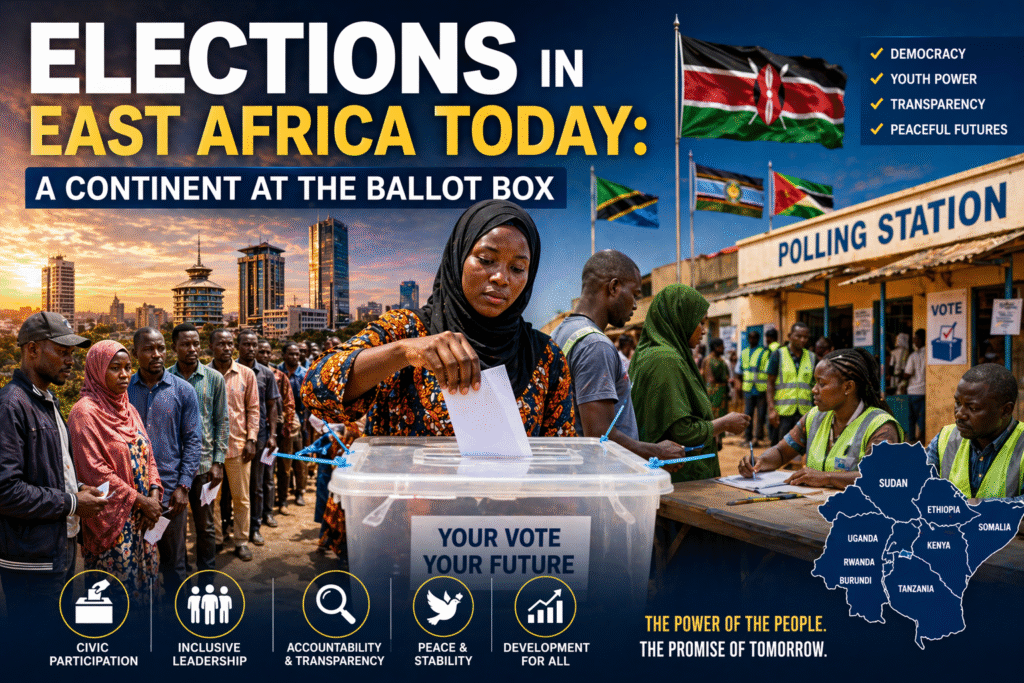
As the sun rises over the highlands of East Africa in 2026, it illuminates a region in the throes of democratic renewal. This year has proven to be a pivotal moment for the East African Community (EAC), with millions of citizens heading to the polls across several member states. From the disputed oil fields of Uganda to the bustling cities of Tanzania and the political maneuvering in Kenya, the “winds of change” are blowing once again, bringing with them a complex mix of hope, tension, and high-stakes political drama.
Here is the state of elections across East Africa today.
Part 1: Uganda – The January Vote and the Long Shadow of Museveni
The year kicked off with a major political event on January 15, 2026: Uganda’s general elections. As a crucial trade partner for the region, particularly regarding the Northern Corridor through Mombasa, Uganda’s stability is paramount to East Africa’s economy.
Incumbent President Yoweri Museveni, who has held power for decades, faced a familiar challenge from opposition figurehead Dr. Kizza Besigye, among others. However, the run-up to the polls was marred by tension. The Electoral Commission, under Justice Simon Byabakama Mugenyi, rolled out a four-year strategic plan and a detailed roadmap for the elections, with polling for Presidential and Parliamentary seats occurring on the same day.
Despite the logistical planning, analysts noted that “rising authoritarian tactics” led to escalated political tensions during the campaign season, with the opposition accusing the state of using the military to undermine their activities. To ensure transparency, the East African Community (EAC) deployed a 61-member Election Observation Mission (EOM) led by Ambassador Edda Mukabagwiza. The mission emphasized its role: “We are here to observe and assess the electoral process in an independent, impartial and objective manner,” noting they were not there to “arbitrate political outcomes”.
Part 2: Tanzania – By-Elections and CCM Dominance
Following the conclusion of the Uganda general election, attention turned to Tanzania for a significant by-election. On February 26, 2026, voters in the Peramiho Constituency went to the polls to fill a vacancy left by the passing of the late MP Jenista Mhagama.
The ruling party, Chama Cha Mapinduzi (CCM), demonstrated its enduring political machinery. Dr. Lazaro Komba, a PhD holder in Economics from Peking University, secured a resounding victory, garnering 87 percent of the valid votes cast. Dr. Komba, who previously served as a District Commissioner, won with 69,002 votes, leaving 14 other political parties trailing far behind.
This by-election served as a bellwether for the national political climate, reinforcing CCM’s grip on the legislature as the region looks toward future national contests.
Part 3: Kenya – The 2027 Shadow and the Battle for Mt. Kenya
While Kenya’s next General Election is scheduled for August 2027, the battle for 2027 is already being fought in the present. The political temperature is rising, fueled by a series of by-elections and the realignment of political heavyweights.
In February 2026, President William Ruto’s United Democratic Alliance (UDA) scored a “clean sweep” in four by-elections across Isiolo, Kakamega, and Embu counties. These victories were a significant setback for the “United Opposition” led by former Deputy President Rigathi Gachagua, raising questions about whether the opposition’s “hype” translates into actual votes.
The most explosive battleground is the upcoming Ol Kalou Constituency by-election. This contest has become a proxy war between former President Uhuru Kenyatta’s Jubilee Party and Rigathi Gachagua’s Democracy for Citizens Party (DCP). The seat fell vacant following the death of MP David Kiaraho, and the fight for it is seen as a test of who truly controls the Mt. Kenya voting bloc.
Deputy President Kithure Kindiki has declared that UDA will also field a candidate, aiming to prove that Gachagua’s influence is “all talk and no action”. Meanwhile, there are efforts to reconcile the warring factions to form a united front against the government, highlighting the intense fragmentation within the region’s political elite.
Part 4: The Wider Region – South Sudan and Ethiopia on the Horizon
Beyond the immediate contests, the broader East African region is preparing for two elections with massive implications for stability.
South Sudan is scheduled to hold its first-ever national election since independence on December 22, 2026. After years of civil war and repeated delays (previously set for 2015, 2018, 2021, 2023, and 2024), the stakes could not be higher. A successful vote is seen as critical for the country’s fragile peace agreement. Conversely, a contested outcome could draw in regional powers like Kenya for potential peacekeeping or mediation efforts.
Ethiopia, a major player in the Horn of Africa, is slated for a general election on June 1, 2026. As a strategic partner in counter-terrorism and the LAPSSET infrastructure project, instability in Ethiopia would send shockwaves through the region’s security and economic corridors.
Part 5: The Democratization of Fear – Digital Threats and Disinformation
As observed during the Kenyan election cycle, a new phenomenon is shaping East African elections: the weaponization of digital media. In the lead-up to previous votes, a “strikingly toxic” campaign ad circulated online, presenting a dystopian scenario of an opposition victory leading to dictatorship.
Experts have drawn parallels to tactics used during the Brexit referendum and the 2016 US elections, warning that targeted disinformation campaigns could “drive different conversations about the election in different sub-communities”. As one anti-corruption campaigner noted, in the ethnically aligned politics of East Africa, “the wrong video, the wrong information, it can go out of control” and potentially “lead to war”.
Part 6: Economic Stakes – The High Cost of Democracy
Hosting elections in East Africa is an expensive endeavor, often straining national budgets. For instance, the Ugandan government allocated approximately 1.367 trillion Shillings for its 2026 polls, a significant rise from the 868 billion Shillings spent in 2021. This increase is attributed to population growth, the rising cost of materials, and necessary electoral reforms.
In Kenya, a pre-election economic report showed that up to $499 million was allocated for the general election, with $53 million specifically earmarked for election-related security operations. These figures represent a substantial investment in democratic processes, diverting resources from other critical sectors like health and infrastructure.
Part 7: The “Big Man” Syndrome and Incumbency Power
Despite the spread of democratic institutions, the “Big Man” syndrome remains prevalent. The removal of presidential age limits in countries like Djibouti (which held elections in April 2026) and the Republic of the Congo allows octogenarian leaders to extend their rule, raising concerns about democratic backsliding.
In East Africa, the dominance of ruling parties—such as the CCM in Tanzania and the NRM in Uganda—presents a significant hurdle for opposition movements. The playing field is often uneven, with incumbents leveraging state resources for campaigns and controlling the security apparatus.
Part 8: The Role of Observers – Legitimizing or Policing the Vote?
To counter claims of fraud, the EAC has strengthened its election observation mandate. The mission to Uganda in January 2026 included members from all Partner States, representatives of Electoral Management Bodies, and civil society organizations.
These observers are tasked with monitoring the pre-election environment, the voting process, and the tabulation of results. Their final reports, which include “practical recommendations aimed at strengthening future electoral processes,” are crucial for maintaining regional credibility.
Part 9: The Judiciary as Arbiter
Increasingly, the courts are becoming the final battleground for election disputes in East Africa. In Kenya, the High Court intervened in the electoral process by canceling a tender for printing presidential ballots, ruling that the electoral commission had failed to conduct public participation.
Similarly, the opposition in various countries is turning to the judiciary to rule on the means of “ballot counting and transmitting the results”. This judicialization of politics, while a sign of maturing institutions, also risks overwhelming the legal system and delaying final outcomes.
Part 10: Voter Apathy and the Youth Quotient
East Africa has one of the youngest populations in the world. However, translating this demographic dividend into political power remains a challenge. Many young voters feel disillusioned with the “old guard” of politicians.
In Kenya, the 2022 elections saw a surge in youth participation driven by “hustler nation” rhetoric, but by the 2026 by-elections, analysts noted that the “hype” among the youth did not always translate into voter turnout. Engaging this demographic remains the single greatest challenge for political parties in the region.
Part 11: Regional Integration vs. National Sovereignty
The elections in 2026 occur against the backdrop of the expanded EAC, which now includes Somalia (admitted in 2024) and the DRC. The outcomes of elections in these large member states directly affect the feasibility of the EAC’s Common Market and Monetary Union protocols.
A contested election in one country leads to border closures and trade disruptions, directly contradicting the goals of regional integration. Thus, how a country votes is no longer just a domestic affair; it is a matter of regional economic security.
Part 12: The Outlook for 2027 – The Kenyan Decider
While 2026 is busy, the eyes of the continent are ultimately fixed on August 2027, when Kenya will hold its next General Election. The by-elections of 2026 are merely the dress rehearsal for what promises to be a fiercely contested battle between President William Ruto’s UDA and the fragmented opposition.
The issues of high living costs, the debt burden, and political realignments will dominate the discourse. As the region watches, the question remains whether Kenya can avoid the specter of the post-2007 election violence that left over 1,100 dead. For now, East Africa remains a region “gearing” for the polls, hoping that the “troubled waters” lead to stability rather than storms.
Conclusion: A Region at a Crossroads
Elections in East Africa today are a test of resilience. From the streets of Kampala to the villages of the Kenyan Rift Valley, the demand for accountable governance is clashing with the realities of political machines and economic hardship. As South Sudan prepares for its historic first vote, the region stands at a crossroads: one path leads to deeper integration and democratic maturity, the other to the familiar specter of instability. The outcomes of these ballots will determine not just who leads, but how East Africa will trade, grow, and live for the next decade.
