

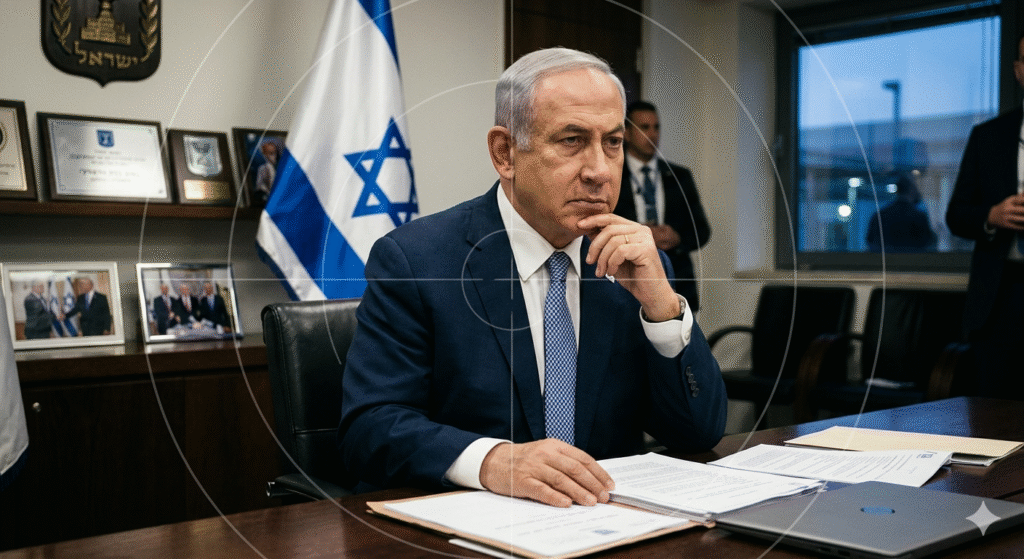
April 22, 2026 – If there is a single figure who embodies the chaos, resilience, and profound contradictions of the modern Middle East, it is Benjamin “Bibi” Netanyahu. Today, on Israel’s 78th Independence Day, the man who has served as Israel’s Prime Minister for over 15 non-consecutive years is standing at a precarious intersection of triumph and turmoil .
He is simultaneously a wartime leader who claims to have “saved the Jewish people from a nuclear Holocaust” and a criminal defendant whose corruption trial has been postponed yet again due to “security concerns.” He is a close ally of Donald Trump, directing the most aggressive war in Israel’s history, yet facing unprecedented domestic criticism from his own former generals, who accuse him of “hijacking” the country .
Here is the state of Benjamin Netanyahu today.
Part 1: The War Narrative – “Am Yisrael Chai”
On Tuesday night, as the sun set over Jerusalem marking 78 years of Israeli independence, Netanyahu delivered a video address to the nation. The backdrop was the war room. The tone was defiant.
“On Israel’s 78th Independence Day, we stand tall and we say to the world: Am Yisrael Chai!” Netanyahu declared, using the Hebrew phrase meaning “The people of Israel live” .
He highlighted the strategic partnership with the United States, calling it central to confronting shared threats. “Israel is stronger than ever, and together with the United States, we are leading the fight against the forces of evil in the world,” he said .
For Netanyahu, the war that began on February 28 with coordinated US-Israeli strikes on Iran has been framed as an existential victory. He claimed that Iran’s plan to inflict a “nuclear Holocaust” on Israel has been thwarted . However, even as he spoke of strength, the reality on the ground told a more complex story.
Part 2: The “Unfinished Business” of Iran
Despite the fireworks of the Independence Day address, Netanyahu has conceded a critical point: the war is not over.
Earlier in April, following a fragile, Pakistan-brokered ceasefire between the US and Iran, Netanyahu admitted to the Israeli public that the fight remains “unfinished business” . In a televised address, he acknowledged that while the “double existential threat” of Iran’s ballistic missiles and nuclear program has been “distanced,” it has not been eliminated.
“We still have goals to complete,” Netanyahu said, “and we will achieve them either by agreement or by the resumption of fighting” .
This admission of incomplete victory has opened a floodgate of criticism from opposition leaders. Avigdor Liberman, leader of the right-wing opposition party Yisrael Beiteinu, posted a scathing tally on social media: “914 days of war, over 2000 killed, tens of thousands wounded, 4 open fronts and — 0 decisive wins!”
Part 3: The Lebanon Buffer Zone
While the ceasefire paused the aerial bombardment of Iran, Netanyahu made it explicitly clear that Lebanon remains a battlefield. The US-brokered truce, he insists, does not apply to the northern front .
In recent weeks, Israel has launched what it calls the largest wave of strikes across Lebanon since the conflict began. Netanyahu confirmed that Israel is establishing a “deeper security buffer zone” along the Lebanon-Israel border.
“We are not talking about five posts,” he told his cabinet. “We are talking about a solid, deeper security zone that both prevents the threat of invasion and pushes away the anti-tank missile threat” .
He accused Hezbollah of establishing “terror villages” in southern Lebanon, claiming that “every terrorist position… has simply been flattened” . The human cost has been staggering: since Hezbollah entered the war on March 2, over 2,200 people have been killed in Lebanon .
Part 4: The Diplomatic Pivot – Seeking Peace with Beirut
In a surprising twist that emerged last week, Netanyahu announced a sudden shift in strategy regarding Lebanon. Despite the bombs falling on Beirut’s southern suburbs, Netanyahu declared that he is seeking direct peace talks with the Lebanese government.
“In light of Lebanon’s repeated requests to open direct negotiations with Israel, I instructed the cabinet yesterday to start direct negotiations with Lebanon as soon as possible,” he said in a statement .
The proposed negotiations have two stated goals: the disarmament of Hezbollah and the establishment of peaceful relations between the two neighboring states . This represents a historic pivot—Israel and Lebanon have technically been in a state of war since Lebanon’s independence in 1943.
However, the move has been met with skepticism. Hezbollah lawmaker Ali Fayyad immediately rejected the offer, insisting that the Lebanese government should demand a ceasefire as a precondition to any talks . Meanwhile, Western allies—including the UK and Spain—have publicly rebuked Netanyahu for continuing to strike Lebanon while claiming to seek peace .
Part 5: The ICC Arrest Warrant – A Shadow Over Europe
As Netanyahu wages war, a legal sword hangs permanently over his head. The International Criminal Court (ICC) issued an arrest warrant for Netanyahu in November 2024 on allegations of war crimes and crimes against humanity related to the Gaza conflict .
For the past year, Netanyahu has relied on friendly governments—particularly Hungary’s Viktor Orbán—to ignore the warrant. Orbán invited Netanyahu to Budapest in April 2025 and publicly guaranteed he would not be arrested, even announcing Hungary’s withdrawal from the ICC .
But that protection is now crumbling. On Monday, Hungary’s Prime Minister-elect Péter Magyar announced a dramatic policy reversal. Magyar stated that if Hungary remains an ICC member and a person wanted by the court enters its territory, “that person must be taken into custody” .
Magyar said he has already conveyed this position directly to Netanyahu. The Israeli leader has accepted an invitation to visit Hungary this fall—a trip that could now result in his arrest the moment he steps off the plane .
Part 6: The Corruption Trial – Postponed Again
On the domestic legal front, Netanyahu’s long-running corruption trial has hit another procedural snag. His testimony, which was scheduled to resume in the Jerusalem District Court, has been postponed.
Netanyahu’s office requested the cancellation citing “security-diplomatic reasons” connected to the dramatic events of the war . The court granted the request, deciding to hear another defense witness instead.
The prosecution expressed frustration, arguing that Netanyahu should adjust his schedule to the court’s calendar, stressing the “public interest in advancing the trial” . This marks the latest in a series of delays that have stretched the trial—which began in May 2020—into its sixth year.
Netanyahu is the only sitting prime minister in Israel’s history to stand trial. He faces charges of bribery, fraud, and breach of trust across three separate cases . The most damaging, Case 4000, centers on allegations that Netanyahu promoted regulatory favors worth hundreds of millions of dollars to the Bezeq telecom company in exchange for favorable news coverage of himself and his family.
Part 7: The Domestic Revolt – Former Generals Speak Out
Perhaps the most stinging criticism of Netanyahu has come not from his political opponents, but from the men who once commanded Israel’s military.
On the eve of Israel’s Independence Day, three former senior Israeli officials published a devastating critique in the Haaretz newspaper. Former army chiefs of staff Dan Halutz and Moshe Yaalon—both of whom served as defense minister—wrote that the government has “hijacked” the country.
“Israel has been hijacked by a regime that views the state’s resources as its own private property,” they wrote. They described the government as “completely detached from the reality of its citizens, acting as if the country were the personal property of Netanyahu, his wife (Sara), and Miri Regev” .
Former Prime Minister Ehud Barak added his own blistering assessment. He argued that despite the military campaign, “none of the war’s objectives were achieved. Hamas is still in Gaza, and Hezbollah remains in Lebanon” .
Barak concluded that Israel has become “a state subordinate to the United States, which imposed decisive operational and diplomatic decisions on it through harsh — and sometimes humiliating — directives” .
Part 8: The Russian Rebuke
On the international stage, Netanyahu has faced a sharp diplomatic rebuke from an unexpected quarter: Moscow.
Russian Foreign Ministry spokeswoman Maria Zakharova condemned recent statements by Netanyahu regarding Iran. Netanyahu had claimed that Iran planned to inflict a “nuclear Holocaust” on Israel and that the US-Israeli campaign had eliminated this threat.
Zakharova called the statements “unacceptable” and accused Netanyahu of distorting historical facts . The rebuke, while symbolic, highlights the increasingly isolated position of the Israeli premier as the war drags on.
Part 9: The Relationship with Trump – The “Low-Key” Pressure
Netanyahu’s closest international ally remains Donald Trump. Throughout the Iran war, the two leaders have coordinated closely. Netanyahu has publicly supported Trump’s plan to impose a naval blockade on Iran, and Trump has spoken of constant communication with “Bibi” .
However, even this relationship has shown signs of strain. When Israel launched a massive wave of strikes on Lebanon immediately after the US-Iran ceasefire was announced—killing over 300 people—Trump reportedly pressed Netanyahu to “dial down” the attacks.
“I spoke with Bibi and he’s going to low-key it,” Trump told NBC News. “I just think we have to be sort of a little more low-key” . Vice President JD Vance added that the Israelis “may check themselves a little bit” on attacking Lebanon .
For a leader like Netanyahu, who prides himself on Israeli sovereignty and military independence, being told to “low-key it” by Washington is a bitter pill.
Part 10: The Home Front – “We Cannot Afford the Luxury of Despair”
Despite the external pressures and internal dissent, Netanyahu maintains a message of resilience to the Israeli public. In his Independence Day address, he did not shy away from the costs of war.
“The enemies suffered painful blows, which weakened them all,” he said, echoing the sentiment of his former rival Ehud Barak . But unlike Barak, Netanyahu framed the current situation as a necessary step in a longer journey.
He highlighted the unity of the Jewish people, stating: “Israel cannot survive without the Diaspora’s support, and the Diaspora needs Israel for its identity and a safe haven in a time of need” .
Part 11: The Election Clock
Politically, Netanyahu is running out of time. General elections are due before the end of October 2026 . The electorate is exhausted after years of war, economic strain, and political turmoil.
Netanyahu’s strategy appears to be clear: present himself as the indispensable wartime leader, the only figure capable of managing the complex alliance with Trump and standing up to Iran. He is betting that the Israeli public, despite their grievances, will not change horses in the middle of a war.
But the opposition is mobilizing. The message from the former generals—that Netanyahu has failed to achieve decisive victory and has turned Israel into a US client state—is resonating with a war-weary populace .
Part 12: The Verdict of History
As Benjamin Netanyahu marks Israel’s 78th Independence Day, the question of his legacy hangs in the balance.
If the ceasefire holds and the Lebanon talks succeed, Netanyahu could be remembered as the leader who reshaped the security map of the Middle East—neutralizing Iran, disarming Hezbollah, and making peace with Lebanon.
If the war resumes, if the hostages remain in Gaza, if the ICC warrant is enforced in Hungary, and if the corruption trial finally reaches its conclusion, Netanyahu could face a very different fate: the leader who took Israel to the brink and lost.
For now, Netanyahu stands firm. “We are stronger than ever, we stand as one, and we will prevail,” he said . Whether those words are prophecy or delusion will be determined in the weeks and months ahead. But one thing is certain: Benjamin Netanyahu remains the most consequential—and the most controversial—figure in Israeli history.
