

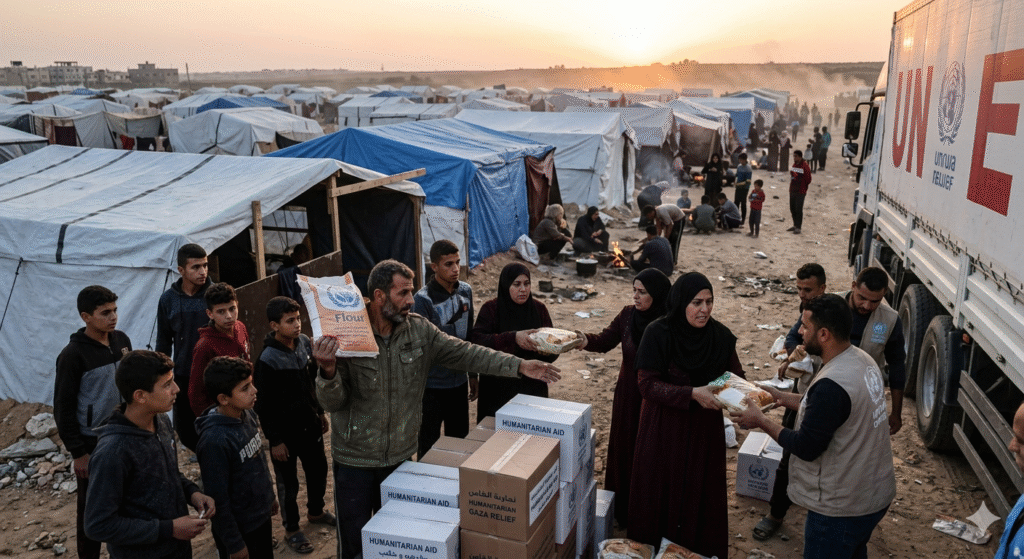
Six months after the world celebrated the October ceasefire, Gaza is bleeding again—quietly, steadily, and with the world’s attention firmly fixed elsewhere. The headlines have moved to the war in Iran, the drama of Washington politics, and the shifting sands of global diplomacy. But for the 2.3 million Palestinians trapped in the coastal enclave, the emergency has never ended. It has only changed shape, becoming slower, more insidious, and in many ways, more deadly than the bombs that fell from the sky.
This is Gaza today: a place where water contractors are shot while trying to deliver aid, where cancer patients die waiting for permission to leave, where rats outnumber medicines in hospitals, and where a generation of children has been told that school no longer exists.
Part 1: The Ceasefire That Wasn’t – Violence Surging
The ceasefire agreement of October 10, 2025, was supposed to bring a new era. Instead, it has become a legal fiction. According to the UN, between April 12 and 18, 2026, incidents of gunfire, shelling, and airstrikes increased by 46 percent compared with the previous week—the highest weekly total since the ceasefire took effect .
The Gaza Media Office has documented 2,400 Israeli violations of the ceasefire since October, including killings, arrests, blockades, and systematic starvation measures . The human cost of these violations is stark: at least 777 Palestinians have been killed since the ceasefire began, with over 2,193 wounded . Among the recent victims was Al Jazeera journalist Mohammed Wishah, killed in a drone strike west of Gaza City on April 8 .
The violence is not evenly distributed. The North Gaza, Gaza, and Deir al-Balah governorates have seen the sharpest increases in attacks . Civilians who thought they had found safety in these areas are discovering that nowhere is truly safe.
Part 2: The Water Contractor Murders – A Red Line Crossed
On Friday, April 17, 2026, two civilian contractors working for UNICEF were killed by Israeli fire at a water filling point in northern Gaza . They were delivering water—perhaps the most basic, most neutral, most necessary of humanitarian acts.
The UN Humanitarian Country Team, which brings together the heads of every major UN agency and NGO working in the Occupied Palestinian Territory, issued a rare joint condemnation. Such attacks, they said, “not only cost lives but also disrupt critical services” . The water these men were delivering would have gone to thousands of families. Instead, it has become a symbol of how the rules of war—the separation of combatants from civilians, of military targets from humanitarian infrastructure—have been systematically eroded.
Part 3: 18,000 Patients Waiting to Die
If there is a single number that captures Gaza’s health crisis, it is this: more than 18,000 patients are currently registered on waiting lists for medical evacuation through the Rafah crossing .
Since the crossing partially reopened on March 19, 2026, after a 20-day closure, only approximately 700 patients have been allowed to leave Gaza for treatment abroad . This represents less than 4 percent of those in urgent need.
The consequences are not abstract. On Sunday, a funeral was held in Khan Younis for Muvaffak Kadiha, a 45-year-old colon cancer patient who died while waiting for permission to travel abroad for treatment . He is not the first, and unless conditions change, he will not be the last.
Mohammed Zaqout, director general of hospitals at Gaza’s health ministry, warned that Israeli restrictions at Rafah pose “a direct threat to the lives of thousands of patients” . The Red Crescent’s Raed Al-Nems put it even more bluntly: “We are dealing with lives at stake” . Patients are selected for evacuation based on the severity of their conditions, but delays linked to Israeli security approval procedures mean that by the time permission arrives, it is often too late.
Part 4: The Collapsed Healthcare System – Numbers That Cannot Be Treated
Even for those who remain in Gaza, the healthcare system has effectively ceased to function. According to the International Rescue Committee (IRC), 94 percent of Gaza’s hospitals have been destroyed or damaged . More than 50 percent of hospitals are entirely non-functional .
The shortages are catastrophic. According to the Ministry of Health, 51 percent of essential medicines are currently at zero stock in Gaza . This means that patients requiring intensive care, cancer treatment, dialysis, or even basic surgical procedures are being turned away or treated without the necessary supplies.
Hospitals that remain open are overwhelmed, under-resourced, and increasingly unable to provide adequate care. Staff are working around the clock with equipment that has not been properly maintained, treating wounds that cannot be properly sterilized and diseases that cannot be properly diagnosed.
Part 5: The Rodent Crisis – When Sewage Becomes a Weapon
The destruction of Gaza’s infrastructure has created a secondary health emergency that receives almost no international attention. Israel’s bombing campaign destroyed sewage networks and landfills across the Strip . The result is predictable and horrifying: rodents and insects are spreading rapidly through displacement camps.
Civil society committees have warned of imminent disease outbreaks. Many displacement tents are polluted with sewage, waste, and insects—conditions that aid groups note pose severe health risks for children, the elderly, and the sick .
Young Palestinians have launched grassroots initiatives to clean up the camps, but they lack the resources, tools, and heavy equipment to deal with the scale of the problem. One of the most bizarre and cruel obstacles: Israel has reportedly banned the entry of rat poison and any chemicals or tools used to combat pests . Hospitals have reported a rise in patients suffering from rodent bites—a condition that would be almost unimaginable in any other context.
Part 6: Food Insecurity – Famine Pushed Back, Not Defeated
The food situation remains dire. According to the IRC, approximately 1.6 million people—77 percent of Gaza’s population—are expected to face acute food insecurity . Over 100,000 children and 37,000 pregnant and breastfeeding women are projected to suffer acute malnutrition .
The October ceasefire brought a brief improvement in aid flows, but restrictions have tightened again. The Israeli military has stopped the entry of large quantities of aid, and Gaza requires at least 450 tonnes of flour daily but receives less than 200 tonnes . Only 30 bakeries are currently operating—a sharp decline from pre-war levels.
The situation is made worse by soaring prices. Basic items have become unaffordable for most families, who have already exhausted their savings, sold their possessions, and borrowed from relatives who have nothing left to give.
Part 7: The 18-Month Emergency – $26.3 Billion Just to Start
On April 20, 2026, the European Union and the United Nations released the final Gaza Rapid Damage and Needs Assessment (RDNA), conducted jointly with the World Bank . The numbers are staggering:
- Total recovery and reconstruction needs over the next decade: $71.4 billion
- Amount required in the first 18 months: $26.3 billion
- Physical infrastructure damages: $35.2 billion
- Economic and social losses: $22.7 billion
The hardest-hit sectors include housing, health, education, commerce, and agriculture . Over 371,888 housing units have been destroyed or damaged . More than 60 percent of the population have lost their homes . Nearly all schools have been destroyed or damaged . Gaza’s economy has contracted by 84 percent .
Perhaps the most devastating statistic in the report is this: the conflict has set back human development in Gaza by 77 years . A child born in Gaza today enters a world with less opportunity, less infrastructure, and less hope than a child born there in 1949.
Part 8: The Displacement Cataclysm – 1.9 Million Uprooted
Approximately 1.9 million people have been displaced within Gaza, often multiple times . Families who fled their homes in Gaza City in 2023 are now living in makeshift tents in Rafah or Khan Younis, having moved four, five, or six times as Israeli military operations shifted.
The conditions in displacement camps are brutal. In winter, families face flooding and storms; in summer, they endure high temperatures with no relief . As the IRC noted, families are “being forced to survive without access to the most basic and life-saving supplies, stripped of essential goods needed to live safely with dignity” .
Anera, a humanitarian organization operating in Gaza, reported that in early April 2026, its teams distributed 25,629 hot meals, 6,521 ready-to-eat meals, and 4,776 bags of wheat flour—but these numbers represent a fraction of the need . Their solid waste management team, consisting of just 56 workers, collects 48 tons of waste daily from seven camps—a Sisyphean task given the scale of accumulation .
Part 9: The Education Apocalypse – A Generation Lost
Nearly all of Gaza’s schools have been destroyed or damaged . The destruction of educational infrastructure has effectively paused the lives of an entire generation of children.
The IRC warned that “the destruction of schools has left children facing an uncertain future, deepening parents’ fears about their education, while ongoing violence is driving severe psychological stress, particularly among children” . For the children of Gaza, the trauma of war is compounded by the absence of any structure, any routine, any sense of a future worth preparing for.
Part 10: The Political Stalemate – Disarmament and the PA
The recovery cannot begin without political resolution, and the political resolution remains elusive. Nickolay Mladenov, the High Representative for Gaza at the Board of Peace, told Reuters that negotiations with Hamas over disarmament are ongoing but difficult. “I’m quite optimistic” that a deal can be reached, he said, but added: “In my judgment, we have only days, at most weeks, otherwise we will miss the current negotiating opportunity” .
The core issues are familiar: Hamas’s willingness to disarm, the Israeli withdrawal from the “Yellow Line” dividing the Strip, and the role of the Palestinian Authority in post-war governance. The EU and UN have explicitly called for reconstruction to be “Palestinian-led” and to “actively support the transition of governance to the Palestinian Authority”—a clear rebuke to any plans for permanent Israeli control or the mass displacement of Gaza’s population .
Part 11: The Funding Mirage – Promises and Reality
The financial picture is mixed. The United States has pledged $100 million to the Peace Council’s operating fund, and American allies have donated over $70 million for humanitarian action . Mladenov confirmed that the promised funds have been received and that the Peace Council is not facing financial problems .
But pledges are not the same as delivery. The aid that enters Gaza remains far below the 600 truckloads per day required by the ceasefire agreement—currently operating at only about 38 percent of that target . And the $26.3 billion needed for the first 18 months of reconstruction is not just sitting in a bank account; it must be raised from international donors who are facing their own budget pressures and competing crises.
Part 12: The Forgotten Crisis – A Call for Attention
The most dangerous development of the past six months has not been any single violation or any specific shortage. It has been the gradual, creeping normalization of Gaza’s catastrophe.
As the IRC warned: “Six months on from the announcement of the ceasefire in Gaza, the International Rescue Committee warns that Gaza’s humanitarian crisis is being forgotten as the world’s attention shifts elsewhere in the Middle East, despite conditions within Gaza deteriorating at an alarming pace” .
The war in Iran, the drama of the Trump administration, the economic anxieties of the West—all of these have pushed Gaza off the front pages and out of the public consciousness. But the absence of headlines does not mean the absence of suffering. Every day, children go hungry. Every day, patients die on waiting lists. Every day, the rubble accumulates, and the future recedes further.
Conclusion: The Ceasefire Is Not Enough
A ceasefire is not a solution. It is, at best, an opportunity—a pause in the killing that allows for the possibility of something better. But six months into the pause, that possibility remains unrealized.
The reconstruction estimates are clear: $71 billion and a decade of work. The human needs are clear: food, water, medicine, education, and the freedom to move. The political requirements are clear: a sustained ceasefire, unrestricted humanitarian access, a functional financial system, and a credible pathway to Palestinian statehood.
What remains unclear is whether the international community has the will to meet this moment. The UN and EU have committed to doing so “in support of the Palestinian people and of a just and lasting peace in the region” . But commitments are measured in actions, not words.
For the 2.3 million people of Gaza, the ceasefire has not brought an end to their suffering. It has only changed its shape—from the sudden violence of airstrikes to the slow, grinding violence of starvation, disease, and a future that has been stolen. The question is not whether Gaza can be rebuilt. The question is whether the world will allow it to be.