

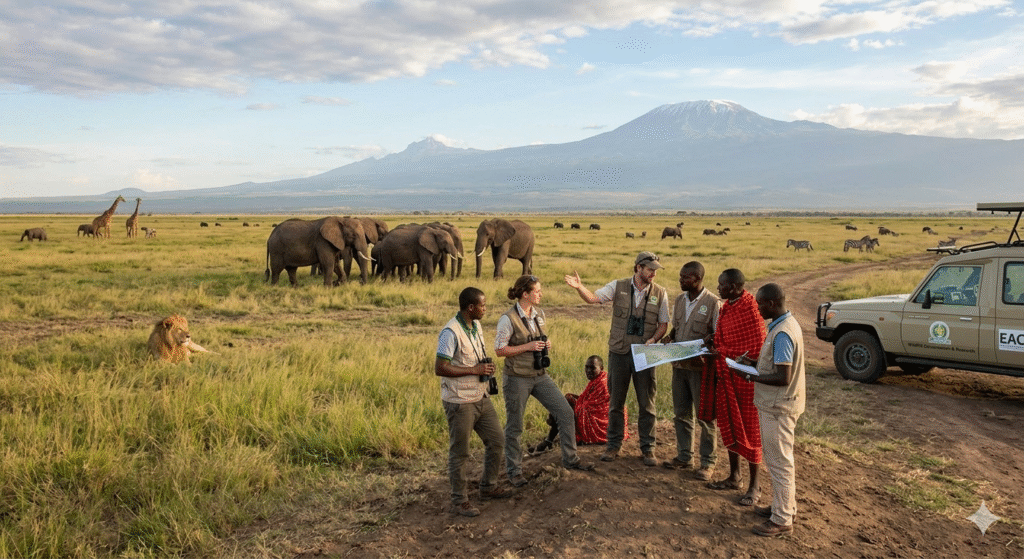
In the savannas of East Africa, where elephants roam beneath snow-capped peaks and lions stalk the grasslands, the question of hunting has never been simple. Today, in April 2026, the region finds itself at a crossroads. Legal trophy hunting generates millions of dollars for conservation and rural communities. Illegal poaching continues to slaughter endangered species for their ivory and skins. And a rising tide of human-wildlife conflict is pushing desperate villagers to take matters into their own hands. This article examines the complex and often contradictory realities of hunting across East Africa today.
Part 1: The Two Faces of Hunting – Legal vs. Illegal
Any discussion of hunting in East Africa must begin with a fundamental distinction: legal, regulated trophy hunting is permitted in some countries under strict quotas, while illegal poaching is a criminal act that threatens the very survival of iconic species.
Tanzania, for example, permits trophy hunting in designated Wildlife Management Areas (WMAs) and game reserves. The country expects to earn over $314 million from hunting concessions over the next 20 years, with additional funds flowing into community development programs. Under a new Special Wildlife Investment Concession Areas (SWICA) model, hunting blocks have seen their tenure extended from five to twenty years, allowing operators to invest confidently in infrastructure and anti-poaching measures.
Illegal poaching, meanwhile, remains a persistent threat. In Kenya alone, recent operations have uncovered suspects carrying 42 kilograms of elephant tusks valued at 4.2 million shillings, alongside leopard and python skins. Another suspect was arrested in Kwale County with 39 kilograms of tusks, suggesting two elephants had been killed. The demand for ivory in Asian markets continues to fuel this illicit trade, despite a global ban on commercial ivory sales.
Part 2: The Economic Case for Trophy Hunting
Proponents of legal hunting argue that it is not merely permissible but essential for conservation. Zimbabwe, East Africa’s southern neighbor, projects $20 million in revenue from its 2026 hunting season, targeting elephant, lion, leopard, and buffalo under strictly regulated quotas. At the community level, these proceeds fund boreholes, road construction, and even internet connectivity.
Tanzania is making a similar calculation. Under its WMA system, 25-33 percent of hunting revenue goes directly to village members through elected representative bodies—a far higher percentage than the 3 percent allocated in conventional game reserves. For rural communities living alongside dangerous wildlife, this revenue provides a tangible incentive to tolerate elephants and lions on their land.
The logic is straightforward: if wildlife pays, communities will protect it. If it only brings danger and crop destruction, they will eliminate it.
Part 3: The Enduimet Scandal – When Legal Hunting Kills “Super Tuskers”
But the line between legal and responsible hunting can blur dangerously. The Enduimet Wildlife Management Area in northern Tanzania, adjacent to Kilimanjaro National Park, was long presented as a model of community-based conservation. It involved 11 Maasai villages in a system designed to share benefits from tourism and hunting.
Then, between 2023 and 2024, the burned remains of five “super tuskers” were found in the area. Fewer than 30 of these critically rare elephants—known for tusks so long they scrape the ground—remain alive today. According to anonymous sources, the animals were killed during trophy hunts authorized by the Tanzania Wildlife Management Authority (TAWA). One elephant was only 30 years old, in full reproductive age. The bodies, sources allege, were burned to prevent identification and avoid media scrutiny.
The company that organized the safari, Kilombero North Safaris (KNS), claims to practice “ethical hunting.” But its owner, Akram Aziz, previously faced 75 charges in Tanzania, including money laundering and illegal possession of ivory and automatic weapons—a case later settled with a fine. The incident broke an informal agreement that had stood for almost three decades, ensuring elephants’ safe passage between Kenya and Tanzania.
Part 4: The Human Cost – Evictions and Marginalization
Behind the statistics of hunting quotas and conservation funding lies a more troubling story: the displacement of indigenous communities. In Enduimet, local Maasai report increasing pressure on their land. In July 2024, the WMA authority issued eight eviction orders, triggering protests during which the agency’s local office was destroyed.
Navaya Ole Ndaskoi of the Tanzanian NGO PINGOs Forum told DW: “From what sources on the ground have told me, the Maasai of Enduimet have always been opposed to the establishment of this Wildlife Management Area”. The core issue, critics argue, is land ownership. Although Enduimet is presented as a community-managed area, the villages do not actually own the land. It remains under the president’s trusteeship.
Due to repeated human rights violations—including the use of live ammunition against protesters and violent evictions—the European Commission suspended conservation funding to Tanzania in 2024. Yet Western organizations, including the World Wildlife Fund (WWF), continue to operate in the region through projects funded by Germany’s development ministry and private foundations.
Part 5: The WWF and Wildlife Credits – A New Approach?
The WWF’s approach in Enduimet focuses on developing “alternatives to hunting, showing that it is possible to achieve much higher earnings through ecotourism”. The SOKNOT-Unganisha project, funded with €6.5 million from Germany, supports a pilot initiative on “wildlife credits” in the Kitenden Corridor.
Under this model, the economic value of credits is tied to the presence of wildlife. Villages receive payments from donors, companies, or tourism operators interested in strengthening their environmental credentials. The concept has attracted support from Ikea and the UK’s Darwin Initiative.
But critics remain skeptical. Lawyer Joseph Oleshangay, who has long worked on Maasai land issues, told DW: “It is no coincidence that in the places where WWF carries out its projects, hunters are often active as well. And they collaborate with the same agencies responsible for human rights violations, such as TAWA”. Survival International and other advocacy groups see wildlife credits as a form of commodifying nature that leaves communities dependent on donor flows while failing to address structural pressures on Maasai land.
Part 6: Human-Wildlife Conflict – The Deadly Toll on Communities
While debates rage over trophy hunting and conservation funding, ordinary East Africans are dying. In Samburu County, Kenya, seven people were killed by marauding elephants in just three months leading up to March 2026. Residents of Lpepet village described being forced to lock themselves indoors during the day. Women fetching water and firewood—daily necessities—were the most frequent victims.
“We cannot even go to the farms, nor venture out of our homes to fetch firewood and water,” resident Esther Lenkaina told The Standard. “The elephants have become a menace. KWS must act now.”
In Tana River County, a 65-year-old man was gouged by a buffalo on his own farm. In Lamu, a hippopotamus killed a 67-year-old man as he went to fetch water. On Lake Victoria, a crocodile killed a man bathing at the shoreline—the second such incident in a week.
Local residents have begun threatening to take matters into their own hands. “We will be forced to hunt down the elephants and kill them,” warned Kitwa Lenengwesi in Samburu. “We cannot just sit and wait as the elephants destroy our lives.”
Part 7: Anti-Poaching Efforts – The Frontline Response
Against this backdrop of conflict, rangers and wildlife authorities are waging a daily battle against poachers. The Big Life Foundation, operating in the Amboseli ecosystem across the Kenya-Tanzania border, publishes weekly reports that read like a chronicle of low-intensity warfare.
In the week of March 30 to April 5, 2026, rangers recovered three pieces of broken elephant tusks weighing 4.3 kilograms. They blocked heavy machinery and drilling equipment at a barrier due to lack of relevant documents. They located an injured elephant and continued monitoring. They responded to a lion incident that killed one cow and successfully calmed community members attempting retaliation. A joint operation led to the arrest of one suspect with python skin.
The previous week, joint operations led to the arrest of three suspects with 6.1 kilograms of elephant ivory. Rangers recovered 10 kilograms of broken ivory pieces. They pushed four lions away from settlements and stopped fencing activity on a 42-acre parcel that lacked documentation. Every week brings a similar litany: arrests, recoveries, conflict mitigation, and the relentless pressure of protecting wildlife while safeguarding people.
Part 8: Kenya’s Response – Compensation and Innovation
Kenya has taken significant steps to address both poaching and human-wildlife conflict. In May 2025, the government introduced the third phase of its Human-Wildlife Conflict Compensation Programme. President William Ruto unveiled the Wildlife Conservation Card, developed in partnership with KCB Bank, available in three tiers: Platinum (Elephant), Gold (Lion), and Silver (Cheetah). A portion of every transaction—10, 5, or 3 shillings respectively—goes directly to the Wildlife Conservation Trust Fund.
“Compensation is justice, but prevention is progress,” Ruto said at the launch in Meru National Park. “Through the Conservation Card, fencing, and community-led tourism, we are turning conflict into opportunity”.
Kenya has also deployed high-tech surveillance equipment, including drones, to track poachers and monitor elephant and rhino populations. These efforts led to zero rhino poaching in Kenya in 2020—the first time in about two decades. Parliament has passed strict anti-poaching laws, and the government has beefed up security at parks.
Yet the persistence of ivory seizures—42 kilos here, 39 kilos there—demonstrates that the battle is far from won.
Part 9: The Regional Picture – Divergent Policies
East African countries have taken different approaches to hunting, creating a patchwork of policies that wildlife—and poachers—do not respect. Tanzania permits trophy hunting and has extended concession periods to encourage investment. Kenya, by contrast, banned trophy hunting in 1977 and relies on photographic tourism and anti-poaching enforcement.
This divergence creates challenges. The “super tuskers” killed in Tanzania’s Enduimet area were part of a population that migrates between Kenya’s Amboseli National Park and Tanzania’s Kilimanjaro ecosystem. An informal agreement had protected them for three decades—until it was broken. Cross-border coordination is essential but often politically difficult to maintain.
Zimbabwe, while not in East Africa, offers a regional comparison. The country has aggressively marketed itself as a hunting destination, securing an invitation to exhibit at Europe’s largest hunting and conservation exhibition in Germany for the first time. The United States accounts for more than 60 percent of Zimbabwe’s hunting business, with Germany contributing over 40 percent. The debate over importing hunting trophies remains politically charged in Western countries, where animal welfare advocates push for bans while hunting lobbies defend the practice as conservation.
Part 10: The Ethical Debate – Can Hunting Ever Be Conservation?
At the heart of the matter is a profound ethical question: can killing individual animals ever serve the goal of preserving species?
Proponents argue that regulated hunting generates revenue that funds anti-poaching patrols, compensates communities for livestock losses, and creates economic incentives to maintain wildlife habitat. Without hunting, they contend, vast areas of land would be converted to agriculture or livestock, leaving no space for wildlife at all.
Critics counter that the ethical cost is too high, that hunting disrupts social structures of species like elephants, and that the revenue argument is overstated—photographic tourism generates far more income per animal than hunting ever could. The WWF’s project in Enduimet is explicitly designed to demonstrate that ecotourism and wildlife credits can outcompete hunting economically.
Professor Bram Büscher, who researches biodiversity conservation, offers a sobering perspective: “Since 1960, the number of protected areas has increased ten- or fifteen-fold, and conservation funding has never been higher. Yet the extinction crisis has worsened. Many insects, amphibians, and small mammals are disappearing, but they do not fall within the economic priorities of the present system”.
Part 11: The Poaching Economy – Who Kills and Why
Understanding the persistence of poaching requires understanding its economics. A single elephant tusk can fetch thousands of dollars on the black market, eventually reaching consumers in Asia where ivory is carved into ornaments and traditional medicine. For a subsistence farmer in rural Kenya or Tanzania, the amount of money offered for a set of tusks may represent several years’ income.
Poaching networks are often sophisticated, involving local hunters, transporters, and international smugglers. The motorcycle is a common vehicle for moving tusks from kill sites to collection points, as seen in the Kwale and Turkana arrests. Some poachers are organized criminal enterprises; others are desperate individuals pushed into illegality by drought, poverty, or lack of alternatives.
The Kenya Wildlife Service’s approach combines intelligence-led operations, community education, and interagency collaboration. The arrest of 13 suspects in a single week in late January 2026, with the recovery of 23 snares and over 650 kilograms of illegal sandalwood, demonstrates the scale of ongoing enforcement.
Part 12: The Future – Finding Balance in a Crowded Continent
East Africa’s wildlife faces an uncertain future. The human population is growing, land is being converted, and climate change is intensifying droughts that bring wildlife and livestock into closer contact. Hunting—both legal and illegal—will remain a factor in this equation.
The path forward likely involves several elements: stronger cross-border coordination to protect migratory species; genuine community ownership of conservation areas, not just nominal participation; diversified funding that reduces dependence on hunting revenue; and continued investment in anti-poaching technology and enforcement.
For the Maasai communities of Enduimet, the core issue remains land. As one local source told DW: “For the Maasai, who for centuries have moved their herds between Kenya and Tanzania, the new borders, permits and regulations represent exclusion where elephants, giraffes and zebras form the backdrop to a landscape turned into an asset to be monetized”.
Until communities see wildlife as their asset to protect—not as a foreign imposition or a dangerous nuisance—the conflicts over hunting will continue. The animals, as always, will pay the price.
