

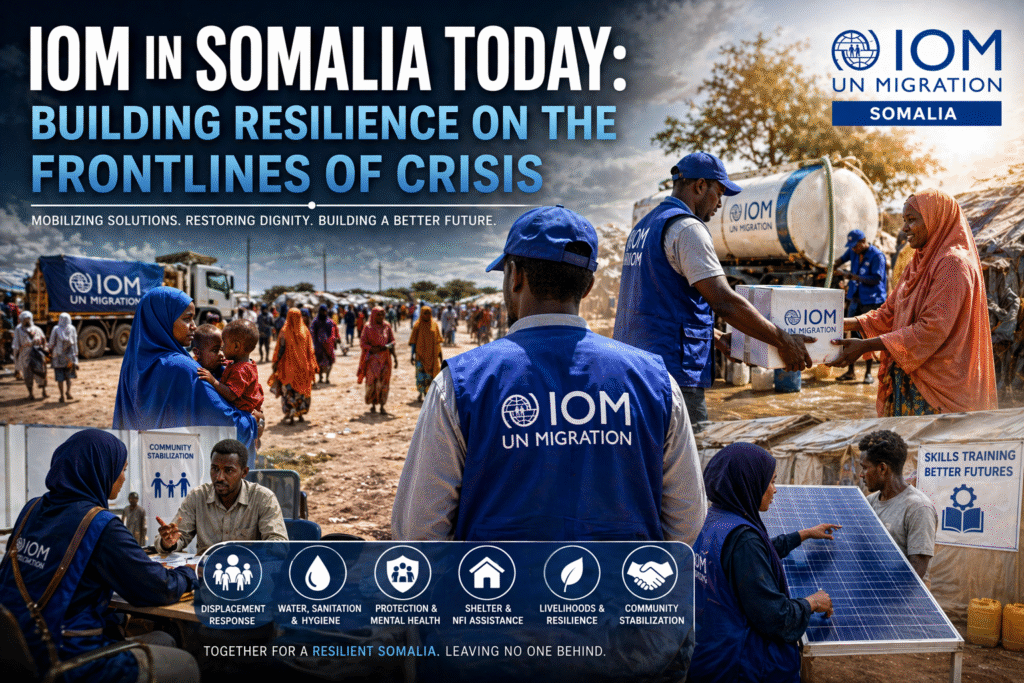
In the arid landscape of the Horn of Africa, where drought, displacement, and danger have become a grim routine, the International Organization for Migration (IOM) is quietly rewriting the rules of humanitarian engagement. As of April 2026, Somalia remains one of the world’s most complex crisis zones—but the IOM’s presence has evolved from emergency responder to long-term architect of resilience. With a $132 million Crisis Response Plan for 2025-2026 targeting 2.1 million people, the organization is pioneering a new model that links immediate relief with durable solutions, climate adaptation, and regional cooperation . Here is the state of IOM’s work in Somalia today.
Part 1: The Scale of the Crisis – 4.8 Million in Need
Somalia’s humanitarian landscape remains dire. According to the 2026 Humanitarian Response Plan launched by the Somali government and the UN, 4.8 million people will require humanitarian assistance this year . While this represents a 20 percent decrease from 2025, the reduction reflects a stricter definition of needs rather than any genuine improvement in living conditions.
Prolonged drought, armed conflict, and disease outbreaks continue to drive the crisis. Water sources are depleting, pastureland is deteriorating, and livelihoods are eroding—forcing millions into food insecurity and displacement . The Somali Disaster Management Agency’s head, Mohamud Moalim, describes the situation as “a severe and escalating drought following several seasons of below-average rainfall” .
Against this backdrop, the IOM’s $132,293,248 Crisis Response Plan for 2025-2026 represents a strategic commitment to saving lives while building pathways out of crisis .
Part 2: The Three Pillars – Saving Lives, Driving Solutions, Facilitating Pathways
IOM Somalia’s strategy rests on three interconnected pillars, each addressing a distinct phase of the displacement and migration cycle.
Pillar One: Saving Lives and Protecting People on the Move ($51 million) targets 1.2 million people with rapid, coordinated humanitarian assistance across shelter, water and sanitation (WASH), protection, and camp coordination. Using mobile teams and a Rapid Response Mechanism, IOM delivers aid to internally displaced persons (IDPs) in both camp and non-camp settings, as well as vulnerable migrants and host communities .
Pillar Two: Driving Solutions to Displacement ($69.5 million) is the largest investment, focusing on 865,000 people. This pillar supports voluntary, safe, and dignified return when conditions allow, while building urban resilience to support integration. Critically, it includes housing, land, and property (HLP) interventions that help displaced people reclaim rights, lower eviction risks, and find safe settlements .
Pillar Three: Facilitating Pathways for Regular Migration ($11.7 million) targets 40,698 people through diaspora engagement, social inclusion, and protection assistance. IOM is building Somalia’s National Coordination Mechanism on Migration (NCM)—an independent directorate with working groups on data, return and reintegration, diaspora, protection, border management, and counter-trafficking .
Part 3: The Saameynta Programme – From Shelter to Home
Perhaps the most transformative initiative is the Saameynta Joint Programme (“Impact” in Somali), now entering its second phase (2026-2030). This partnership between IOM (as lead agent), UN-Habitat, and UNDP is funded by the Netherlands, Switzerland, and Norway .
Phase 1 (2021-2025) laid the groundwork, piloting integrated durable solutions in Baidoa and Bossaso. The results have been life-changing. At Grible, just outside Bossaso, what began as a relocation project has become a model for integrated displacement response .
Faiza Hashim Ali, who relocated from the Tawakal displacement site to Grible, describes the transformation: “Before moving to Grible, life was so difficult. We lived in a hut. When it rained, we paid too much for water and didn’t even have showers. It felt like we were displaced people in our own country” .
Today, Faiza and her family live in a durable home with a veranda and proper sanitation. Each of the 61 newly constructed houses comes with a land deed—offering something many displaced families have never had: legal recognition of ownership and protection from being evicted again. “This is not just shelter,” Faiza says. “It is a completely new life” .
Phase 2, running through 2030, scales up these approaches, embedding climate resilience at its core—including climate risk-informed planning, green infrastructure, and adaptive livelihood opportunities .
Part 4: The DARIS WACAN Project – Good Neighbors Across Borders
Climate shocks do not respect national boundaries, and neither does IOM’s response. The DARIS WACAN project (“Good Neighbors” in Somali) is a three-year initiative funded by the European Union and jointly implemented by IOM and IGAD, targeting communities along the Kenya–Somalia border .
The Mandera Triangle—spanning Kenya’s Mandera County and Somalia’s Gedo Region—faces recurrent droughts, water scarcity, poor infrastructure, and limited economic opportunities. The project supports pastoralists, farmers, women, youth, migrants, and host communities who depend on shared natural resources increasingly exposed to climate-driven shocks .
At a February 2026 steering committee meeting in Nairobi, officials reviewed progress and agreed on priority actions. As Oleg Naumov, IOM Deputy Regional Director for East, Horn and Southern Africa, stated: “Communities along the Kenya–Somalia border are facing pressures that transcend borders—including climate shocks, resource scarcity, and increasing vulnerabilities that no country can tackle alone. DARIS WACAN embodies the kind of collective, practical cooperation needed to turn shared challenges into shared resilience” .
The project is now in its second year, focusing on climate-adaptive water management, feeder road development, sustainable livelihood support, and cross-border coordination .
Part 5: The Migrant Response Plan – Addressing the Eastern Route Crisis
Beyond Somalia’s borders, IOM is leading a $91 million regional appeal to support migrants along the Eastern Route from the Horn of Africa to Yemen and the Gulf, as well as the Southern Route toward Southern Africa . Forty-eight partners are involved in this coordinated response.
The numbers are staggering. Each year, thousands of migrants—including children—primarily from Ethiopia and Somalia, undertake perilous journeys through Djibouti to Yemen. In 2025, more than 900 migrants died or went missing on the Eastern Route—the deadliest year on record . In January 2026 alone, over 21,000 migrants were tracked entering Yemen .
IOM Director General Amy Pope underscored the urgency: “Migration along these routes is a shared responsibility. The 2026 Migrant Response Plan brings governments and partners together to protect people on the move and support host communities under pressure” .
The plan delivers life-saving aid and protection services, expands access to voluntary return and reintegration, and supports community stabilization. Without increased funding, IOM warns that shelters in Somalia, Ethiopia, Kenya, and Djibouti could close—cutting off critical medical care, protection, and safe accommodation for trafficking survivors, unaccompanied children, and others facing violence .
Part 6: Reintegration Research – Understanding What Works
IOM is also investing in evidence-based programming. A major study on reintegration outcomes—conducted in Somalia alongside five other countries—examined differences between forced and voluntary returnees, as well as gender-specific outcomes .
Commissioned by IOM under the EU-IOM Knowledge Management Hub and implemented by Maastricht University, the research used mixed methods: quantitative data from IOM’s Reintegration Sustainability Survey (RSS) and qualitative data from in-depth interviews with returnees, their families, and key informants .
The findings help IOM tailor its reintegration assistance to be more effective, sustainable, and sensitive to the distinct needs of men, women, and vulnerable groups returning to Somalia.
Part 7: The Funding Challenge – A $132 Million Gap
Despite the scale of need, funding remains the critical bottleneck. IOM’s Somalia Crisis Response Plan for 2025-2026 requires $132 million, but as of the plan’s publication, significant gaps remained . Across the region, the $91 million Migrant Response Plan faces similar shortfalls .
The broader humanitarian context is equally strained. The UN’s 2026 Humanitarian Response Plan for Somalia appeals for $852 million to assist 2.4 million people—but this represents a reduction from previous years, reflecting declining donor appetite rather than reduced need .
As humanitarian actors emphasize, tackling the root causes requires integrated approaches that combine humanitarian aid, development, and peacebuilding—exactly the model IOM is pioneering .
Part 8: The Future – Scaling Up Durable Solutions
Looking ahead, IOM Somalia’s focus is clear: scaling what works. Phase 2 of the Saameynta programme (2026-2030) will expand integrated durable solutions in Baidoa and Bossaso, embedding climate resilience and economic empowerment .
The four pillars of Saameynta Phase 2 are:
- Enhancing government leadership and coordination – Building state capacity to manage displacement
- Inclusive land governance – Securing tenure rights and preventing evictions
- Economic empowerment and livelihoods – Creating jobs and self-reliance opportunities
- Access to services – Ensuring healthcare, water, education, and infrastructure
This approach recognizes that displacement in Somalia is not a temporary emergency to be managed but a long-term reality to be addressed through development, governance, and community building.
Conclusion: A New Paradigm for Crisis Response
The IOM in Somalia today is no longer just a humanitarian first responder. It is a development partner, a climate adaptation agency, a land rights advocate, and a regional coordinator. From the land deeds handed to families in Grible to the cross-border water management projects in the Mandera Triangle, the organization is demonstrating that even in one of the world’s most challenging environments, durable solutions are possible.
As one resident of Grible put it, reflecting on her journey from a hut to a home with a land deed: “This is not just shelter. It is a completely new life” . For millions more across Somalia, the question is whether the resources and political will can match the ambition of that vision.
