

April 20, 2026
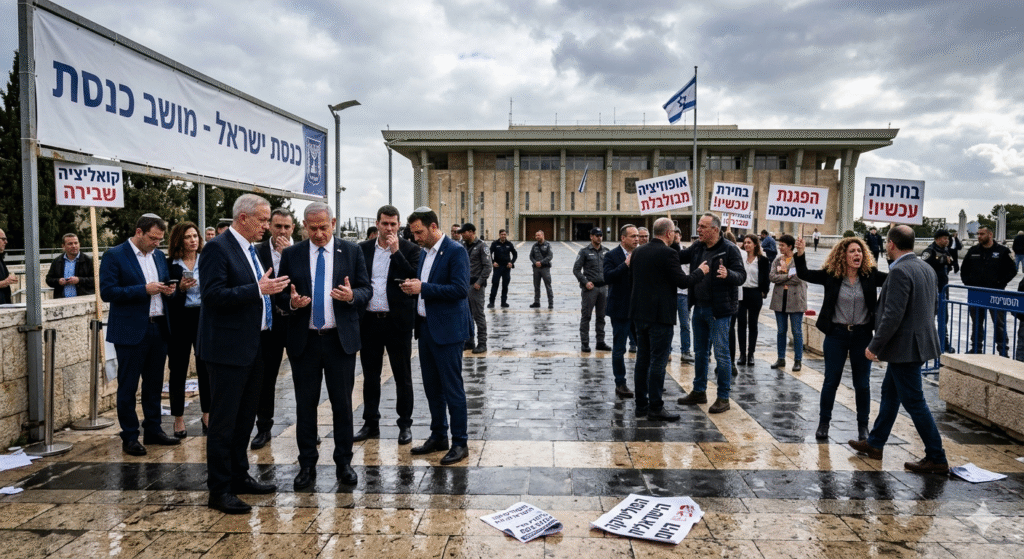
Israel’s political landscape is a pressure cooker. With a war against Iran ongoing, a fragile ceasefire in Lebanon, a High Court battle threatening to oust a far-right minister, and elections looming in October, Prime Minister Benjamin Netanyahu is fighting on multiple fronts—military, judicial, and political. Here is the state of Israeli politics today.
Part 1: The Coalition’s Bleeding Numbers
The most immediate threat to Netanyahu’s government is not the courtroom or the battlefield—it is the ballot box. Multiple polls released in the past week paint a consistent picture: the Prime Minister’s right-wing bloc is falling short of a majority.
According to a Zman Yisrael/Times of Israel survey conducted April 15-16, Netanyahu’s Likud party would receive 28 Knesset seats if elections were held today. Gadi Eisenkot’s Yashar! and Naftali Bennett’s Bennett 2026 would follow with 16 each .
The numbers tell a stark story for the coalition. The current right-wing bloc stands at just 51 seats—ten short of the 61 needed to form a government . Even more concerning for Netanyahu, a Maariv daily poll found that the Zionist opposition bloc would receive 61 seats without needing support from any Arab parties—the third consecutive week showing this result .
Yet the picture is not uniformly bleak. Channel 14—a network known for its close ties to the right and settler community—presents a dramatically different scenario, granting Likud 35 seats and boosting Netanyahu’s camp to 65 seats . The discrepancy reflects a deeply divided electorate and a media landscape that has become an active participant in the political battle.
Part 2: The Ben-Gvir Crisis—Judiciary vs. Far Right
While polls signal future trouble, a more immediate crisis is unfolding in Israel’s High Court of Justice. On Wednesday, the Court began hearing four petitions seeking the removal of far-right National Security Minister Itamar Ben-Gvir .
The petitions, backed by Attorney General Gali Baharav-Miara, accuse Ben-Gvir of “abusing his position to improperly influence the activities of the Israel Police in the most sensitive areas of law enforcement and investigations” . They allege repeated and unlawful interference in operational police matters, politicization of police appointments, and overt interference in police investigations .
Ben-Gvir arrived at the Court defiant. “More than half a million voters chose us to bring about real change,” he told supporters outside. “Democracy will not fall. Legal dictatorship will fall” .
Justice Minister Yariv Levin went further, declaring that the government would not respect any ruling ordering Ben-Gvir’s removal. “The hearing taking place this morning to oust Minister Ben-Gvir is unlawful, and the decision of the judges will regardless have zero validity,” Levin said .
The standoff threatens a full-blown constitutional crisis. Netanyahu submitted a 129-page response arguing the Court lacks authority to interfere in government decisions or ministerial appointments, describing the attorney general’s request as “inconceivable… in the midst of an existential war” .
Part 3: The Lebanon Ceasefire—Opposition Cries “Betrayal”
If the Ben-Gvir crisis divides the government from the judiciary, the Lebanon ceasefire has divided the government from itself—and inflamed the opposition.
On Thursday, the US announced a 10-day ceasefire between Israel and Lebanon. The truce stipulates that “all parties recognize Lebanon’s security forces as having exclusive responsibility for Lebanon’s sovereignty and national defence” .
The reaction from Israel’s political right was immediate and furious. Opposition Leader Yair Lapid slammed the agreement, saying “all the promises of this government are crashing against the ground of reality” .
Avigdor Liberman called the ceasefire a “betrayal.” “Once again, Hezbollah is being given time to recover and strengthen itself. The war must not be ended without a clear decision and the elimination of Hezbollah,” he said .
Most striking was the criticism from former army chief of staff Gadi Eisenkot, who accused Netanyahu of forcing Israel into ceasefires—citing Gaza and Iran as previous examples. “Netanyahu, as prime minister, does not know how to realize military achievements into political achievements, and therefore a ceasefire is being forced upon us for the third time,” Eisenkot charged .
The sharp condemnation has raised concerns that Netanyahu may be pressured into restarting the war—a prospect that would suit his political base but risks further isolating Israel internationally.
Part 4: The Strategy Behind the Chaos—Netanyahu’s Iran Calculus
Amid the domestic turbulence, Netanyahu is executing a calculated regional strategy centered on Washington. According to POLITICO reporting, Israel is “leaning on Trump, pressuring Iran, and keeping the military option” as its primary approach .
Yaakov Amidror, a former national security adviser who still consults with Netanyahu, explained the calculus: “Since Trump was elected… whenever we can, we coordinate with the Americans. For example, now, to stop attacking Iran, that was the price. But for us, being with the Americans and paying the price along the way was more important than to do it by ourselves” .
The strategy has delivered tangible results. Israel has agreed to scale back operations in Lebanon at Trump’s request—though not without extracting maximum military advantage first. Netanyahu has also directed his team to begin negotiations with Lebanon to disarm Hezbollah, with initial consultations expected to begin in Washington .
Privately, Israeli officials describe their goals more narrowly: deepening a buffer in the north and shaping the battlefield so any future negotiations begin from a more favorable balance of power. “We’re trying to create the conditions for Hezbollah to be disarmed,” an Israeli military official told POLITICO .
The economic damage to Iran has been substantial. A regional intelligence assessment obtained by POLITICO estimates Iran faces direct reconstruction costs between $7 billion and $44 billion, with its missile program accounting for the steepest losses .
Part 5: The Opposition’s Leadership Crisis
If Netanyahu has problems, the opposition may have an even deeper one: it lacks a leader.
Despite the coalition’s polling weakness, Netanyahu still dominates the “suitability for prime minister” category. A Channel 12 poll showed Netanyahu surpassing Yair Lapid by 42% to 27%—a 15-point margin .
Lapid’s personal numbers have declined to critical levels. According to a Zman Yisrael poll, his Yesh Atid party—currently the largest opposition faction with 24 Knesset seats—would drop to just five seats if elections were held today .
The numbers explain the frantic merger talks underway. Channel 12 reports that representatives for Naftali Bennett, Gadi Eisenkot, and Yair Lapid are “discussing” a merger ahead of the October elections, potentially forming a joint party called “New Israel” .
The arithmetic is compelling. If the three ran together, their combined list would receive 38 seats—making it the largest faction in the Knesset . However, even this super-merger would not significantly change the size of the rival blocs, as the right-wing coalition would remain largely intact .
The biggest obstacle remains the Arab parties. While they hold between 5 and 10 seats in various scenarios, centrist and right-wing opposition leaders refuse to partner with them in government—a “veto” that keeps the political crisis ongoing without a clear resolution .
Part 6: The Religious Parties—Kingmakers in Waiting
Amid the turmoil, one constant remains: the ultra-Orthodox parties. Shas and United Torah Judaism maintain relative stability in their voting power, making them the kingmakers in any future coalition scenario .
This stability gives them outsized influence. Neither Netanyahu’s coalition nor any hypothetical opposition government can reach 61 seats without their support. And they know it.
Religious Zionist parties present a different picture. Finance Minister Bezalel Smotrich’s party failed to cross the electoral threshold in any of the recent polls . The far-right, it seems, may be consolidating behind Ben-Gvir’s Otzma Yehudit, which polls between 6 and 10 seats depending on the survey .
Part 7: The Annexation Factor—Sovereignty in Practice
While Israelis debate elections and ceasefires, the government is quietly advancing what Energy Minister Eli Cohen called “applying sovereignty in practice” in the occupied West Bank .
Cohen, a member of Israel’s Security Cabinet, announced an agreement to connect new illegal settlements—including Homesh, Sa-Nur, Rehavam, and Ebal—to electricity and water networks .
Since taking office in December 2022, Netanyahu’s government has accelerated settlement activity across the West Bank, including East Jerusalem. The United Nations considers these territories occupied Palestinian land .
The timing is significant. As international attention focuses on the wars in Gaza, Lebanon, and Iran, settlement expansion continues largely unnoticed—but with profound long-term implications for any future two-state solution.
Part 8: The Security Mood—Hawkishness on the Rise
The polls reflect a clear shift in Israeli public opinion: security hawkishness is ascendant. The vast majority of Israelis oppose a ceasefire with Hezbollah before strict security conditions are met, reinforcing the right’s political discourse .
Sixty-two percent of respondents in a Maariv poll expect a direct confrontation with Iran soon, pushing existential security issues to the forefront at the expense of economic and social concerns .
This mood benefits Netanyahu, who has built his political identity around security credentials. But it also constrains him. Any perceived weakness—whether on Hezbollah, Hamas, or Iran—could trigger a revolt from his own base.
Part 9: The Economic Front—Coalition Voters Unhappy
Even Netanyahu’s own voters are expressing dissatisfaction—not on security, but on economics. A Channel 12 poll found that even coalition voters believe not enough has been done to help those hurt financially by the war .
The cost of the Iran war, combined with disrupted trade through the Strait of Hormuz and ongoing military operations, is taking a toll. Whether economic discontent will translate into electoral punishment remains unclear, but it is a vulnerability Netanyahu’s opponents are eager to exploit.
Part 10: The Election Calculus—October Looms
Elections are scheduled for October. Whether they will happen as planned—or sooner—is an open question. Netanyahu might be tempted to call early elections while his personal polling remains strong and his opponents remain divided .
But coalition tensions may prevent him from acting on that temptation. According to analysis from Israel Hayom, what we are seeing is “both sides testing each other’s limits”—positioning themselves advantageously without triggering an early collapse .
The national unity government may last a few more months, but the clock is ticking.
Part 11: The International Dimension—Washington’s Leverage
Throughout the political turbulence, one external factor looms above all: the United States. Netanyahu has staked his strategy on alignment with President Trump, even when it requires uncomfortable compromises .
Trump has demonstrated his leverage. “I spoke with Bibi and he’s going to low-key it,” Trump told NBC after the massive Lebanon strikes. “I just think we have to be sort of a little more low-key” .
Netanyahu has not publicly acknowledged making such a commitment, but the reduction in strikes speaks for itself. The question is how long he can maintain this balancing act—keeping Washington satisfied while preventing his own coalition from fracturing.
Part 12: The Road Ahead—Three Scenarios
As April turns to May and October approaches, three broad scenarios present themselves:
Scenario One—Coalition Holds: Netanyahu manages the Ben-Gvir crisis, weathers the Lebanon ceasefire backlash, and keeps the government intact through the October elections. His personal polling advantage and the opposition’s disarray give him a fighting chance.
Scenario Two—Early Elections: The High Court rules against Ben-Gvir, the coalition fractures, and Netanyahu calls early elections while his numbers are still strong. The gamble could pay off—or backfire spectacularly.
Scenario Three—Opposition Consolidation: Bennett, Eisenkot, and Lapid finalize their merger, presenting a unified alternative. The Arab parties signal willingness to support a non-Netanyahu government. The race becomes competitive.
Conclusion: A Nation at a Crossroads
Israeli politics today is defined by paradox. Netanyahu is simultaneously strong—dominating personal polling, executing a coherent Iran strategy—and weak, with his coalition bleeding seats and his far-right partners threatening constitutional crisis.
The opposition has the numbers to potentially form a government—if it can find a leader, overcome its internal divisions, and resolve the Arab party dilemma. The religious parties hold the balance of power, as they always have.
And beneath all the political maneuvering, a war continues. Iran has been degraded but not destroyed. Hezbollah remains armed. The hostages in Gaza remain unfreed. And the Israeli public, exhausted by conflict, is also increasingly hawkish, demanding security before compromise.
In October, Israelis will go to the polls. What they will find—a stable coalition, an opposition revival, or a constitutional crisis—remains unwritten. But one thing is clear: the battle for Israel’s political future is already underway.
Sources: Anadolu Ajansı, The Times of Israel, Al-Quds, POLITICO, The New Arab, ARY News, Israel Hayom
