

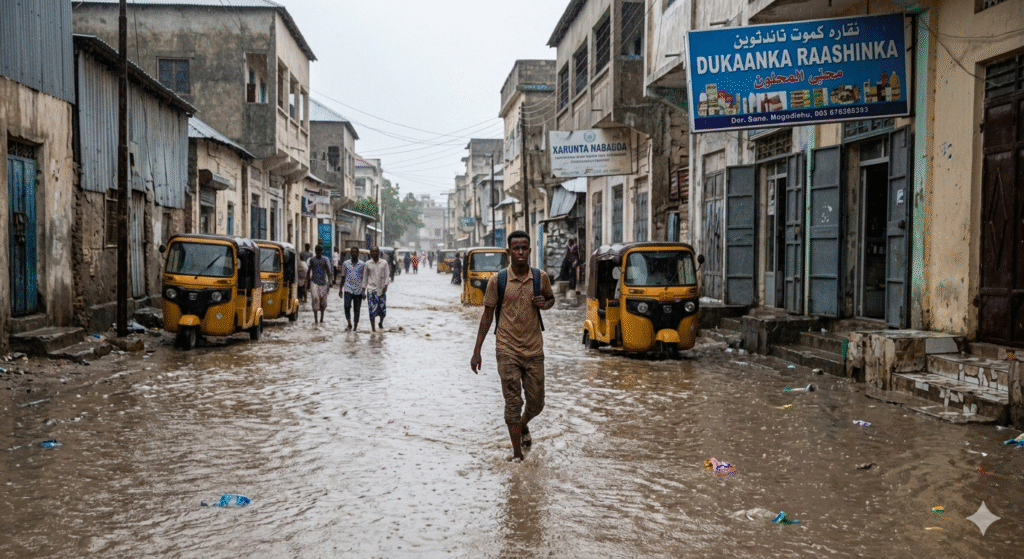
Mogadishu, Somalia — April 20, 2026
The seasonal rains have arrived in Somalia’s capital—not as a gentle relief after months of drought, but as a destructive force that has already claimed lives, destroyed hundreds of homes, and pushed an already fragile city to its limits. As the Gu rainy season (March–April–May) intensifies, Mogadishu finds itself trapped between two climate extremes: the parched earth of a record drought and the overwhelming waters of flash floods.
This is the state of Mogadishu’s rains today.
The Death Toll: Six Lives Lost in the Capital
In the last 48 hours alone, at least six people have lost their lives in Mogadishu due to record rainfall and subsequent flash flooding. Among the dead are three children, according to Abdirahman Omar Osman Yarisow, the city’s mayor .
The numbers are staggering for a single urban area. At least 301 homes have been completely destroyed, and the estimated financial losses have reached approximately $35 million . These are not just statistics—they represent families displaced overnight, livelihoods washed away, and a city scrambling to respond.
The rainfall Mogadishu has experienced is being described as the heaviest Somalia has seen in over 30 years, according to the United Nations Office for the Coordination of Humanitarian Affairs (OCHA) . For a country that was emerging from the worst drought in four decades just months ago, the whiplash has been devastating.
The Regional Crisis: Beyond the Capital
While Mogadishu bears the immediate brunt, the flooding is a national catastrophe. Across southwestern and central Somalia, flash flooding has claimed at least 29 lives and affected approximately 850,000 people, with over 300,000 displaced from their homes .
The most affected regions are in the southwest of the nation, where riverine flooding along the Shabelle River has proven particularly destructive. In Beledweyne town in the Hiran region, the Shabelle River burst its banks, sending water gushing into homes and submerging roads and buildings. Residents grabbed what belongings they could carry and waded through flooded streets in search of refuge .
Initial estimates indicate that flash and riverine floods across Somalia have affected at least 460,470 people, of whom nearly 219,000 have been displaced from flood-prone areas . The floods have left a trail of destruction—inundating homes and farmland, washing away livestock, temporarily closing schools and health facilities, and damaging critical road infrastructure .
The Forecast: More Rain on the Horizon
The outlook for the coming days offers little comfort. Weather forecasts for Mogadishu predict continued rainfall through the remainder of April. Today, April 20, the capital is expected to experience light rain turning to moderate rain, with temperatures ranging from 26°C to 32°C .
The seven-day forecast shows persistent precipitation:
- April 20: Light rain turning to moderate rain (26°C – 32°C)
- April 21: Light rain turning to cloudy (27°C – 31°C)
- April 22: Light rain turning to overcast (27°C – 31°C)
- April 23: Overcast turning to light rain (27°C – 31°C)
- April 24: Light rain (27°C – 31°C)
- April 25: Cloudy turning to light rain (26°C – 31°C)
- April 26: Light rain (26°C – 31°C)
[Citation: 8, 10]
The extended 30-day forecast indicates that Mogadishu will experience rainy days interspersed with clear skies, with maximum temperatures potentially reaching 39°C during dry intervals .
The Seasonal Outlook: Wetter Than Average
The Gu 2026 seasonal climate outlook, released by Somalia’s Ministry of Environment and Climate Change in February, had already warned of the coming crisis. The forecast predicted wetter-than-average rainfall across much of Somalia, including the Mogadishu area .
Key findings from that outlook included:
- Late Onset: The Gu rains were most likely to begin in the second half of April, with a risk of false starts and early dry spells. This timing aligns with the current flooding .
- Above-Average Temperatures: Higher-than-normal air temperatures are expected throughout the season, which may increase evapotranspiration and water demand, potentially reducing the effectiveness of rainfall for crop and pasture recovery .
- Elevated Flood Risk: The risk of localized flooding—particularly in the Juba–Shabelle river basins—is elevated. Heavy upstream rains could exacerbate flood risk in downstream and floodplain areas, including the capital region .
The outlook was issued against a degraded humanitarian baseline, following a failed Deyr 2025 season, a harsh and prolonged Jilaal dry period, and an evolving drought that had already severely affected livelihoods across the country .
The Infrastructure Crisis: A City Unprepared
Mogadishu’s vulnerability to flash flooding is not solely a matter of rainfall intensity—it is also a matter of infrastructure. Years of conflict, neglect, and underinvestment have left the capital with inadequate drainage systems, unplanned settlements, and roads that quickly become rivers when the rains come.
The destruction of 301 homes in just 48 hours speaks to the fragility of housing stock in the city’s most vulnerable neighborhoods. Many of these homes are makeshift structures in informal settlements, built on low-lying or flood-prone land without any engineering standards to withstand heavy water flow .
When the downpours hit, water has nowhere to go. It pools in low-lying areas, seeps into homes, and turns unpaved roads into muddy traps. Families who have already been displaced multiple times by conflict now find themselves fleeing yet again—this time from nature.
The Humanitarian Response: Racing Against Time
Mayor Yarisow has issued an urgent call to the Somali people and the international community to assist those displaced in the capital who are facing a dangerous situation after the rains . The Somali Disaster Management Agency (SoDMA) is coordinating response efforts, but the scale of the crisis strains limited resources.
In other parts of the country, aid agencies are “racing against time” to rescue people trapped by rising flood waters. In the town of Luuq, on the road linking the Somalia-Ethiopia border with Baidoa, approximately 2,400 people remain trapped, according to OCHA .
The challenges are immense. Roads, bridges, and airstrips have been damaged in several areas, affecting the movement of people and supplies and leading to increased prices of basic commodities . Schools and health facilities have been temporarily closed, disrupting education and medical care when they are needed most .
The Climate Paradox: From Drought to Deluge
Perhaps the most cruel aspect of Mogadishu’s current crisis is its timing. Just months ago, Somalia was emerging from the worst drought in 40 years—a dry spell that pushed millions to the brink of famine, killed livestock, and dried up water sources across the country.
The transition from extreme drought to extreme flooding is a classic signature of climate change, and Somalia—one of the most vulnerable countries to climate shifts—is experiencing it acutely. The parched earth, unable to absorb sudden heavy rainfall, exacerbates runoff and flooding. What should be a blessing—life-giving rain after years of thirst—becomes a curse when it arrives too fast and too hard.
As the Ministry of Environment and Climate Change noted in its seasonal outlook, the Gu 2026 rains are a double-edged sword. They offer potential short-term relief from prolonged dry conditions, but they also bring elevated flood risk, particularly in river basins and urban areas with poor drainage .
The Displacement Crisis: 300,000 and Counting
Nationwide, the displacement figures are staggering. More than 300,000 Somalis have been uprooted from their homes by the flooding . This number adds to an already massive displaced population—those fleeing conflict, drought, and now floods.
For those who have lost their homes, the immediate needs are urgent: shelter, clean water, food, and medical care. The destruction of bridges and roads complicates delivery of these essentials. And with more rain forecast, the window for humanitarian access may close further.
The disaster comes on the heels of a record drought that has left millions of Somalis on the brink of famine, with the troubled nation also battling an Islamist insurgency for decades . The cumulative effect is a population under siege from multiple directions: climate, conflict, and now floodwaters.
The Government Response: Warnings and Preparations
The Somali government has been actively monitoring the situation. The Ministry of Humanitarian Affairs and Disaster Management has been warning of potential heavy rains and flooding, urging preparedness measures to mitigate possible impacts .
The release of the Gu 2026 Seasonal Climate Outlook in February was itself a preparedness measure—an effort to inform anticipatory action and response planning. The question is whether the warnings translated into adequate preparation on the ground, given the limited resources available to Somali institutions.
Hirshabelle State, which includes flood-prone areas along the Shabelle River, has been reviewing security and flood risks as part of its cabinet meetings, indicating that the threat is being taken seriously at the regional level .
The International Dimension: A Call for Help
Mayor Yarisow’s appeal to the international community reflects a broader reality: Somalia cannot face this crisis alone. The country’s institutions, weakened by decades of conflict and now stretched by successive climate shocks, require external support to mount an adequate response.
The $35 million in estimated losses in Mogadishu alone represents a significant financial burden for a country with limited fiscal space. The destruction of hundreds of homes, roads, and other infrastructure will require reconstruction—and that reconstruction will require funding that Somalia does not currently possess .
International aid agencies are already on the ground, but their resources are stretched. The World Food Programme, UNICEF, OCHA, and other UN agencies are working alongside Somali authorities, but the scale of the crisis demands more.
Looking Ahead: The Remainder of the Gu Season
As of today, April 20, Mogadishu is only partway through the Gu rainy season, which extends through May. The forecast suggests continued rainfall, meaning the current crisis may worsen before it improves .
The Ministry of Environment and Climate Change has urged continued preparedness, monitoring, and anticipatory action. The message is clear: the rains are not finished, and neither is the danger.
For the people of Mogadishu—those who have lost homes, lost family members, or are simply trying to keep their families dry and fed—the coming weeks will be a test of resilience. The city has survived decades of war, but climate may prove an even more relentless adversary.
Conclusion: A City Between Extremes
Mogadishu today is a city caught between two versions of itself: the dusty, drought-stricken capital of just months ago and the waterlogged, flood-damaged city of today. The transition has been brutal, and the human cost is mounting.
Six dead, 301 homes destroyed, $35 million in losses, and the rain still falling. These are the numbers of Mogadishu’s rains today. Behind each number is a family wading through flooded streets, a child who lost a parent, a home that no longer exists.
Mayor Yarisow’s call for help is not just a plea—it is a recognition that in an era of climate extremes, no city, no matter how resilient, can face these storms alone. The rains have come to Mogadishu. The question now is whether the world will come, too.
Sources: Ministry of Environment and Climate Change, Somali Disaster Management Agency, UN OCHA, AFP, weather forecasts for Mogadishu