

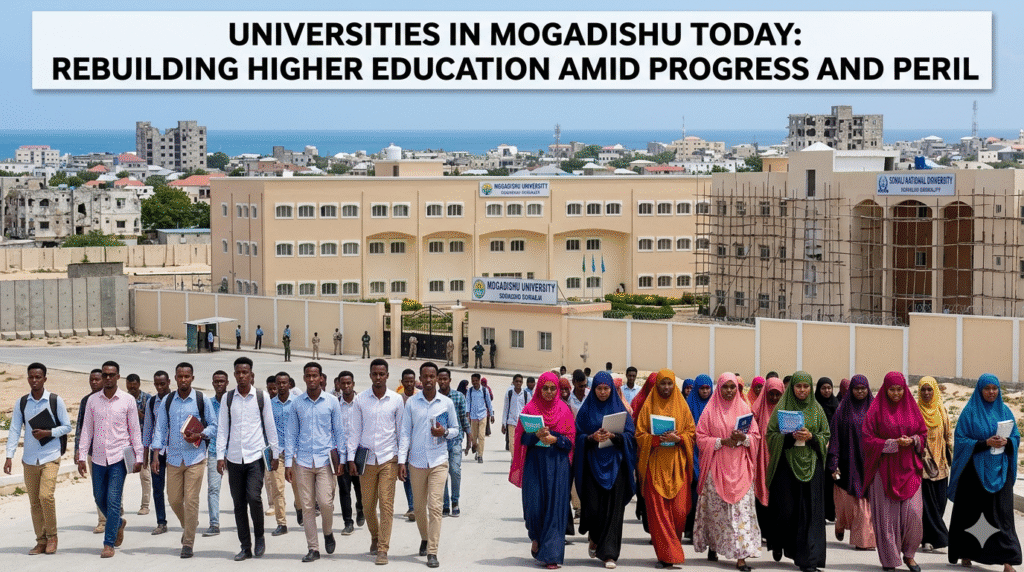
Mogadishu, the capital of Somalia, is a city of contradictions. After decades of civil war that shattered nearly every institution, the city is rebuilding. Nowhere is this rebirth more visible—and more fragile—than in its universities. Today, Mogadishu is home to a growing number of higher education institutions, serving tens of thousands of students who represent the best hope for Somalia’s future. Yet these universities operate against a backdrop of political tension, land disputes, infrastructure challenges, and a complex federal system that often pits Mogadishu against regional states. This article examines the state of higher education in Mogadishu today across multiple dimensions.
The Institutional Landscape: Two Pillars of Somali Academia
Mogadishu’s higher education sector is anchored by two major institutions, each with its own history and character.
Somali National University (SNU) stands as the country’s oldest and most prestigious public university. Founded in 1971 (with origins dating back to 1954), SNU was once the crown jewel of Somali education before the civil war reduced it to rubble . Today, it has risen from those ashes. SNU is a large institution, enrolling between 10,000 and 14,999 students, with branch campuses extending to Bosaso, Garowe, and Dhusamareb . The university operates on a selective admission policy based on entrance examinations, though its acceptance rate is notably high at 90-99 percent, reflecting the massive demand for higher education among Somalia’s young population .
Mogadishu University, a private institution, represents the other pillar. In October 2025, the university welcomed approximately 2,000 new students as part of “Batch 29” for the 2025/2026 academic year . During the orientation week, university president Dr. Ibrahim Mohamed Mursal addressed the incoming class with a message that captures the spirit of Somali higher education: “Many great leaders and professionals have walked through these halls and gone on to serve Somalis with distinction in high positions locally and globally. You too have the potential to excel if you remain disciplined and committed to your studies” .
Together, these two institutions—along with 20 other verified universities across Somalia—form the backbone of a higher education system that is expanding rapidly .
Academic Programs and Affordability
Somali universities offer a range of degree programs designed to meet national development needs. SNU provides pre-bachelor’s certificates and diplomas, bachelor’s degrees, and master’s degrees across multiple faculties . The “Rajo Kaaba” (Hope Builder) project, launched in April 2026, represents a significant expansion of postgraduate education. Under this initiative, 250 Somali women and girls have won master’s scholarships to study in 11 strategic fields, including education, health, and public administration .
The program is implemented through an international partnership: Kenyatta University provides educational expertise, SNU hosts the program locally, and the World Bank provides strategic funding . This model—international expertise combined with local delivery—represents a sustainable approach to building advanced educational capacity.
Affordability remains a critical advantage of Somali higher education. For local undergraduate students at SNU, annual tuition fees range from $0 to $999—effectively free for the poorest students . International undergraduate students pay within the same range. Postgraduate fees for local students range from $1,000 to $2,499 annually . These figures make Somali universities among the most accessible in the region, though they also reflect the severe resource constraints facing these institutions.
International Partnerships: A Lifeline for Capacity Building
One of the most promising developments in Mogadishu’s higher education sector is the growth of international partnerships. On April 17, 2026, the Somali National University’s School of Management and Public Administration (SMPA) signed a Memorandum of Understanding with Italy’s National School of Administration (SNA) .
The agreement, signed in the presence of the Italian Ambassador to Somalia, the Somali Deputy Minister of Foreign Affairs, and the Rector of SNU, provides a formal framework for training public officials . Ambassador Pier Mario Daccò Coppi emphasized that the agreement “joins the numerous initiatives in the sectors of defense, health, humanitarian aid, and culture through which Italy offers its support for the stabilization and institutional consolidation of Somalia” .
For Somalia, which is rebuilding its state institutions from the ground up, such partnerships are not merely academic—they are foundational to governance. The SMPA has become “a training institution of recognized importance in Somalia’s institutional reconstruction process” . By training a new generation of civil servants, these programs directly address the capacity gaps that have long plagued Somali governance.
The Land Dispute Crisis: Universities Under Siege
Yet for all the progress, Mogadishu’s universities face existential threats. In January 2026, Somali National University issued an urgent warning about the “illegal” demolition of its land in Mogadishu’s Hodan district . The demolitions have affected student service facilities and even the residence of the university’s chairperson. The university administration stated that no lawful authority had granted permission for these actions .
The dispute reflects a broader crisis in Mogadishu. Over the past two years, the city has witnessed a wave of demolitions, forced evictions, and repurposing of public land under the banner of urban redevelopment . While federal and Banadir regional authorities argue these actions are necessary to reclaim public land and improve urban planning, critics accuse the government of bypassing due process and failing to provide adequate compensation or legal justification .
The university has vowed to pursue “all necessary legal measures” to protect its property rights and prevent what it describes as attempts to “unlawfully reclassify the land under names unrelated to the institution” . The public has been warned against engaging in any commercial activity linked to the disputed land.
For an institution still recovering from the destruction of civil war, the loss of land and facilities is not merely bureaucratic—it is a direct threat to its ability to educate Somalia’s next generation.
The Federal Tension: Mogadishu vs. the Regions
Beyond land disputes, Somalia’s universities are caught in a broader political struggle between the federal government in Mogadishu and regional states like Puntland. A January 2026 analysis published in WardheerNews described how education has become “weaponized” in this conflict .
Under Somalia’s “one-country system,” all international assistance is channeled through federal ministries in Mogadishu. In theory, this framework restores national coherence. In practice, it has “concentrated enormous discretionary power in Mogadishu, enabling federal officials to decide who receives development assistance, when, and on what political terms” .
For Puntland, which has managed its own education system since the late 1990s—long before federal institutions were reassembled—this arrangement has proven disastrous. The article alleges that the Federal Ministry of Education has “increasingly obstructed, delayed, or micromanaged education projects intended for Puntland’s students” as punitive measures for political non-compliance .
The author, Abdisalam Ali Farah, describes a system where “education projects are not tools of state control. They are lifelines in a country where millions of children are out of school, teachers are underpaid, and communities are barely surviving. Turning these projects into political weapons is not just immoral—it is criminally negligent” .
While this analysis focuses on Puntland, it reflects a dynamic that affects all of Somalia’s higher education institutions, including those in Mogadishu. Universities operate within a political system where federal authority is contested and resources are distributed along political lines.
Student Life and Values
Despite these challenges, Mogadishu’s universities remain vibrant communities. The orientation week at Mogadishu University in October 2025 exemplified the emphasis on values that defines Somali higher education. President Dr. Ibrahim strongly cautioned new students against academic dishonesty, “emphasizing the importance of integrity in shaping ethical and competent health professionals” .
The university’s colors—blue and white—and its motto, “Our unity is our strength” , reflect a commitment to national cohesion that transcends clan and regional divisions. Students are introduced not only to academic expectations but also to “university history, rules, services and opportunities” . The orientation includes events designed to “build community, create engagement and develop friendships” .
For a generation that has known only conflict, these institutions offer something precious: structure, purpose, and hope.
The Path Forward
Mogadishu’s universities stand at a crossroads. On one hand, the growth in enrollment—2,000 new students at Mogadishu University alone—demonstrates massive demand . International partnerships with Italy and Kenya are expanding capacity . Scholarship programs are opening doors for women, who have been disproportionately affected by decades of conflict .
On the other hand, land disputes threaten the physical infrastructure of these institutions . Political tensions between Mogadishu and regional states risk turning education into a battlefield . And the chronic underfunding of Somali higher education means that even basic facilities remain inadequate.
Conclusion
Universities in Mogadishu today are monuments to resilience. They operate in a city still healing from war, governed by institutions still finding their footing, and serving a population with enormous needs and limited resources. Yet every day, tens of thousands of students walk through their gates. They sit in classrooms, take exams, earn degrees, and graduate into a country that desperately needs their skills.
As Mogadishu University’s president told the incoming class: “Many great leaders and professionals have walked through these halls.” The question for Somalia is whether those leaders will have universities worthy of their potential—or whether political battles and resource shortages will undermine the very institutions the nation needs most.
