

Mogadishu, Somalia — April 17, 2026
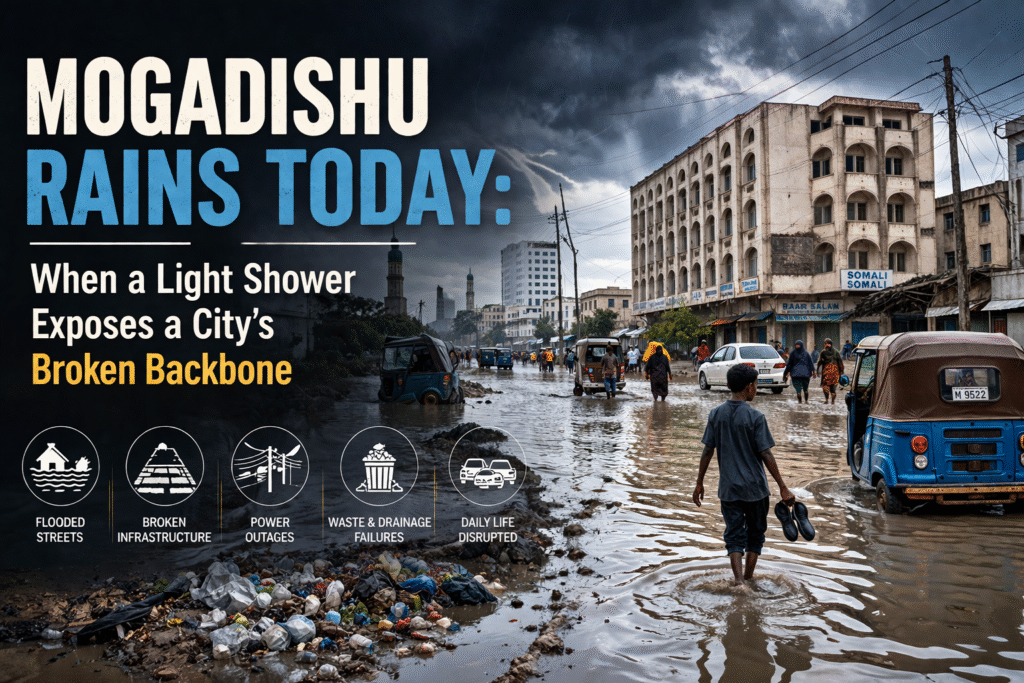
The rain that fell on Mogadishu this week was not, by any meteorological measure, exceptional. Weather stations recorded only light showers, temperatures remained steady between 27°C and 31°C, and there was no thunderous tempest or cyclonic fury . Yet, the aftermath has been nothing short of catastrophic—not because of the sky, but because of the ground below.
In a city still recovering from decades of civil war, the first substantial rains of the Gu season (March–April–May) have exposed a haunting truth: Mogadishu’s infrastructure is failing. A brand-new drainage system, inaugurated just weeks ago with World Bank funding, has collapsed under the pressure of a routine shower . The incident has triggered a firestorm of public outrage, fears of urban flooding, and desperate calls for accountability.
Here is the state of Mogadishu’s rains today.
Part 1: The Gu 2026 Forecast – A Season of Warnings
The current downpours were not a surprise. On February 12, 2026, Somalia’s Ministry of Environment and Climate Change, in collaboration with the Somali Disaster Management Agency (SoDMA), the UN’s FAO-SWALIM, and the IGAD Climate Prediction Centre (ICPAC), released the official Gu 2026 Seasonal Climate Outlook. The message was unequivocal: “The Gu 2026 season is likely to bring wetter-than-average rainfall across much of Somalia” .
However, the forecast came with critical caveats. The report predicted a “risk of false starts and early dry spells,” warning that the real onset of the heavy rains would most likely occur in the second half of April . Crucially, it highlighted an elevated risk of localized flooding in the Juba and Shabelle river basins, particularly if heavy rains fell upstream in the Ethiopian highlands .
For the capital, this meant a race against time. With an estimated 113 mm of rainfall expected throughout April—a dramatic spike from the near-zero precipitation of the previous months—the window to prepare was narrow .
Part 2: The Siigaale Collapse – A Brand-New Failure
The focal point of this week’s crisis is the Siigaale drainage system in Mogadishu’s Hodan district. Just weeks ago, this project was held up as a symbol of progress. Funded by the World Bank and implemented by the Banadir Regional Administration, the reconstruction was meant to be a key intervention to manage the city’s notorious floodwaters .
Mogadishu Mayor Hassan Mohamed Hussein Mungab officially inaugurated the structure earlier this month, praising it as a vital step toward urban resilience .
Then came the rain. Not a historic flood, but a light, seasonal shower.
Footage circulating widely on Somali social media shows sections of the new drainage walls buckling and collapsing under the water pressure. The structural failure occurred almost immediately, turning the celebration of urban renewal into a scene of public embarrassment and fury . For residents of Hodan district, the collapse is not just an engineering failure; it is a betrayal. After years of navigating roads that turn into rivers every Gu season, the promise of a $1 million solution has literally crumbled.
Part 3: The Human Geography – Why Mogadishu Floods
To understand the fury, one must understand the layout of Mogadishu. The capital is a coastal city with a complex topography. It is built on a series of wadis (seasonal riverbeds) that channel water from the dry hinterlands toward the Indian Ocean.
When functioning properly, a network of canals and culverts diverts this runoff. However, after years of neglect and conflict, these channels are often blocked by solid waste, silt, and even informal settlements that have sprung up illegally within the waterways .
The collapse of the Siigaale drain means that water now has nowhere to go but sideways—into the streets, into the foundations of homes, and into the makeshift shelters of internally displaced persons (IDPs). The Banadir Regional Administration has yet to issue an official response regarding the collapse, leaving citizens in the dark about whether repairs will be made before the heavier rains arrive .
Part 4: The UNESCO Intervention – Hope for the Old Town
While the news from Hodan is grim, there is a small pocket of hope in the historic Xamar Weyne (Old Town) district. Recognizing the unique vulnerability of this coastal area—with its narrow alleys, aging masonry, and proximity to the sea—UNESCO launched a critical intervention in February 2026.
Funded by the Government of Japan, the project titled “Strengthening Urban Flood Preparedness in the Old Town of Mogadishu” aims to protect these communities through emergency drainage clearance, flood hazard mapping, and the installation of evacuation signage .
The project applies UNESCO’s Historic Urban Landscape (HUL) Recommendation, ensuring that safety measures respect the historic fabric of the area. While the Siigaale collapse highlights the fragility of modern infrastructure, the UNESCO project represents a targeted, community-led effort to build resilience where it is needed most. The question remains: will the drills and maps be ready before the water rises?
Part 5: The National Context – 300,000 Displaced
Mogadishu’s struggles are a microcosm of a national emergency. While the capital grapples with drainage collapses, the rest of the country is drowning. According to the Somali Disaster Management Agency, flash flooding across southwestern Somalia has claimed at least 29 lives and affected approximately 850,000 people .
The numbers are staggering: over 300,000 people have been uprooted from their homes. In the town of Luuq, located on the road linking the Somali-Ethiopian border with Baidoa, aid agencies are “racing against time” to rescue roughly 2,400 people trapped by rising flood waters .
This is the cruel paradox of the Horn of Africa. Just months ago, the region was emerging from its worst drought in four decades. The ground was baked hard, unable to absorb the sudden deluge. Now, the same dry riverbeds that offered passage for nomads have become death traps.
Part 6: Weather Outlook – The Calm Before the Storm?
As of April 17, the immediate forecast for Mogadishu offers a brief respite. The seven-day outlook predicts light rain and cloudy conditions, with temperatures hovering between 27°C and 31°C and gentle southeasterly winds . There are currently no warnings for tropical cyclones or extreme wind events.
However, this calm is deceptive. The official seasonal forecast reminds us that the Gu rains typically peak in May. The ground is already saturated in many areas. The drainage system is already compromised. If the “wetter-than-average” predictions hold true and heavy rains begin in the Juba and Shabelle basins, Mogadishu could face a secondary wave of flooding far worse than the current nuisance flooding .
Part 7: The Political Reckoning
The collapse of the Siigaale drain is rapidly becoming a political liability for the Banadir administration. For years, the government has struggled to balance security operations against Al-Shabaab with the mundane but equally vital task of garbage collection and drain cleaning.
Critics argue that too much focus has been placed on flashy, visible projects (like the Siigaale reconstruction) while the routine maintenance of existing canals has been neglected. There is a growing call for third-party audits of all World Bank-funded infrastructure projects in the capital .
The residents of Hodan district are not waiting for audits. They are digging makeshift trenches with their bare hands, trying to divert the murky water away from their doorsteps. In Mogadishu, resilience is often a do-it-yourself endeavor.
Part 8: What Comes Next
As April moves toward May, the citizens of Mogadishu find themselves in a precarious waiting game.
- For the government: The priority is emergency repairs to the Siigaale drain before the weekend is out, coupled with a transparent explanation of why a new structure failed.
- For residents: The advice is to remain vigilant. With more rain forecast for the coming week, low-lying areas in Hodan, Bondhere, and especially the historic Xamar Weyne district remain at risk of flash floods .
- For the world: The collapse is a stark reminder that investment in fragile states is not just about building new things; it is about building right. If a drainage pipe cannot survive April, it cannot survive Somalia.
Conclusion
Today, Mogadishu is a city at war with the weather. Yet, the enemy is not the sky. It is the crumbling infrastructure and the lack of accountability on the ground.
The rains this week have been mercifully light, but they have served as a harsh diagnostic tool. They have revealed that a $1 million drain can be washed away by a light shower. They have shown that a capital city remains dangerously exposed.
As the sun sets over the Indian Ocean, the clouds are gathering inland. The people of Mogadishu are watching the skies with anxiety—not because they fear the rain, but because they no longer trust the ground beneath their feet to hold.