

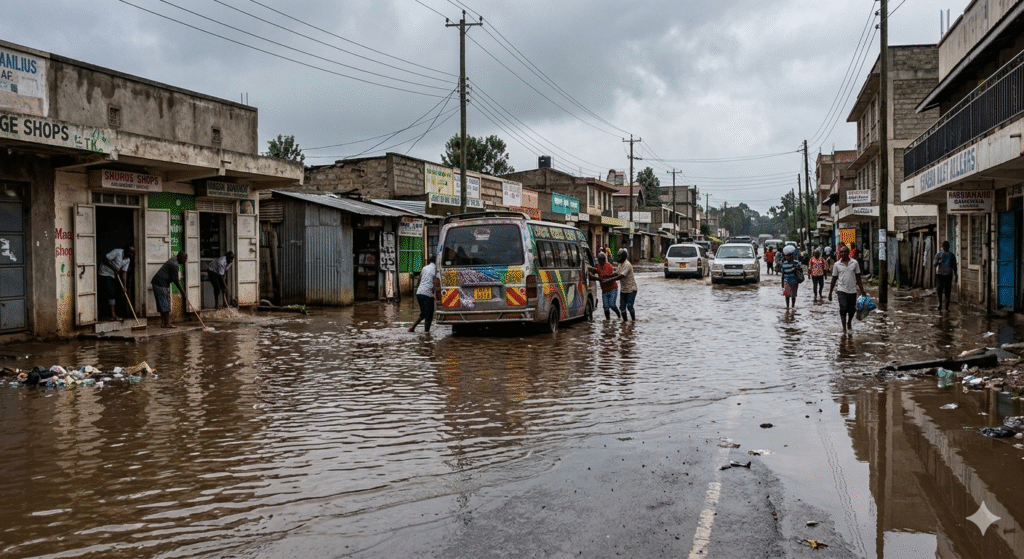
April 8, 2026 – For the past week, East Africa has been in the grip of nature’s fury. While the March-April-May (MAM) rainy season is an annual fixture, the intensity of the downpours since late March 2026 has overwhelmed rivers, burst drainage systems, and turned highways into death traps . From the crowded riverbanks of Kenya to the fragile plains of Somalia, the region is counting the dead, searching for the missing, and bracing for even more water.
Here is the situation across East Africa today.
Kenya: 110 Dead and Counting
Kenya remains the epicenter of the crisis. According to the Ministry of Interior, at least 110 people have died due to the ongoing floods, a figure that has continued to rise as search and rescue operations scramble to reach stranded communities .
The devastation is widespread, cutting across 30 of the country’s 47 counties . The capital, Nairobi, has recorded the highest number of fatalities with 37 deaths, followed closely by the Eastern region at 26, and the Rift Valley at 14 . Beyond the tragic loss of life, the humanitarian impact is staggering: over 34,765 people have been displaced and are now sheltering in temporary accommodation, while numerous roads and bridges have been rendered impassable, isolating rural communities .
Climatologists attribute this sudden surge to a “climate whiplash” effect. The combination of the Inter-Tropical Convergence Zone (ITCZ) sitting directly over the country, moisture-laden winds from the Congo Basin, and a warming Indian Ocean has supercharged the atmosphere . As the week draws to a close, the Kenya Meteorological Department has warned that the rain is not over. In their 5-day forecast covering April 17 to 21, they predict continued showers and thunderstorms across the Highlands, the Lake Victoria Basin, and even isolated heavy events in the usually arid Northeastern regions .
Somalia: 29 Dead and a Race Against Time
Somalia’s fragile infrastructure has once again proven no match for the elements. Flash flooding in the southwestern regions has claimed the lives of more than two dozen people, with official figures placing the death toll at 29, though authorities fear the numbers could rise as remote areas are assessed .
The scale of the displacement is immense. Over 300,000 people have been uprooted from their homes, and approximately 850,000 individuals have been affected by the raging waters . The most harrowing situation is unfolding in the town of Luuq, located on the road linking the Somali-Ethiopian border with Baidoa. A joint effort by aid agencies is currently “racing against time” to rescue roughly 2,400 people trapped by rising flood waters .
The humanitarian response is being crippled by the geography of the disaster. Roads have been cut, vehicles are stuck in mud, and inaccessible routes are delaying the delivery of life-saving aid . This comes as a particularly cruel blow to a nation still reeling from the region’s worst drought in four decades, highlighting the extreme volatility of the climate crisis.
Tanzania, Ethiopia, and South Sudan: Regional Overflow
The heavy rains have not respected borders. In Ethiopia, particularly in the Somali region bordering its troubled neighbor, reports indicate that over 12,000 people have been forced from their homes, with dozens of casualties .
Tanzania is also experiencing significant ground saturation, with experts warning of landslides and flash floods in vulnerable hilly areas . The ICPAC (IGAD Climate Prediction and Applications Centre) seasonal forecast for April to June 2026 confirms the trend, predicting “wetter than normal conditions” over most parts of the region, including Ethiopia, Kenya, Somalia, Uganda, and Tanzania .
Further north, the situation in South Sudan remains dire. The Sudd wetlands, one of the world’s largest floodplains, remain inundated, preventing displaced populations from returning home and complicating the logistics of humanitarian aid delivery .
Looking Ahead: A Soaked Forecast
As East Africa moves further into April, the scientific consensus is grim. The Global Weather Hazards Summary released on April 16 confirms that flooding persists in parts of Eastern Africa from ongoing heavy rains, while other parts of the continent face opposite extremes .
However, there is a slight shift on the horizon for some areas. While the Kenyan forecast predicts continued storms, meteorologists note a potential decrease in intensity towards the middle of next week in some highland areas, though cold nights with temperatures dropping below 7°C are expected . For the millions living in makeshift shelters or near riverbanks, the immediate concern remains the same: how much more water can the ground hold?
